Who Was Myron? Ancient Greek Sculptor and the Discobolus Statue
Myron was a famous Ancient Greek sculptor who was active during the Early Classical period of Greek art, roughly between 480 BC and 440 BC. He is believed to have been born in Eleutherai, a town on the border between Attica and Boeotia. His exact birth and death dates are unknown, but the dating of his works shows that he reached the peak of his career in the middle of the 5th century BC. Today he is best known for the Discobolus (Discus Thrower) statue, one of the most famous and most copied works in the history of Ancient Greek sculpture.
Myron Biography and Artistic Training
Most of what we know about the life of Myron comes not from his own time but from writers who lived centuries later. The Roman author Pliny the Elder names Myron as a student of Ageladas, a master sculptor from Argos. The travel writer Pausanias states that Myron was born in Eleutherai. Myron is thought to have had strong ties to Athens, since several works displayed on the Athenian Acropolis are linked to his name. At that time Athens had become the center of art and architecture under the leadership of Pericles, and Myron is considered one of the leading figures of that lively environment.
Myron Style and Artistic Approach
Myron is one of the key figures in the shift from the early Severe Style to the softer and more natural approach of the Classical period. What sets him apart from other artists is his skill in capturing the body in motion. In earlier periods statues were mostly upright and still. Myron instead showed his figures in the middle of an action, at a moment of tension. Rhythm, proportion and balance of the body play a central role in his work. Pliny the Elder writes that Myron was very successful at lifelike anatomy, but paid less attention to facial expression and hair details. This criticism also reveals the early period features of his art.
Materials and Techniques Used by Myron
Myron made his works mainly from bronze. Bronze allows thinner limbs and tense poses that hold the body in mid air, so it is ideal for figures in motion. In the ancient world, bronze statues were cast with the lost wax method. In this technique a wax model was prepared first, then covered with a mold, the wax was melted out and molten bronze was poured in its place. Most bronze works were melted down in later centuries and reused for weapons, coins and other objects. For this reason, none of the original works of Myron has survived to the present day.
Discobolus: The Most Famous Statue by Myron
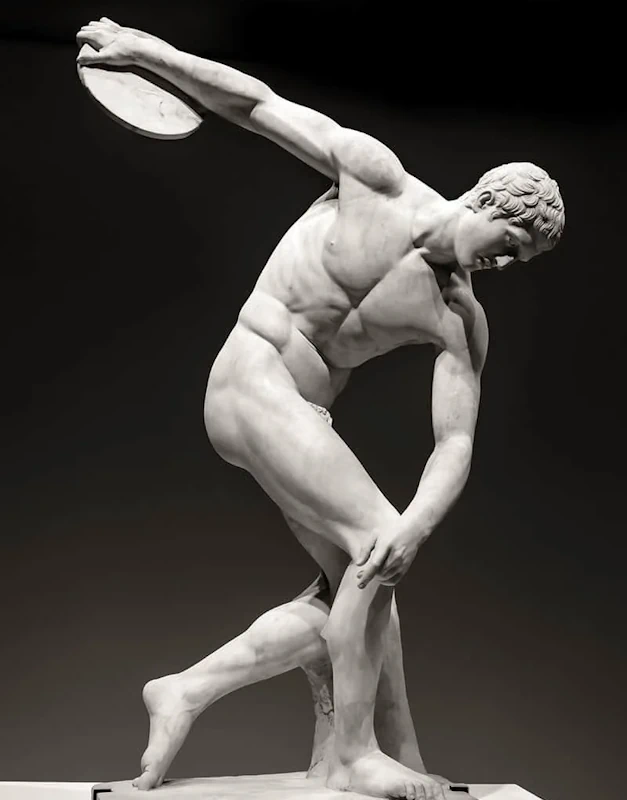
The Discobolus is a bronze statue thought to have been made between about 460 BC and 450 BC. The work shows an athlete twisting his body backward as he prepares to throw a discus. This sports statue captures the athlete in the short, tense moment just before the throw. One arm swings back while the other reaches toward the knee. The lines of the body are drawn tight like a bow. Although the pose is full of movement, the face is calm and balanced. This contrast gives the work its special strength.
The original Discobolus is lost. The form we know today is based on Roman marble copies made centuries later. The best known copies are the following:
Lancellotti Discobolus: Found near Rome in 1781, it is displayed in the National Roman Museum. This copy is considered one of the closest to the original pose.
Townley Discobolus: Found in 1791 near the Villa of Hadrian, it is kept in the British Museum in London. Because the position of its head differs from the other copies, researchers have studied it for a long time.
In later centuries the Discobolus became one of the symbols of the Olympic Games and sports culture. It has been used on posters, coins, stamps and many other works of art.
Athena and Marsyas Statue Group
Another important work by Myron is the Athena and Marsyas statue group. According to the myth, Athena threw away the aulos, a wind instrument she had been playing, because it distorted her face when she played. The satyr Marsyas found the instrument and tried to approach it, but the goddess drove him back. Myron showed both moments together: Marsyas surging forward with surprise and eagerness, and Athena stopping him. This work is an important example of the skill of the sculptor in capturing tension and movement between two figures. The group was displayed on the Acropolis in Athens and has survived through Roman period copies. The Athena copy is in the Liebieghaus Sculpture Museum in Frankfurt, while the Marsyas copy is in the Vatican Museums.
Other Famous Works by Myron
Ancient writers recorded many works by Myron. The most important ones are the following:
Heifer Statue: This very famous bronze cow statue was considered so lifelike that many poems were written about it. The Greek Anthology contains dozens of epigrams about this work.
Ladas Statue: This is the statue of Ladas, an athlete who won a running race at the Olympic Games. Sources describe the runner as breathless at the end of the race.
Samos Heraion Statues: This trio of Zeus, Athena and Herakles was displayed in the Temple of Hera on the island of Samos. It was later taken to the city of Rome by the Roman authorities.
Perseus and Erechtheus: Pausanias writes that he saw these works on the Athenian Acropolis.
It is also known that Myron created a dog statue and worked on many other subjects such as heroes and a boxer. This variety shows that the sculptor could portray gods, athletes and animals with the same realism.
What Ancient Writers Said About Myron
Myron was a highly respected artist in the ancient world. Writers such as Pliny the Elder, Pausanias, Lucian and Quintilian praised his works. The complex and difficult pose of the Discobolus in particular attracted the attention of Roman period writers and was cited as proof of the mastery of the sculptor. These writings are the most important sources that allow us to know the works of Myron today.
Myron Place in Art History and Legacy
Myron is one of the pioneers of Ancient Greek sculpture who brought movement and rhythm to the forefront. Great masters who came after him, such as Polykleitos and Phidias, opened new paths in body proportion and ideal beauty. The works of Myron are an important step in the shift from still figures to dynamic expression in sculpture. When interest in ancient statues grew during the Renaissance, the Discobolus was rediscovered and became a source of inspiration for artists and art teachers. Today it is still one of the most frequently mentioned ancient statues in world famous museums, textbooks and accounts of sports history.
Key Facts About Myron
Myron was an Ancient Greek sculptor of the 5th century BC with roots in Eleutherai. His most famous work is the Discobolus statue. His original bronze works have not survived, but his art is known through Roman period marble copies. The Athena and Marsyas group, the Heifer statue and the Ladas statue are also among his best known works. His skill in freezing motion makes him one of the most important names in the history of Ancient Greek art.
Date Added: