Polykleitos - Ancient Greek Sculptor
Polykleitos was one of the greatest ancient Greek sculptors, active during the 5th century BC. Born in Argos, he established one of the most respected workshops of his era and shaped the foundations of Western art through both his works and theoretical writings. Referenced by philosophers such as Plato and Aristotle, Polykleitos elevated sculpture far beyond a mere craft, transforming it into a mathematical discipline.
According to ancient sources, Polykleitos trained under the master Ageladas of Sicyon. Alongside Myron and Pheidias, who emerged from the same workshop, he is regarded as one of the three great masters of classical period sculpture. While Pheidias excelled in monumental divine statues and architectural ornamentation, Polykleitos carved his own distinctive path by perfecting the athletic human figure.
Who Is Polykleitos and What Is the Canon of Ideal Proportions?
What sets Polykleitos apart from his contemporaries is that he defined the ideal proportions of the human body through a mathematical system. He named the theoretical treatise in which he outlined this system the "Canon." Although the text itself has not survived, numerous ancient writers including Galen quoted from it extensively.
According to the Canon, beauty arises from the numerical ratio relationships between the parts of the body and the whole. The proportions between the finger, hand, forearm, arm, and torso must follow a precise arithmetic harmony. In the ancient world this idea was expressed through the concept of "symmetria," meaning a harmonious proportionality between parts. Its opposite is known as asymmetry.
Polykleitos did not stop at writing; he also created a statue to give his rules physical form. This sculpture, likewise called the "Canon," is the living bronze expression of his theory. It may well represent the first time in art history that a master united the roles of theorist and practitioner within a single work.
Doryphoros: The Spear Bearer
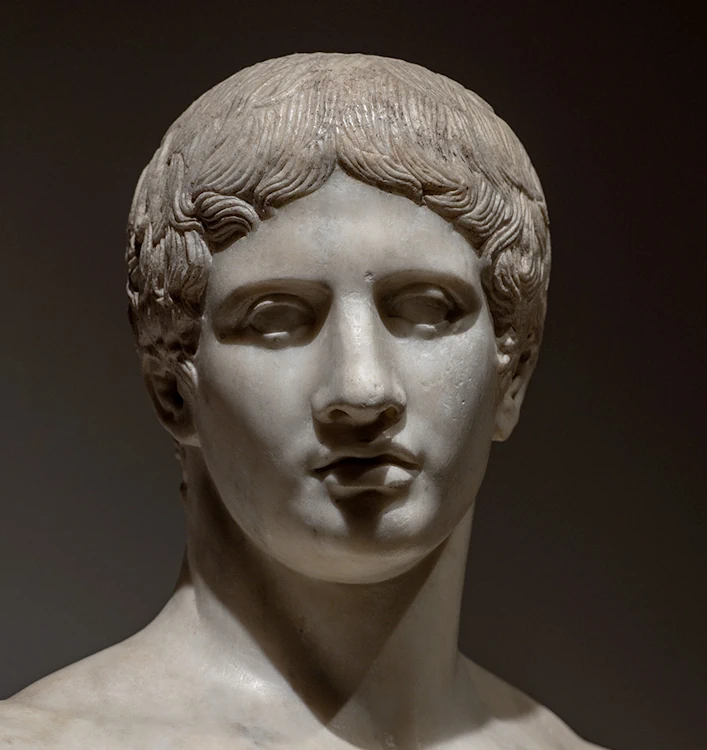
Polykleitos's most celebrated work, the Doryphoros (Spear Bearer), was produced around 450–440 BC. Although the original bronze has been lost, dozens of Roman-period marble copies have survived; the best-preserved is displayed at the National Archaeological Museum in Naples.
The sculpture depicts a young athlete carrying a spear over his shoulder. The figure is composed according to the contrapposto principle: the left leg bears the body's weight while the right leg is relaxed; correspondingly, the left shoulder is lower and the right shoulder higher. This cross-balanced arrangement gives the figure a sense of both stillness and latent movement. The contrast with the rigid, frontally posed Kouros statues of earlier periods is immediately striking.
Ancient sources emphasize that this statue embodies Polykleitos's Canon in three dimensions. The Doryphoros is not merely a sculpture; it functions as a walking, breathing manifesto.
Diadumenos: The Athlete Tying His Headband
Another major work by Polykleitos is the Diadumenos (Headband Tier), dated to approximately 420–410 BC. The statue depicts a young man who has won an athletic contest in the act of tying his victor's ribbon around his head. Compared to the Doryphoros, this figure displays softer contours, revealing the hand of a master at the height of his maturity.
The original was again cast in bronze and has come down to us through marble copies. One of the best-known copies is housed in the National Archaeological Museum in Athens, while another is held at the Metropolitan Museum of Art in New York. The Diadumenos demonstrates Polykleitos's capacity to portray the human body not as pure anatomy, but as a moment filled with triumph and dignity.
The Hera Statue and Religious Works
Polykleitos was not confined to athletic subjects. Ancient sources record that the artist created a colossal goddess statue for the Heraion of Argos. This chryselephantine work, crafted from gold and ivory, was considered one of the most significant religious monuments of its age. Travel writers such as Pausanias described it with great admiration, though the statue itself has not survived.
The existence of this work reveals that Polykleitos was interested not only in secular athletic imagery but also in divine representation. Just as Pheidias's Zeus at Olympia is regarded as a supreme religious masterpiece, Polykleitos's Hera held the same symbolic importance for Argos.
Influence and Legacy
The artistic legacy of Polykleitos shaped not only his own era but Western art across the centuries. Sculptors of the Hellenistic period and later the Roman world consistently referenced his principles of proportion and balance. Copies of his works adorned Roman villas, bathhouses, and public spaces.
When renewed interest in ancient Greek ideals swept through the Renaissance, Polykleitos returned to the center of artistic discourse. Leonardo da Vinci's studies of human proportion, Michelangelo's understanding of musculature and balance — in all of these, the traces of the Canon are clearly perceptible.
In the modern era, Polykleitos is celebrated above all as a pioneer of art theory. By committing his principles to writing, he transformed art into an intellectual pursuit that could be taught, debated, and refined.
Conclusion
In the mid-5th century BC, Polykleitos redefined Greek sculpture not merely as a craft but as a scientific and philosophical discipline. His masterworks such as the Doryphoros and the Diadumenos, combined with the mathematical Canon he developed to capture the perfection of the human body, constitute one of the most cohesive programs in the history of art. Although the originals have been lost over the centuries, through the ideas he left behind and the copies that preserve them, Polykleitos remains one of the firmest keystones in the bridge stretching from antiquity to the modern world.
Date Added: