Sword Statue Price and Sales
The sword sculpture is a unique art form that transforms one of history's most deep-rooted and powerful symbols into a three-dimensional masterpiece. For centuries, the sword has represented power, justice, courage, and honor, and it maintains this profound meaning in the art of sculpture. The sword sculptures produced in our studio reflect both the intricacies of traditional Turkish-Islamic art and a contemporary sculpture approach. Each hand-sculpted sword sculpture is the product of a long and meticulous production process, starting from raw materials.
History and Symbolic Meaning of the Sword Sculpture
The sword is one of the oldest and most meaningfully charged objects in human history. For thousands of years, it has served not only as a weapon of war but also as a symbol of power, authority, justice, and spiritual protection. From Ancient Egypt to Medieval Europe, and from the Ottoman Empire to Far Eastern civilizations, almost every culture has imbued the sword with deep meaning. This symbolic weight makes the sword an exceptionally powerful subject in sculptural art.
In Turkish and Islamic traditions, the sword carries a particularly sacred meaning. The Zulfiqar, the double-edged sword attributed to Imam Ali, is one of the most recognized symbols of the Islamic world and has been featured in art, architecture, and handicrafts for centuries. The Arabic calligraphy on the sword sculptures produced in our studio is a reflection of this deep-rooted tradition. This calligraphy, which adorns the body of the sword from end to end, adds both spiritual depth and aesthetic richness to the piece.
During the Ottoman period, the sword was a symbol not only of the warrior but also of the authority of the state and the Sultan. Sword-girding ceremonies were among the most important rituals of the Ottoman sultanate tradition. This historical and cultural context elevates the sword sculpture far beyond a mere decorative object, granting it a profound historical identity.
Design Features of Our Sculpture
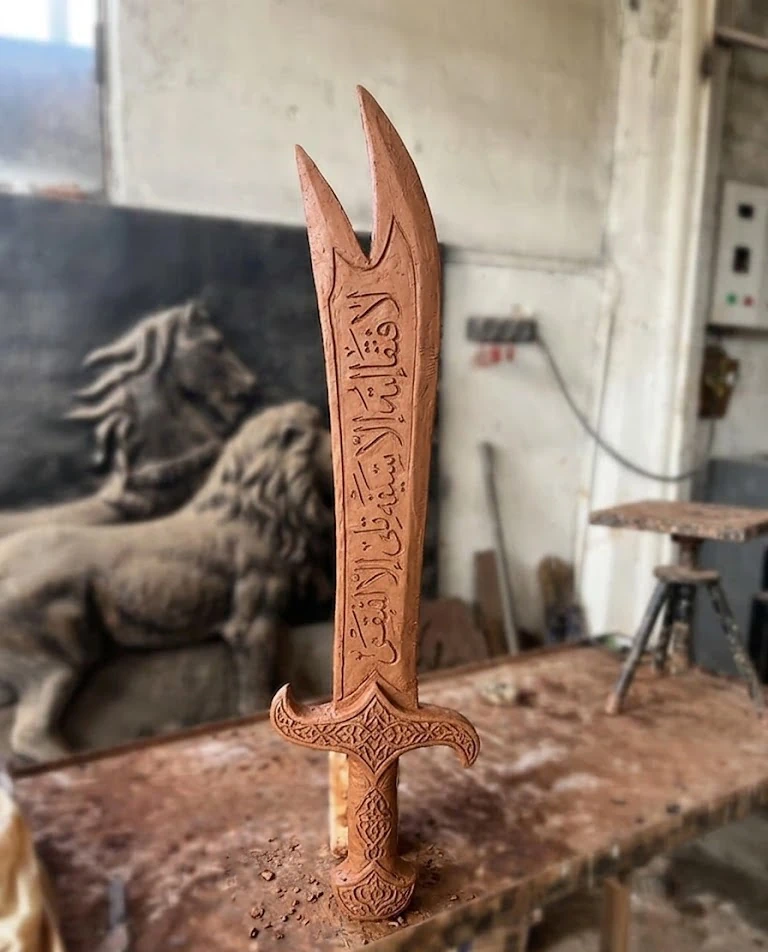
The sword sculpture shown in the photograph was captured during the production stage, where the detailed clay work has just been completed. Even in this raw state, the design clearly reveals how much care and thought has been invested. While the general form of the sword draws inspiration from traditional Islamic sword art, it has been reinterpreted with a unique design language.
The most striking feature of the sword is the splitting of its tip into two distinct points. This design directly references Zulfiqar, the legendary sword of Imam Ali. The Zulfiqar motif has been used in Islamic art for centuries and constitutes the strongest identity element of this sculpture. The twin-tipped form is not just an aesthetic choice; it is a carrier of a deep cultural and historical message.
The Arabic calligraphy covering the body of the sword is one of the most special elements of the work. Crafted with the intricacies of traditional calligraphy art, this script brings the surface of the sword to life. The harmonious integration of the calligraphy with the body of the sword reflects the meticulous care and artistic maturity shown during the design phase. The script, engraved on both sides of the blade, adds 360-degree aesthetic value to the piece.
The design of the hilt also warrants special attention. Inspired by traditional Ottoman and Islamic sword hilt forms, this section is adorned with complex geometric motifs and floral decorations. Every centimeter of the hilt requires separate craftsmanship and care. The guard (hilt) is designed as both a functional form and a decorative element.
Production Process: From Clay to the Final Masterpiece
As seen in the photo, the work is currently in the clay modeling stage. This stage is the most critical and creative part of sculpture production. Clay is the fundamental material shaped by the sculptor's hands, where every detail is meticulously processed. After the clay model is finished, the piece passes through several different stages to reach its final form.
Once the clay model is complete, the silicone mold making process is performed. During this process, the entire surface of the clay model is covered with high-quality silicone material to obtain a perfect mold. The greatest advantage of a silicone mold is its ability to flawlessly transfer every tiny detail, including the calligraphy and fine geometric motifs on the sword's surface. The quality of this stage directly determines the richness of detail in the final product.
Usage Areas of Sword Sculptures
Sword sculptures create a powerful visual impact in many different settings. In corporate environments—especially in the offices and entrance areas of security companies, defense industry organizations, and military institutions—the sword sculpture serves as a highly appropriate and effective decorative element. For any organization wishing to visually convey a message of strength and determination, a sword sculpture is a meaningful choice.
Sword sculptures also hold an important place in historical and cultural venues. Custom-designed sword sculptures can be commissioned for museums, cultural centers, historical buildings, and municipal offices. Particularly in spaces dedicated to Ottoman and Islamic history, a sword sculpture in the Zulfiqar form stands as a highly original and meaningful work of art.
There is also great interest in sword sculptures for private collections. For collectors interested in history—especially Ottoman and Islamic history—these sculptures are pieces that can become the most valuable parts of their collections. Each original work delivered with its certificate serves as an important document certifying the piece's authenticity and artistic value.
Custom sword sculpture orders are also accepted for religious sites and community centers (Cemevis). Considering the deep symbolic meaning of the Zulfiqar motif in Islamic faith, the sword sculptures produced for these spaces carry both aesthetic and spiritual value.
Size and Material Options
Sword sculptures can be ordered in various sizes and material options. Production is carried out across a wide range of sizes, starting from small tabletop decorations to medium-sized wall hangings and large-scale monumental versions for public spaces. In every size option, all details of the original clay model are preserved perfectly.
Among the material options, fiberglass is a prestigious and durable choice. The polyester resin option eliminates the weight and cost issues associated with materials like bronze or stone while offering similar aesthetic quality at a more accessible price point. Stainless steel is another option, though less frequently preferred, specifically for large-scale outdoor projects.
Custom Orders and Personalization
Personalization options for sword sculptures are quite extensive. The calligraphy on the sword can be changed or new inscriptions can be added according to the customer's preference. The general form, size, and proportions of the sword can also be customized based on the customer's space and vision. Corporate logos, special dates, or meaningful texts can be engraved onto the sword's surface. These personalization options elevate the sword sculpture far beyond a standard decorative object, turning it into a unique and meaningful work of art.
During the ordering process, we work in close communication and cooperation with our customers. We inform our customers at every step from the design phase to delivery, managing the production process transparently by sharing photos and videos at intermediate stages. We deliver to every province in Turkey and offer specialized packaging and shipping solutions for international orders.
Registration Date:

Rate:
5
4 Vote