Sculpture Education and Contemporary Sculpture Art
Sculpture has been one of the most powerful means of self-expression throughout human history. From the first drawings on cave walls to the monumental works of ancient civilizations, from the flawless forms of the Renaissance to the abstractions of modernism, sculpture has served as a mirror of society in every era. Today, contemporary sculpture asserts itself not only through aesthetic concerns but also through conceptual depth, diversity of materials, and social messages. This transformation has inevitably influenced sculpture education as well, giving rise to a new pedagogical understanding that blends traditional methods with modern approaches.
The Transformation of Sculpture Education: From Studio to Laboratory
Traditional sculpture education has generally focused on specific materials (clay, marble, bronze) and techniques (carving, modeling, casting) within a master-apprentice relationship. However, as contemporary art has pushed boundaries, sculpture studios have also transformed into laboratories. Students today not only learn classical forms but also gain the ability to use advanced technologies such as digital modeling and laser cutting. This requires aspiring sculptors to develop not only their manual skills but also their analytical thinking and problem-solving abilities.
Throughout the educational process, students are encouraged to discover their own artistic language and develop original forms of expression. This aims to give them not merely a craft, but an artistic vision. The studio environment offers, on one hand, a working space equipped with traditional tools (chisels, hammers, modeling pens) and, on the other, a venue furnished with modern equipment and open to experimental work. In this way, the sculptors of the future can both understand and interpret the heritage of the past while producing innovative works that will shape the art of tomorrow.
The Core Dynamics of Contemporary Sculpture
Contemporary sculpture is an artistic movement that began to take shape in the mid-20th century and continues to evolve to this day. One of its most distinctive features is freedom of material. Artists do not hesitate to use a wide variety of materials alongside traditional ones such as marble and bronze including plastic, glass, metal waste, light, sound, video, and even organic matter. This has become a tool for reinforcing the message carried by the work and forging a different kind of connection with the viewer.
Another important dynamic is conceptual depth. Contemporary sculptures frequently go beyond being merely visual objects, representing an idea, a social critique, or a philosophical inquiry. The thought behind the work is often more important than the work itself. This expects the viewer to participate actively in the process of making meaning from the work, rather than remaining a passive recipient.
The relationship with space is also an indispensable element of contemporary sculpture. Sculptures are no longer simply displayed on a pedestal; they interact with the space they inhabit and even become a part of it. Forms such as public art, installations, and land art foreground the dialogue that the work establishes with its surroundings. This reinforces the idea that art can exist not only in galleries but in every sphere of life.
The Master-Apprentice Relationship and Studio Environment: The Transfer of Knowledge
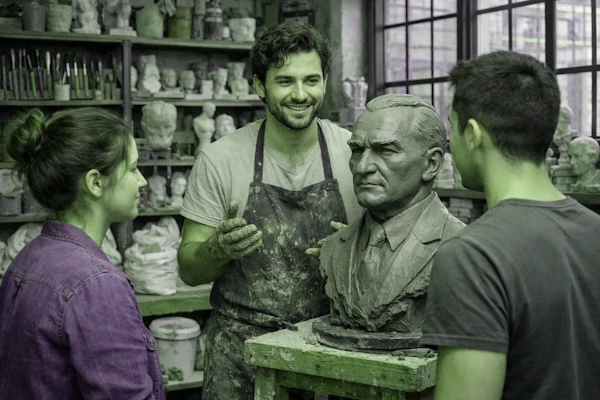
In sculpture education, the master-apprentice relationship still plays a fundamental role despite the adoption of contemporary approaches. As seen in our image, an experienced sculptor explaining the subtleties of a work to young students means not only the transfer of technical knowledge but also the transmission of artistic sensitivity and experience. The studio is a living learning environment where this knowledge is passed from generation to generation, and where practical experience is blended with theoretical knowledge.
The master does not only teach students how to shape clay or cast bronze; they also show them how to breathe life into a work, how to translate an idea into a three-dimensional form, and how to cope with the challenges encountered during the artistic process. Students, under the guidance of the master, discover their own abilities, experiment with different materials, and take important steps toward forming their own artistic identities. This interaction reveals that sculpture education is not merely a course but a way of life.
The Place of Symbolic Works in Education: The Example of the Ataturk Bust
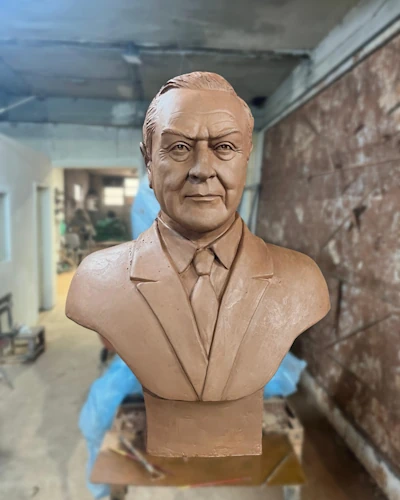
Working on symbolic and historical figures in sculpture education provides students with both technical skills and a cultural and historical context. The Ataturk bust that the young sculptor in our image is working on together with students is one of the finest examples of this. Creating the bust of a national leader like Ataturk requires not only capturing physical likeness but also reflecting the values, ideology, and spirit that figure represents.
Such work instills in students a sense of historical awareness and social responsibility while teaching them the subtleties of portrait sculpture. Creating an Ataturk bust through a contemporary interpretation offers the opportunity to combine traditional forms with modern aesthetics. In this process, students both develop their modeling techniques and learn how to express a leader's character and legacy through an artistic language. This contributes to their development not merely as sculptors but as artists of intellectual depth.
Diversity of Materials and Techniques: Pushing the Boundaries
Contemporary sculpture education frees students from being confined to a single material or technique. In addition to traditional materials such as clay, wood, and stone, various techniques are taught — including metalworking, glass shaping, resin casting, and even the recycling of waste materials into artistic objects. This diversity allows students to unleash their creativity and choose the material and technique most suited to the idea they wish to express.
The integration of digital technologies is also an important part of this diversity. Computer-aided design (CAD) programs, 3D scanners, and 3D printers offer sculptors the ability to create forms and details that were previously unimaginable. Rather than replacing traditional craftsmanship, these tools assume a complementary and expansive role. In this way, students remain connected to the roots of traditional art while harnessing the innovative possibilities offered by technology to build the art of the future.
The Sculptors of the Future and the Role of Art in Society
Today's sculpture education aims to raise the sculptors of the future not merely as individuals who produce works, but as individuals who are sensitive to social issues, capable of critical thinking, and able to contribute to the world through their art. Contemporary sculptors engage in dialogue with society by exhibiting their works in public spaces, galleries, or digital platforms. Through their art, they can draw attention to environmental issues, social injustice, or the search for cultural identity.
Sculpture has the power to create an intellectual and emotional impact on the viewer beyond offering a visual feast. For this reason, sculpture education must provide students not only with technical knowledge but also with a strong artistic vision and ethical responsibility. The sculptors of the future will draw inspiration from the great masters of the past while adding value to the art world and to society with original and compelling works that reflect the spirit of their own era. As Heykel.org, we support students studying in sculpture departments within certain boundaries.
Date Added: | Last Updated: