Praxiteles: Ancient Greek Sculptor, Life and Famous Works
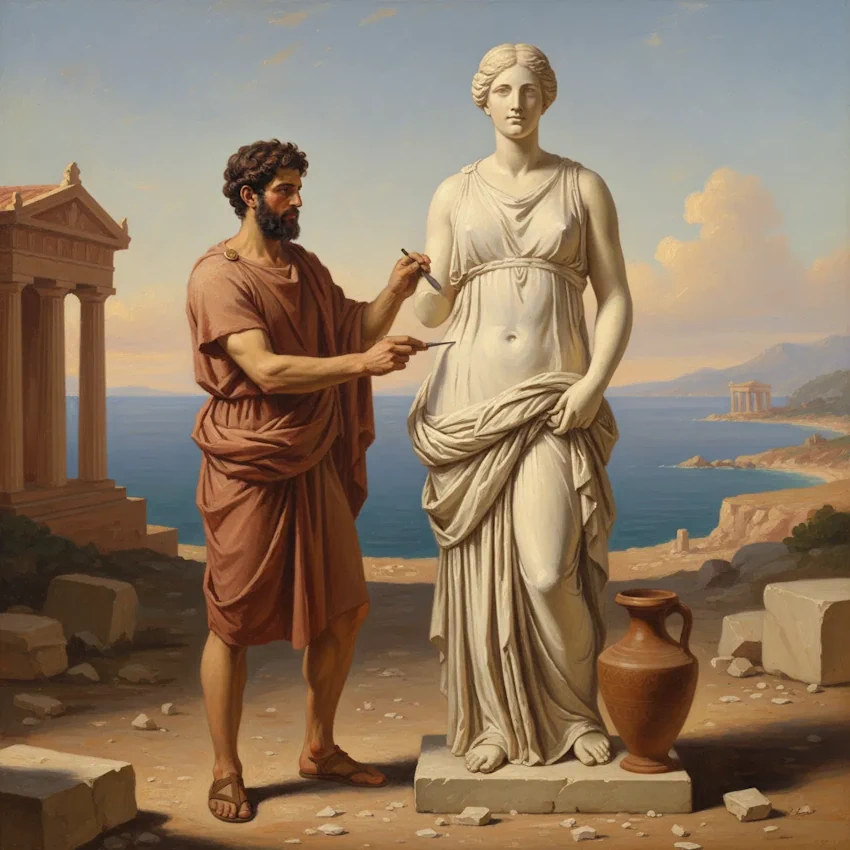
Praxiteles was an ancient Greek sculptor who lived in Athens in the 4th century BC. He is believed to have worked between about 375 and 335 BC and is one of the greatest masters of the Late Classical period. His father, Kephisodotos, was also a sculptor. Praxiteles became famous for portraying gods in a soft, graceful, and human way instead of as showy heroes. He is remembered as the first great artist to portray the nude female body on a monumental scale.
Life and Historical Background of Praxiteles
Information about the life of Praxiteles is limited. Most of it relies on ancient sources such as the Roman writer Pliny the Elder and the traveler Pausanias. In his time, Athens was trying to recover after the Peloponnesian Wars. The dignified and majestic style represented by Phidias was giving way to a more personal, emotional, and graceful expression. Praxiteles is the most important representative of this change. Thanks to his skill in marble carving, he could make hard stone look like living skin.
Aphrodite of Knidos: The First Monumental Nude Female Statue
The most famous work of Praxiteles is the Aphrodite of Knidos. The statue was made around 350 BC. Aphrodite is shown preparing for a bath, having left her robe on a vase, while trying to cover her body with one hand in a modest gesture. It is known as the first example in Greek art of a fully nude goddess made on a monumental scale. The statue caused a great sensation at the time. According to ancient sources, people from all over the world came to the city of Knidos just to see this statue.
Ancient City of Knidos and Its Connection to Turkey
The ancient city of Knidos, from which the Aphrodite of Knidos takes its name, is located today at the tip of the Datca Peninsula in Mugla, Turkey. The statue was displayed in a round temple in the city. This building, designed so the statue could be seen from every angle, also strengthened the relationship between the work and its viewer. Today, the ancient city of Knidos is an important archaeological site that attracts many visitors. The original statue has not survived. It was most likely taken to Istanbul and destroyed in a fire there. The known appearance of the work is based on Roman copies. The Colonna Venus in the Vatican is one of the best known of these copies.
Other Famous Works of Praxiteles
There are other important works known under the name of Praxiteles. Hermes Carrying the Infant Dionysus is displayed in the Archaeological Museum of Olympia. Experts still debate whether this statue was truly made by Praxiteles. Apollo Sauroktonos, the Resting Satyr, and the Eros of Thespiae are also among his best known works. In most of these works, young, slender, and thoughtful bodies stand out. Many of the originals have been lost. For this reason, the art of Praxiteles is known largely through Roman copies and the accounts of ancient writers.
Praxiteles Style: Soft Lines and the S-Curve
The most distinctive feature of the style of Praxiteles is that he places the weight of the figure on one leg and slightly bends the torso. This pose gives the body a graceful S-curve. In art history, this pose is also known as the Praxitelean curve, named after him. The faces have a calm, dreamy, and slightly smiling expression. The marble surfaces are carefully polished to give the feeling of soft skin. Gods stopped being distant and majestic beings and became figures with human feelings. This approach directly influenced Hellenistic sculpture.
Differences Between Phidias and Praxiteles
The two masters are often compared. Phidias lived in the 5th century BC and made gods majestic, dignified, and monumental in scale. Praxiteles worked in the 4th century BC and portrayed gods in a more human, emotional, and graceful way. The best known material of Phidias is ivory and gold plating. Praxiteles stands out especially for his marble sculpture work. While Phidias turned to religious and state projects, Praxiteles reflects a search for individual beauty. This difference clearly shows the shift of Greek art from the Classical period to the Late Classical period.
The Legend of Phryne and the Inspiration of Praxiteles
Ancient sources say that Praxiteles was inspired by a famous woman named Phryne. She is said to have been the model for the Aphrodite of Knidos. This story may be true, or it may be a legend added later. What is certain is that this account played a big role in the fame of the statue. It is also said that Phryne gave another Aphrodite statue by Praxiteles as a gift to the city of Thespiae. Such stories add color to the life of the artist but should be treated carefully from a historical point of view.
The Legacy of Praxiteles
The art of Praxiteles was greatly admired throughout antiquity. His works were copied extensively in the Roman period, which is how they have survived to the present day. Renaissance artists also took his graceful understanding of the body as an example while drawing inspiration from ancient sculpture. The way the nude female body is treated in art largely began with the Aphrodite of Knidos. Today, Praxiteles is regarded as one of the most influential sculptors of ancient Greek art.
Date Added: