Phidias: Ancient Greek Sculptor, Life and Famous Works
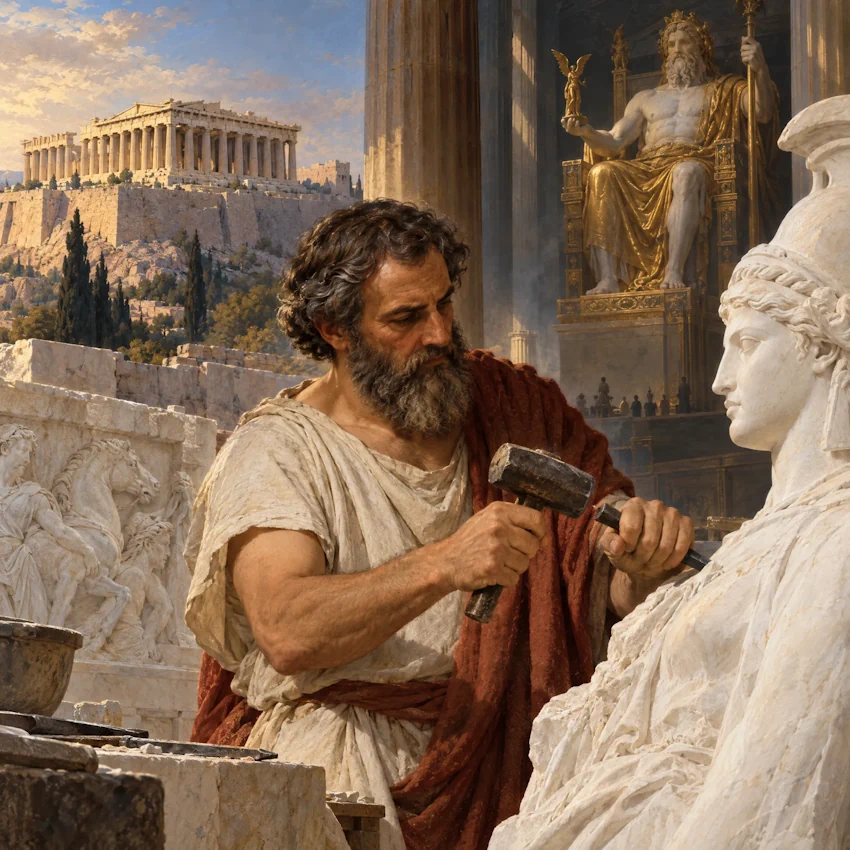
Phidias (Pheidias) was an ancient Greek sculptor, born around 480 BC in Athens and believed to have died around 430 BC. He is regarded as one of the greatest masters of the Classical period, and his name is closely linked with the golden age of Athens. Thanks to his close relationship with the statesman Pericles, he played a leading role in the city's greatest art projects. Most of his works are lost today, but his art is still well known through the accounts of ancient writers and Roman copies.
Life and Artistic Development of Phidias
Little is known for certain about the early years of Phidias. According to ancient sources, he trained as an artist in Athens and learned bronze casting and marble carving in his early works. While the city was being rebuilt after the Persian wars that destroyed Athens, Phidias took part in this great renewal as a young artist. His skill was noticed quickly, and he became one of the most important sculptors commissioned by the state.
Phidias and the Parthenon Sculptures
The name of Phidias is best known for the Parthenon on the Acropolis of Athens. The temple was built between 447 and 432 BC. Its architects were Iktinos and Kallikrates, while Phidias was the artist in charge of the entire sculptural program of the building. The Parthenon sculptures include the pediment figures, the metopes, and the Panathenaic frieze that wraps around the temple. It cannot be said that Phidias carved every piece himself. He managed a large workshop, set the design, and supervised the work. For this reason, the balanced, harmonious, and idealized beauty of the sculptures carries the mark of his style.
The Statue of Athena Parthenos
The most important work Phidias made for the Parthenon is the statue of Athena Parthenos, which stood inside the temple. This giant statue, about twelve meters tall, was dedicated in 438 BC. It was built on a wooden frame and covered with ivory and gold plates, a technique known by its Greek name, chryselephantine. The goddess held the goddess of victory, Nike, in her hand, and battle scenes were carved on her shield. The original statue has not survived. Roman copies such as the small Varvakeion Athena in the National Archaeological Museum of Athens give us an idea of how the magnificent work looked.
The Statue of Zeus at Olympia and the Seven Wonders of the Ancient World
Another great achievement of Phidias was the statue of Zeus he made for the Temple of Zeus at Olympia. The work was completed around 435 BC and was counted among the Seven Wonders of the Ancient World. The god sat on a throne and was covered with ivory and gold. In one hand he held Nike, the goddess of victory, and in the other a scepter decorated with precious metals. The statue was more than twelve meters tall. Excavations at Olympia uncovered the remains of the workshop of Phidias, including a cup with the master's name written on it. In later centuries the statue of Zeus was moved to Istanbul and most likely destroyed in a fire in the 5th century AD.
Other Important Works of Phidias
Phidias is not known only for his giant statues of gods. The bronze statue of Athena Promachos on the Acropolis of Athens was a huge warrior goddess figure that sailors could see from far away. Athena Lemnia is another bronze work, made for the Athenian settlers on the island of Lemnos. Statues of Amazons and various figures of gods are also attributed to him. Ancient writers say that Phidias captured a superhuman dignity and calm in his depictions of gods. This approach deeply influenced the visual language of Greek religion.
Phidias Style: High Classical Greek Sculpture
The art of Phidias is one of the purest examples of High Classical sculpture. His figures stand out with a calm posture, ideal proportions, and a noble expression. The folds of the clothing are carved to reveal the movement of the body. Emotions are not exaggerated, and divine peace comes first. This approach moves away from the rigidity of the earlier Severe Style and interprets the human body with natural beauty. Important sculptors such as Alkamenes and Agorakritos were among his students, so his style was passed on to later generations.
The Death of Phidias and the Controversy Around It
The last period of the life of Phidias is rather controversial. According to ancient sources, the enemies of Pericles accused Phidias of stealing gold given for the statue of Athena. Another claim is that he broke religious rules by carving portraits of himself and Pericles on the shield of Athena. Some sources write that Phidias died in prison in Athens. Others say he fled to Elis and completed the statue of Zeus there. It is not certain which version is true. Still, these stories show that the artist was right in the middle of the political struggles of his time.
The Parthenon Marbles and the Legacy of Phidias
Most of the sculptures removed from the Parthenon are displayed today in the British Museum in London. These pieces were taken from Athens by Lord Elgin at the beginning of the 19th century. Greece has demanded the return of these works for many years, and the issue is still a current cultural debate. The legacy of Phidias is not limited to these pieces. From the Renaissance to the present day, many artists have drawn inspiration from his balanced and idealized sense of beauty. Today, Phidias is regarded as one of the most important symbols of classical sculpture in Western art.
Date Added: