Nefertiti Bust
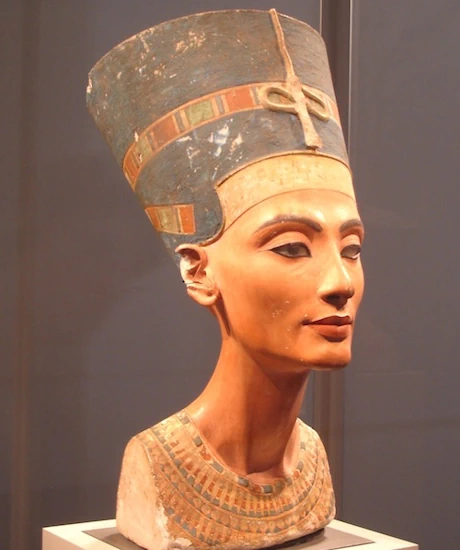
The Nefertiti Bust is one of the most recognized and intriguing works of ancient Egyptian art. Depicting Queen Nefertiti, wife of Pharaoh Akhenaten, this piece is a painted portrait bust made of limestone coated with stucco. Now on display at the Neues Museum in Berlin, the bust continues to draw attention for both its artistic refinement and the historical story behind it.
How Was the Nefertiti Bust Discovered?
The bust was uncovered on December 6, 1912, by a German excavation team led by archaeologist Ludwig Borchardt at the site of Tell el-Amarna in Middle Egypt. During the excavation, the team found the workshop believed to have belonged to the royal sculptor Thutmose, and the bust was discovered inside this workshop. Upon seeing the piece, Borchardt wrote in his diary that the work was too impressive to describe in words. Following the excavation, under the partage agreement of the time, the piece was taken to Germany and first shown to the public in 1923.
Who Was Queen Nefertiti?
Nefertiti was the great royal wife of Pharaoh Akhenaten (Amenhotep IV) of Egypt's 18th Dynasty, and she lived in the 14th century BC. While she is known to have played an important role as his wife during Akhenaten's religious reforms, written sources about her life remain quite limited. As a result, many aspects of the queen's personality and life are still debated among scholars. Even so, thanks to this bust, her face has become one of the most recognized images of an Egyptian woman in history.
Materials and Craftsmanship Behind the Bust
The Nefertiti Bust was shaped using a limestone core covered with a thin layer of stucco. The fine details of the facial features were carved into the limestone core, after which stucco was applied over the surface to create a smooth finish. In the final stage, the piece was painted in vivid colors using the pigments characteristic of the period. The bust stands at roughly 48 centimeters tall and weighs approximately 20 kilograms. The blue crown on her head, the colored band around it, and the wide collar decoration at the neck are among the most striking details of the piece.
The Mystery of the Missing Left Eye
One of the most intriguing features of the bust is the missing inlay in the left eye. When the piece was found, Borchardt had the surrounding soil carefully searched, but the missing eye piece was never located. Over time, it came to be believed that this was not a case of loss, but rather that the piece was left unfinished from the start. According to this theory, the bust may have been created in the Thutmose workshop as a model or study piece for other sculptors to reference. This theory also helps explain why the piece was found inside a workshop rather than in a tomb or temple.
Its Place and Display at the Neues Museum
The Nefertiti Bust is now displayed in a special glass case in the North Dome Room of the Neues Museum on Berlin's Museum Island. Since the museum reopened in 2009, the bust has welcomed hundreds of thousands of visitors every year. Along with the Pergamon Altar and the Ishtar Gate, it is considered one of the three most visited works on Museum Island. For security reasons, photographing the bust is generally not allowed, and the piece is preserved in an environment where light and humidity conditions are carefully monitored.
Repatriation Disputes
Following the bust's first public display in 1923, the Egyptian government requested that the piece be returned to Egypt. Germany, for its part, maintains that the piece was brought to the country in accordance with the excavation and partage rules of the time. This debate continues today, with many Egyptian archaeologists and officials calling for the bust to be sent back to Egypt. This has made the Nefertiti Bust not only an artistic icon, but also an important symbol in international debates over cultural heritage.
Significance of the Nefertiti Bust in Art History
The Nefertiti Bust stands out for its far more natural and fluid style compared to earlier periods of ancient Egyptian art. During what is known as the Amarna period, artists moved away from traditional rigid and formal figures toward more realistic and elegant forms. The bust's symmetrical facial features, slender neck, and flowing lines have made it regarded as one of the finest examples of this period. Today, having become a global symbol of beauty and ancient Egyptian civilization, this piece remains a unique point of interest for both art historians and visitors alike.
Date Added: