William Tecumseh Sherman Monument - New York, USA
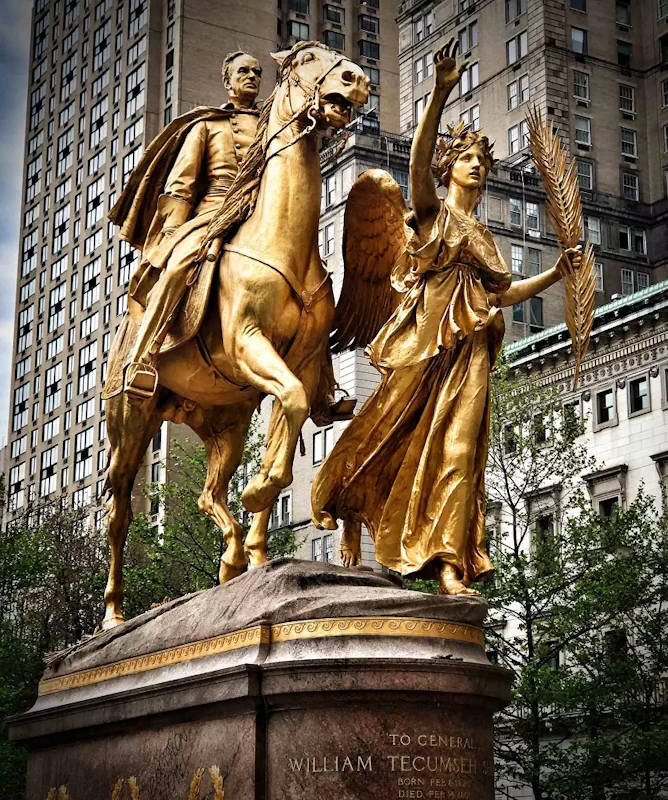
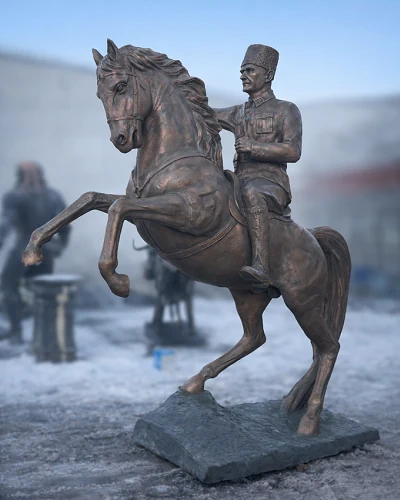
Grand Army Plaza, one of New York's most prestigious public spaces, is located at the southeast corner of Central Park and forms an important part of the city's historical memory. The William Tecumseh Sherman statue rising in this area is considered one of the most successful examples of American sculpture art. Created by Augustus Saint-Gaudens and unveiled in 1903, this gilded equestrian statue depicts Sherman with the air of a victorious commander. This composition, with the goddess of victory Nike walking before him, grants the monument not only a military but also a mythological dimension. Rising right next to Fifth Avenue within New York's busy and cosmopolitan fabric, this statue continues to draw attention with its artistic excellence and historical weight.
Who is William Tecumseh Sherman?
William Tecumseh Sherman was born on February 8, 1820, in the town of Lancaster, Ohio. A graduate of West Point, Sherman served in the Mexican-American War; however, in later years, he engaged in unsuccessful ventures in banking and law. With the outbreak of the American Civil War, he returned to the army and became one of Ulysses Grant's most trusted commanders. The collaboration between the two gave birth to one of the Union forces' most effective military coordinations.
Sherman's name is most often associated in history with the "March to the Sea" operation he carried out in 1864. This operation, extending to Savannah after the capture of Atlanta, is considered one of the earliest examples of the modern concept of total war. Sherman targeted not only the enemy's army but also its economy, infrastructure, and will to fight. This strategy was controversial and continues to be debated. While Sherman is still regarded as a controversial figure in the Southern states today, he is remembered with respect in the North as the commander who effectively ended the war. This deep contradiction forms the most interesting dimension of his historical personality.
The New York Statue and Its Artistic Value
The Sherman statue, coming from the hands of Augustus Saint-Gaudens, is evaluated as one of the zeniths of American monumental sculpture from both a technical and aesthetic perspective. Saint-Gaudens worked on this piece for fourteen years; during this time, he repeatedly revised the proportions of the figures, their facial expressions, and the dynamics of movement. The result is a perfect expression of the delicate balance established between almost photographic realism and mythological sublimity. The gilded surface offers the statue a play of light that changes at different times of the day; this gilding, shining in the morning sun, gains a completely different depth in the evening light.
Its location at Grand Army Plaza further strengthens the impact of the statue. Located at the entrance point to Central Park, at the intersection of Fifth Avenue and 59th Street, this area witnesses the continuous flow of tourists, New Yorkers, and art enthusiasts. The Sherman statue maintains its own space and weight even within this crowd. This monument, which holds an important place in New York City's sculpture heritage, offers visitors of every period a visual window opening onto the most turbulent era of American history.
Sherman's Legacy Today
William Tecumseh Sherman passed away in New York in 1891. Tens of thousands of people attended his funeral; among them was the former Confederate Army Commander Joseph Johnston, who refused to wear his hat despite the cold weather. Sherman's legacy continues to be debated today in terms of both military strategy and war ethics. He is studied in modern military academies as the pioneer of the total war doctrine; he is also criticized in terms of civilian casualties and damage to property.
The Sherman statue in New York embodies all dimensions of this complex legacy. Every visitor who observes it looks not only at a figure made of bronze and gold gilding but at one of the deepest contradictions of American history. What is the price of winning a war? When does victory become tragic? These questions are asked anew every day at Grand Army Plaza, and Sherman's statue continues to be the silent but powerful addressee of these questions.
Date Added: