Who Was Lysippos? Ancient Greek Sculptor and Alexander the Great Statues
Lysippos was one of the most important Ancient Greek sculptors of the Late Classical period, active in the 4th century BC. He was born in the city of Sikyon on the Peloponnese peninsula. He worked roughly between 370 BC and 300 BC and had a long and productive artistic career. He is best known as the court sculptor of Alexander the Great. He portrayed gods, athletes and rulers with a realistic approach and introduced a new system of body proportions. His most famous works include the Apoxyomenos, portraits of Alexander the Great and statues of Herakles.
Lysippos Biography and Artistic Training
Most of what we know about Lysippos comes from later writers such as the Roman author Pliny the Elder and Plutarch. Pliny states that Lysippos began his career as a bronze worker. According to tradition, he was not the student of any particular master and was largely self taught. One day the painter Eupompos was asked which artist he followed, and he pointed to the crowd and said that nature itself was the true model. Lysippos took this idea as a lifelong principle and valued careful observation of the human body. Since his career coincided with the rise of Alexander the Great, he had the chance to work in the circle of the king.
Lysippos and Alexander the Great
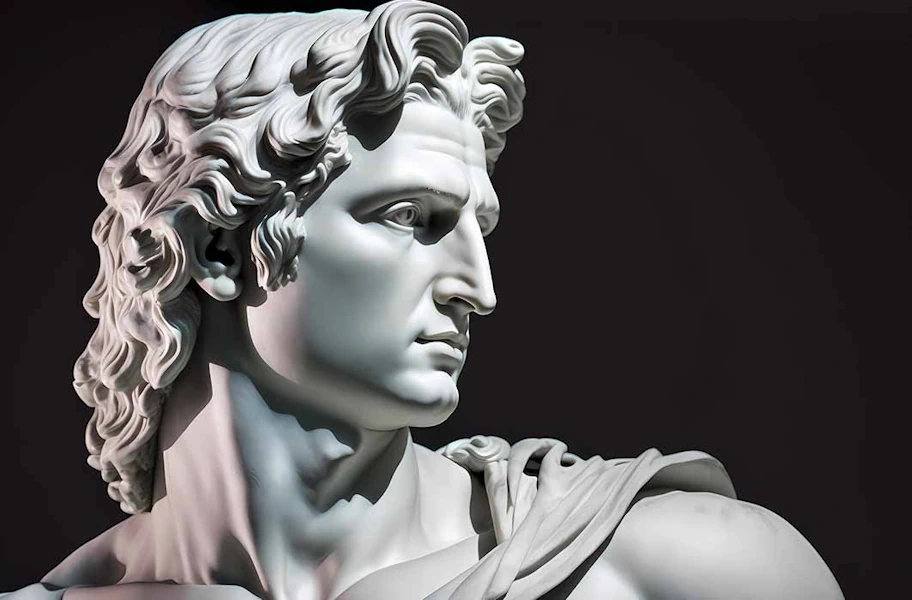
According to ancient sources, Alexander the Great allowed only Lysippos to make his statue. In the same way, only the painter Apelles could paint his portrait and only Pyrgoteles could carve his seal. This shows how strong the position of Lysippos was at the royal court. Plutarch writes that the neck of Alexander tilted slightly to the left and that his gaze was soft. According to him, Lysippos was the artist who captured this feature best. Lysippos portrayed Alexander at different ages and in different poses, from childhood to maturity. The slightly raised head, the lion like mane of hair and the bright gaze are the distinctive features of his Alexander portraits.
Lysippos Style and Artistic Approach
Lysippos is the sculptor who changed body proportions in Ancient Greek sculpture. Before him, Polykleitos had used a proportion of seven head lengths. Lysippos made the head smaller and the body slimmer and longer, developing a proportion of about eight head lengths. This gave the figures a more graceful and natural look. Pliny says that Lysippos made people not as they were, but as they appeared to the eye. This sentence explains the importance he gave to appearance and the point of view of the viewer. Lysippos also designed his statues to be seen from every side, not only from the front. The arms and legs of the figures reach forward, so the statue is thought of together with the space around it.
Materials and Techniques Used by Lysippos
Lysippos made his works mainly from bronze. Bronze allows thin limbs and tense poses, so it suits his dynamic and long proportioned figures very well. The lost wax method was used to cast his works. Pliny writes that Lysippos produced a very large number of works, even reaching 1500. The figure is not certain, but it shows that the sculptor was extremely productive. Most bronze statues were melted down in later centuries and turned into other objects. For this reason, none of the original works of Lysippos has survived to the present day. We know his art today thanks to Roman period marble and bronze copies.
Apoxyomenos: The Most Famous Statue by Lysippos
The Apoxyomenos is a statue of an athlete scraping oil and dust from his body with a tool called a strigil. The work is believed to have been made around 330 BC. The athlete stretches both arms forward, and his gaze turns to the side in a tired and thoughtful way. The forward reach of the arms shows a new sense of space that draws the viewer into the statue. This feature separates it from the flat and still figures of the earlier period.
The original bronze is lost. The best known copy is the marble example found in 1849 in the Trastevere district of Rome, and it is displayed in the Vatican Museums. Pliny tells that the statue stood in front of the baths of Agrippa in Rome, and that Emperor Tiberius liked it so much that he had it moved to his own room, but he had to put it back after the public reacted. There is also a bronze Apoxyomenos found on the sea floor off the coast of Croatia. This work is displayed in the Apoxyomenos Museum in Mali Losinj and allows us to see the craft of ancient bronze statue making directly.
Lysippos Statues of Alexander the Great
One of the best known subjects of Lysippos is the portraits of Alexander the Great. One of them is the statue known as Alexander with the Spear. One of the recognized copies of this lost original is the Azara Herm in the Louvre Museum. This portrait shows the lively and determined expression of Alexander, his raised head and his wavy hair. Another important work is the Granikos Monument. Lysippos made 25 bronze statues in memory of the cavalrymen of Alexander who died in the Battle of the Granicus in 334 BC. The statues were set up in the city of Dion in Macedonia and were later taken to Rome by the Roman commander Metellus. Alexander himself is included in this monument, and the work shows the success of Lysippos in portrait art.
Other Famous Works by Lysippos
Many works are attributed to Lysippos. The most important ones are the following:
Weary Herakles: Lysippos created a type of Herakles who is tired and has lost his strength. The hero leans on his club with his head bowed. The Farnese Herakles in the National Archaeological Museum of Naples, made by Glykon, is the best known copy of this type.
Zeus of Tarentum: This giant bronze statue of Zeus, set up in the city of Tarentum in southern Italy, was about 18 meters high according to ancient sources. This size shows the skill of Lysippos in large scale bronze casting.
Kairos: This is a young figure that represents the concept of opportunity. He has a long lock of hair on his forehead, wings on his feet and balances on the edge of a sharp blade. The statue has not survived, but it is known from reliefs and descriptions in ancient poems.
Eros Stringing His Bow: This statue shows the god Eros at the moment of stringing his bow and reflects the way Lysippos expressed youth and grace.
Delphi Hunting Scene: The monument made in Delphi for Krateros showed Alexander being helped during a lion hunt. The work was prepared together by Lysippos and Leochares.
Chariot of Helios: This work, known to have stood on the island of Rhodes, depicts the four horse chariot of the sun god Helios.
Sources also mention that Lysippos made portraits of Socrates and several athletes.
Students and School of Lysippos
Both the sons and the students of Lysippos were important artists. His brother Lysistratos is remembered as the first artist to use a plaster mold taken from a living face for portraits. His sons Daippos, Boedas and Euthykrates were also sculptors. Chares of Lindos is known as a student of Lysippos and made the Colossus of Rhodes, one of the Seven Wonders of the Ancient World. Thanks to these students, the style of Lysippos lived on for a long time and formed the basis of Hellenistic sculpture.
What Ancient Writers Said About Lysippos
Lysippos was a highly respected artist in the ancient world. Writers such as Pliny the Elder, Plutarch, Cicero and Quintilian praised his works. Pliny notes that he especially valued the detail of hair, the slenderness of the limbs and the harmony of proportions. These writings are the most important sources for knowing an artist whose original works have been lost.
Lysippos Place in Art History and Legacy
Lysippos is one of the most important sculptors who made the transition from the Classical period to the Hellenistic period. His new body proportion, his approach to statues that can be viewed from every side and his individual portrait style were widely followed in later centuries. Roman period artists copied and spread his statues many times. When interest in ancient statues grew during the Renaissance, the works of Lysippos gained importance again, and today he remains one of the most frequently mentioned Ancient Greek sculptors in museums, textbooks and accounts of art history.
Key Facts About Lysippos
Lysippos was an Ancient Greek sculptor of the 4th century BC from Sikyon. He is known as the court sculptor of Alexander the Great. His most famous work is the Apoxyomenos statue. His original bronze works have not survived, but his art is known through Roman period copies. Weary Herakles, Kairos, the Zeus of Tarentum and the Granikos Monument are also among his best known works. His slimmer and longer body proportions make him one of the most important names in the history of Ancient Greek art.
Date Added: