What is a Pointing Machine?
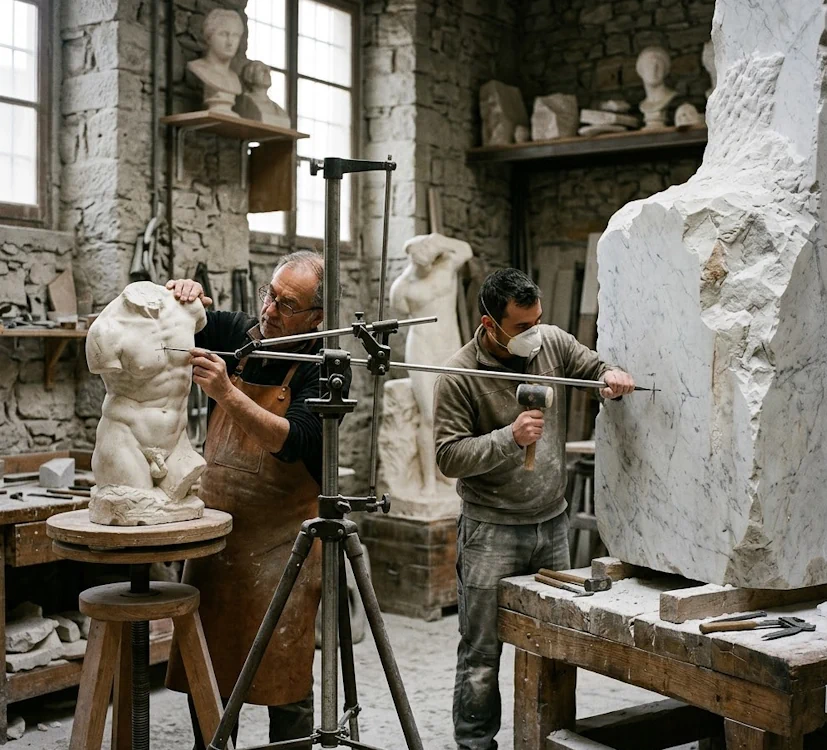
The pointing machine is a mechanical measuring and transfer tool that enables point transfer from a small-scale model to a large-scale stone or marble block. Derived from the Latin word "punctum," meaning point, the pointing machine is considered the most precise and reliable aid in the enlargement process in stone carving. Without this tool, producing large-scale sculptures by carving stone becomes an extremely difficult process that greatly increases the risk of error.
Working Principle of the Pointing Machine
The pointing machine is a mechanical tool built on a skeletal framework that can be fixed to both the small model and the large stone block. Through arms that can move along three spatial axes, any point on the model can be determined with its three-dimensional coordinates. These coordinates are converted from model scale to large scale and transferred to the stone block, establishing the depth to which it must be carved. Use of the pointing machine ensures proportional accuracy especially in complex figurative sculptures and portrait work.
Historical Development of the Pointing Machine
The earliest examples of the pointing machine were developed in Italy in the 18th century. To meet the growing demand for marble sculpture during the Neoclassical period, workshops needed to work more quickly and efficiently with large stone blocks. The pointing machine emerged as a practical solution born of this necessity. In the 19th century, the tool was further developed and became standard equipment in Europe's major sculpture workshops. The master craftsmen in Antonio Canova's workshop made extensive use of the pointing machine, producing extraordinary works in marble as a result.
The Pointing Machine and Division of Labor
The pointing machine laid the groundwork for an important division of labor in the sculpture workshop production process. Alongside the master who designed the model, assistant craftsmen rough-carve the stone block using the pointing machine. These assistants transfer the coordinates taken from the model onto the stone, shaping the large block up to a certain point; the final fine work and surface treatment are then left to the master sculptor. This system allowed large sculpture projects to be completed much more quickly.
The Pointing Machine Today
Today, CNC (computer numerical control) milling machines are used as the digital alternative to the pointing machine. These machines can transfer a digital model obtained through three-dimensional scanning onto stone or other materials with millimeter precision. However, the traditional pointing machine method is still alive in many workshops because it can be applied even in areas without machine access, and because it incorporates the sculptor's direct relationship with the material and hand judgment into the production process.
The Pointing Machine's Contribution to Artistic Freedom
The pointing machine prevents the sculptor from becoming overwhelmed by physical effort and technical details, allowing them to focus entirely on the creative process. The artist can freely make mistakes and refine their form while working with flexible materials such as clay or plaster, knowing that the resulting original work will be transferred flawlessly to marble thanks to this mechanical tool. In this respect, the pointing machine is the bridge that separates craft from art.
Date Added: