What is an Armature?
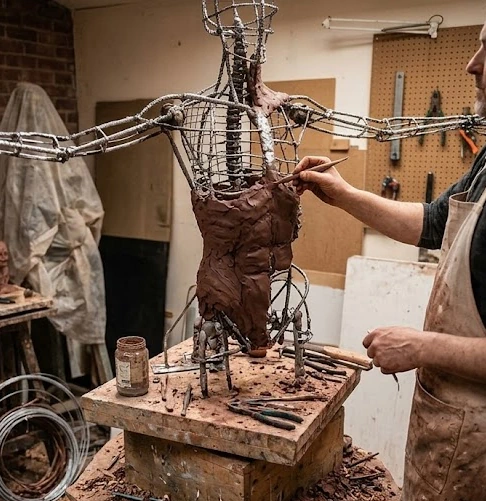
An armature is the internal skeletal system used in sculpture making. Carrying and supporting the form of the sculpture, this structural system acts as the spine that keeps the artwork upright, much like the skeleton in a human body. Using an armature is of great importance, especially when working with materials of limited structural durability such as clay, plaster, and polymer clay. A properly designed armature both facilitates the production process and ensures the longevity of the artwork.
Armature Materials
Different materials are used in armature construction. Aluminum wire is one of the most common choices; it is lightweight, bendable, and easy to work with. Steel wire and rods are preferred for larger and heavier sculptures. Copper wire, on the other hand, is suitable for small-scale and finely detailed works. Wooden blocks and metal pipes are used to create the fixed and voluminous parts of the structure. Armature design must be planned in advance according to the final form of the sculpture, its size, and the materials used.
The Armature Construction Process
Creating an armature requires both technical knowledge and experience. First, a sketch or plan of the sculpture is prepared. Based on this plan, it is determined which parts of the armature should be flexible and which should be fixed. Wires and rods are cut and bent to form the basic shape. Joints and connection points are reinforced through wire wrapping or welding. After the armature is mounted and fixed to a base, the application of clay or other modeling materials begins. It is critical that the armature correctly supports the sculpture's center of gravity to ensure the work remains balanced throughout the production process.
Armatures and Professional Sculpture Production
In professional sculpture studios, armature design and production are considered a distinct area of expertise. Armatures prepared for large-scale monumental statues require steel construction engineering, and these structures are calculated to bear both the artwork's own weight and external influences. The wax models prepared before the bronze sculpture casting process are also built upon armatures. In this process, the armature ensures that the model retains its shape and that the casting mold is formed correctly.
The Importance of Using an Armature
Sculptures made without an armature can encounter serious issues. In thin and long forms—specifically regions like arms, legs, and the neck—the material may sag under its own weight, causing cracks or breakages if an armature is absent. This situation disrupts the production process and leads to a loss of time and material. Conversely, a correctly placed armature allows the sculptor to create much more free and dynamic poses. For this reason, experienced sculptors give as much importance to armature design as they do to the modeling work itself.
Date Added: