What is a Caliper?
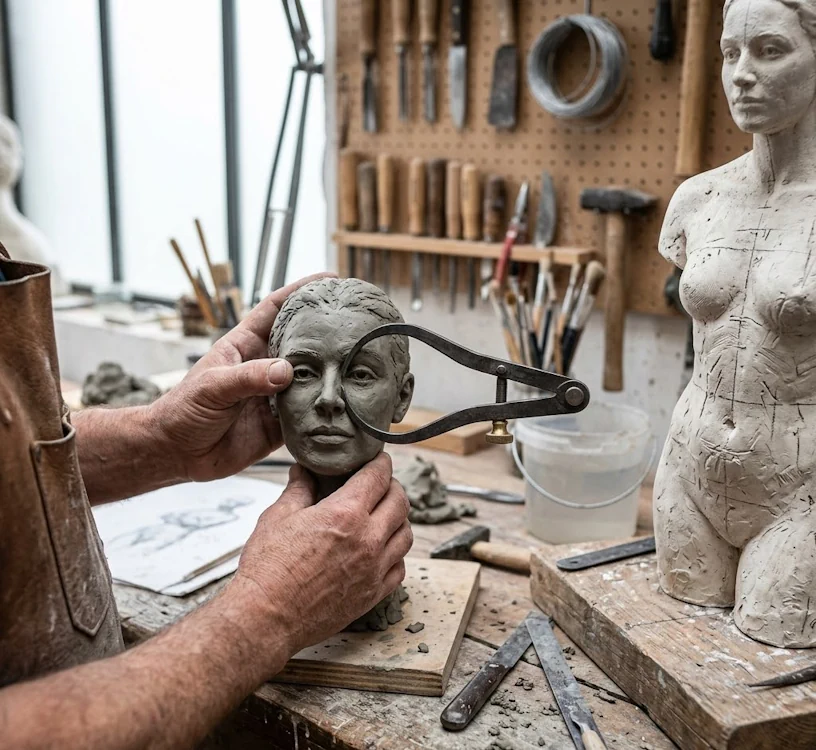
A caliper is a precision measuring instrument used to measure the distance between two or more points. In sculpture, the caliper is an indispensable tool for transferring measurements from a model to a large-scale work, or between any two reference points. Since a sculpture produced without accurate proportions will fail aesthetically, the caliper is one of the sculptor's most trusted aids.
Types of Sculpture Calipers
Various types of calipers are used in sculpture studios for different purposes. The two-arm straight caliper is used for external measurements, allowing the distance between its two tips to be read directly. The inside caliper is preferred for measuring hollow and concave surfaces. The three-point caliper enables three-dimensional measurement transfer simultaneously, making it especially convenient for large-scale enlargement work. Vernier calipers and digital calipers are the preferred choice for technical applications requiring millimeter-level precision.
Caliper Use and Proportion Transfer
Using a caliper in sculptural practice is a skill in its own right. A measurement taken from a specific point on the model is locked in by the opening between the caliper's arms, then transferred to the large-scale work. Throughout this process, the scale factor must always be kept in mind — the model measurement is multiplied by the enlargement ratio to obtain the new measurement. Experienced sculptors treat caliper readings not merely as a checking tool, but as an integral part of the entire process.
Historical Use of the Caliper
The history of caliper use stretches back to antiquity. Egyptian and Greek sculptors are known to have used primitive measuring tools to preserve proportions. During the Renaissance, the caliper became standard equipment in professional sculpture studios. Historical sources note that the workshops of masters such as Michelangelo and Bernini contained calipers in many different sizes. Today, despite the development of digital measuring tools, the traditional caliper remains a fixture in sculpture studios.
Calipers and Modern Technology
In the digital age, laser measurement systems and three-dimensional scanning technology have partially replaced the caliper. However, these technologies remain financially out of reach for small studios. On the other hand, traditional caliper use offers the sculptor a direct physical connection and measuring experience with their model. This experience involves not only numerical data but also the active participation of the hands and eyes. For this reason, many master sculptors use both traditional and modern measuring methods in combination.
Practical Use of Calipers and Key Considerations
Taking accurate measurements with a caliper in a sculpture studio requires patience and physical sensitivity. During the process, the tips of the caliper should neither press too firmly nor rest too loosely against the surface being measured — a light touch yields the most accurate result. Particular care is taken when working with soft materials such as clay, to ensure the caliper tips do not sink into the material, distort the form, or cause depth errors. When transferring a measurement from a model to a large-scale work, the sculptor typically establishes reference points. While the two-arm caliper holds the straight distance between these points constant, it allows the key anatomical prominences to be worked into the new piece with millimeter precision. Once the measurement transfer is complete, the arms are locked with the caliper's screw mechanism, and the same ratio is used as a reliable guide to be checked repeatedly throughout the entire work.
Date Added: