Theodore Roosevelt Statue - New York, USA
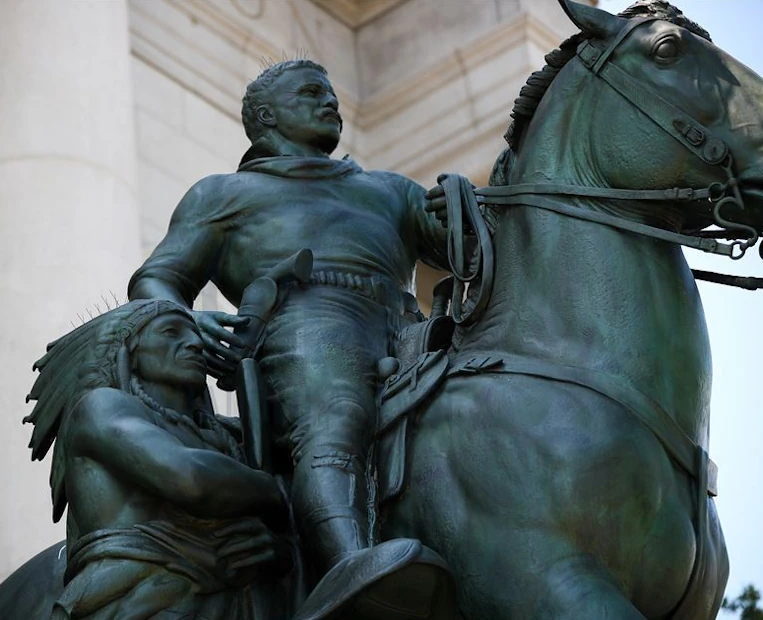
The Theodore Roosevelt Statue stood at the entrance of the American Museum of Natural History, located at the intersection of Central Park West and 79th Street in the Upper West Side neighborhood of New York City. The statue was mounted on a granite pedestal inside Theodore Roosevelt Park, facing the museum's main facade. Following intense public debate, the statue was removed from its position in front of the museum in January 2022 and relocated to North Dakota, Roosevelt's birth state. A separate Roosevelt statue, where visitors can sit beside the figure, continues to be displayed inside the museum's Theodore Roosevelt Memorial Hall.
Who Created the Theodore Roosevelt Statue?
The equestrian statue that stood in front of the museum was created in 1939 by American sculptor James Earle Fraser. Fraser (1876–1953) was one of the leading public sculpture artists of his era, responsible for many significant works including a Benjamin Franklin statue and a Roosevelt bust for the Senate. The overall architecture of the memorial was designed by architect John Russell Pope, who also designed the Jefferson Memorial in Washington, D.C. The relief sculptures on the museum's exterior facade were created by Edward Field Sanford Jr. in 1936. The combined contributions of all these artists made the memorial one of the most carefully designed public structures of its time.
What Does the Theodore Roosevelt Statue Look Like?
The statue is an equestrian work depicting Roosevelt on horseback. Two figures walk alongside him — a Native American man on one side and an African man on the other. According to sculptor Fraser, these two figures are allegorical representations of Roosevelt's "friendliness to all races." However, the positioning and height difference of the flanking figures relative to Roosevelt made the statue a subject of controversy for many years. Critics argued that the arrangement reflected a colonialist perspective, and these debates ultimately played a decisive role in the museum's decision to remove the statue.
The Construction of the Theodore Roosevelt Memorial
The New York State Legislature established the Roosevelt Memorial Commission in 1920, one year after Theodore Roosevelt's death. Construction began in 1929 and was completed in 1935. The cornerstone was laid on October 27, 1931, by Franklin D. Roosevelt, Theodore's fifth cousin, who was serving as Governor of New York at the time. The statue took its place in front of the museum in 1940. In 1958, the park surrounding the museum was renamed Theodore Roosevelt Park in honor of the centennial of Roosevelt's birth. The stated purpose of the memorial, in the words of the Museum Board of Trustees, was to reflect Roosevelt's identity as a nature lover, naturalist, explorer, and author of works on natural history.
Who Was Theodore Roosevelt?
Theodore Roosevelt (1858–1919) served as the 26th President of the United States from 1901 to 1909. Having previously served as Governor of New York, Roosevelt is remembered in history for his forceful personality, energetic style, and deep passion for nature. He championed national parks and conservation areas, undertaking extensive efforts to protect America's natural heritage. Awarded the 1906 Nobel Peace Prize for his role in mediating the end of the Russo-Japanese War, Roosevelt was also a prolific writer who authored numerous books on history, biography, and natural history. He remains one of the most colorful and debated figures in American political history.
The Roosevelt Statue Inside the Museum
After the equestrian statue was removed from outside the museum, Roosevelt's connection to the American Museum of Natural History did not come to an end. At the center of the Theodore Roosevelt Memorial Hall stands a different bronze statue depicting Roosevelt seated on a bench. Rather than portraying him as an explorer or leader, this work presents him as a naturalist and thinker. Evoking the night Roosevelt spent camping with naturalist John Muir during their famous 1903 Yosemite trip, the statue invites visitors to sit beside him and take photographs, offering a warm and personal experience. Compared to the equestrian statue, this work presents a far more intimate and human portrait of Roosevelt.
How to Visit the Theodore Roosevelt Statue
The American Museum of Natural History is located at the corner of Central Park West and 79th Street, easily accessible from midtown Manhattan. The nearest subway station is 81st Street–Museum of Natural History. The museum is open daily with an admission fee. The Theodore Roosevelt Memorial Hall and its statue inside the museum are accessible with general admission. The hall dedicated to Theodore Roosevelt features comprehensive exhibitions on his contributions to the natural sciences, offering visitors a rich and engaging experience.
Date Added: