Sphinx Statue - Egypt Giza
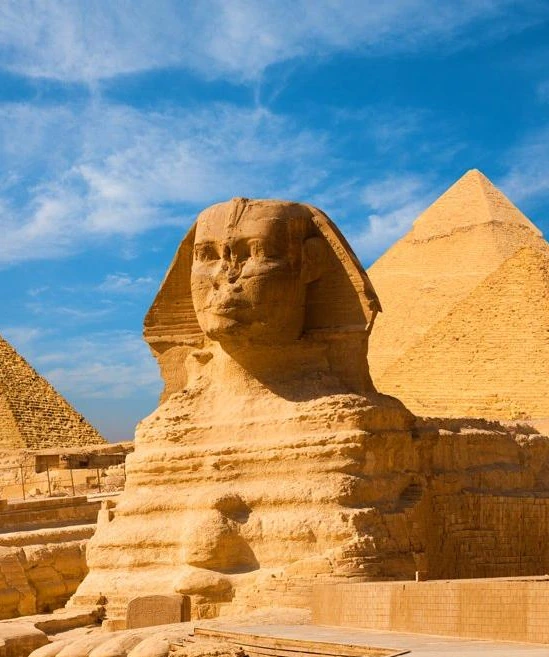
In the Giza plateau of Egypt, right next to Cairo and in the shadow of the world's largest pyramids, one of history's most mysterious and recognizable structures has been waiting silently for thousands of years: The Sphinx. As the most unique and striking example of the entire ancient Egyptian sculptural tradition with its human-headed lion body, the Great Sphinx of Giza is not just a statue; it is also a protector, a symbol of wisdom, and the focus of one of humanity's deepest historical curiosities. This massive structure, which remained under the sand for thousands of years, was unearthed, attempted to be plundered, and still cannot be fully deciphered, continues to enchant visitors from all over the world by dominating the horizon of the Giza Plateau today. It is the first visual that comes to mind when Egypt is mentioned.
History and Construction of the Sphinx
Exactly when and by whom the Great Sphinx of Giza was built continues to be a subject of debate among archaeologists. However, according to the most widely accepted view, the Sphinx was built **around 2500 BC during the reign of Pharaoh Khafre**. Its proximity to Khafre's pyramid and the similarity of the structure's facial features to statues of Khafre are among the strongest evidence supporting this view. Carved from a single block of limestone, the Sphinx holds the distinction of being the the world's largest monolithic statue of the ancient world, with a length of approximately 73 meters and a height of 20 meters.
The purpose of the Sphinx's construction has also been the subject of various theories among historians. According to the most widely accepted interpretation, the Sphinx functioned as a guardian **protecting the divine power of the pharaoh and the Giza necropolis**. The human head symbolized wisdom and intelligence, while the lion body symbolized strength and courage; the combination of these two features brought together both the divine and worldly dimensions of the pharaoh in a single figure. For the ancient Egyptians, the Sphinx was not just a stone statue, but the embodiment of a living protective spirit.
Giza Plateau and the Location of the Statue
The Sphinx is positioned at the most strategic point of the Giza Plateau, right in front of the **three great pyramids** and facing east. This orientation is no coincidence; the Sphinx turning its face toward the rising sun every morning establishes a deep connection with the sun cult of ancient Egypt. Encountering this massive structure in the vast desert of the Giza Plateau evokes a feeling in the visitor that is difficult to describe; it feels as if time has stopped and one finds themselves in the middle of thousands of years ago.
In this unique geography where the modern silhouette of Cairo and the ancient texture of the Giza Plateau exist side by side, the Sphinx stands out as a timeless figure bridging two worlds. The light and sound shows organized at night add a completely different and magical dimension to the Sphinx, offering visitors an unforgettable experience. It is extremely rare to encounter such an impressive atmosphere in the world; this unique experience offered by the Giza Plateau constitutes one of the strongest expressions of humanity's common imagination.
Artistic and Symbolic Features of the Sphinx
The Great Sphinx of Giza is considered one of the most unique and boldest works of ancient Egyptian art. The **lion body with a human face** constitutes the largest and most impressive example of the sphinx figure in ancient Egyptian iconography. It is thought that the structure was originally painted and its face was colored; this fact indicates that the grayish limestone surface we see today actually hides a much more vibrant and colorful appearance. The fact that its nose is broken has been the subject of many legends for centuries; some historians attribute this damage to deliberate destruction in ancient times. But generally, the noses of old statues are always broken.
One of the greatest mysteries of the Sphinx is the strong theories that there are hidden rooms or tunnels beneath it. Although various archaeological studies point to the existence of voids under the structure, a definitive conclusion has not yet been reached. This mysterious dimension takes the Sphinx far beyond being just a historical structure, making it one of the sources from which humanity's deepest curiosity and imagination are fed.
Importance in Terms of Tourism and Cultural Heritage
The Giza Plateau and the Sphinx hold the distinction of being one of the most visited archaeological sites in the world. **Millions of tourists every year** come to this area to have the opportunity to see both the Sphinx and the surrounding pyramids up close. This area, which is on the UNESCO World Heritage List, constitutes undoubtedly one of the most valuable pieces of humanity's common cultural heritage. The Sphinx continues to be a global center of attraction as one of the strongest symbols of not only Egyptian tourism but also world tourism.
Date Added: