Ramses II Statue - Egypt Luxor
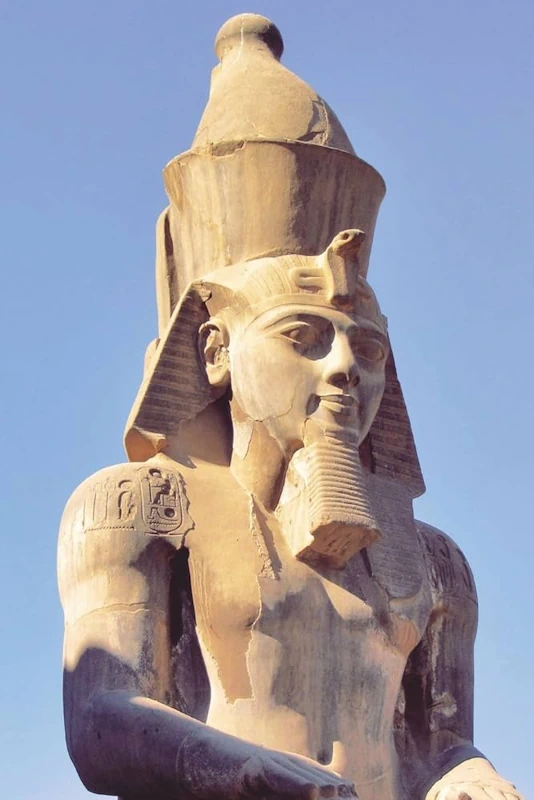
In the city of Luxor, Egypt, along the fertile banks of the Nile River and among the ruins of one of humanity's most ancient civilizations, the statue of one of history's greatest pharaohs has stood for thousands of years: Ramses II. Ramses II, who went down in history not just as a ruler, but as a god-king, a warrior, a builder, and a symbol representing the most brilliant century of ancient Egyptian civilization, continues to be the figure that leaves the strongest mark on the memory of Luxor, woven with stone and sand. His statue in Luxor is not merely a tourist attraction; it is one of the most concrete expressions of humanity's deepest historical narrative dating back thousands of years. Standing before this statue means coming face-to-face with an ancient world, transcending the boundaries of time and civilization.
Who is Ramses II
Ramses II was born in 1303 BC and ruled Egypt for approximately sixty-seven years until his death in 1213 BC. As one of the longest-reigning pharaohs in history, Ramses brought Egypt to its peak both militarily and architecturally during this long period of rule. The Battle of Kadesh in 1274 BC was his greatest military test. Although this epic battle against the Hittite Empire did not result in a definitive military victory, it demonstrated Ramses' mastery of propaganda, and the conflict concluded with the oldest known written peace treaty in history. Ramses managed to present this treaty as a great victory and immortalized his name.
One of the most distinct features that set Ramses II apart from other pharaohs is the architectural legacy he left behind. The Abu Simbel temples, the Ramesseum, and the additions to the Karnak Temple are just a few of the most well-known structures he built or attributed to his name. By placing his own statues and inscriptions of his name throughout Egypt, Ramses virtually transformed the stone and soil into a part of his own narrative. Living a life of over eighty years, Ramses stands out as a figure rarely seen in history, with many wives and over a hundred children. Even after his death, subsequent pharaohs repeatedly claimed his name and legacy; this is the strongest proof of Ramses' undisputed supremacy in Egyptian history.
The Historical Structure of Luxor and the Location of the Statue
Luxor is a unique city built upon the ancient Egyptian capital of Thebes, carrying the legacy of this ancient city within its structure. Spanning both banks of the Nile with its temples, necropolises, and monumental structures, Luxor is described as the the world's largest open-air museum. The Statue of Ramses II, rising right at the entrance of the Luxor Temple, constitutes one of the most striking elements of this massive historical tableau. The seated statues of Ramses lined up in front of the temple's enormous pylons bring the visitor directly face-to-face with the grandeur of ancient Egypt.
These statues at the entrance of the Luxor Temple remained under the sand for thousands of years and were only unearthed through modern archaeological work. This fact brings the meaning carried by the statues to a much deeper dimension; because these stone figures are not just symbols of a pharaoh, but also of the survival power of one of humanity's longest-lasting civilizations. Gaining a completely different appearance with night lighting, the temple and the statues offer one of Luxor's most magical experiences.
Artistic and Symbolic Features of the Statue
The statues of Ramses II in Luxor are shown among the most mature and impressive examples of ancient Egyptian sculpture. Depicted in a seated position with hands on knees, Ramses reflects both royal authority and divine serenity at the same time. The facial features carry an expression that masterfully blends feelings of power, tranquility, and immortality. The double crown on his head and the hieroglyphic inscriptions at his waist symbolize that he is the ruler of both Upper and Lower Egypt. Every carving on the stone's surface bears the traces of the hands of masters who lived thousands of years ago, adding a unique human depth to the statues.
The scale of the statues reveals the ancient Egyptian understanding of power in its most naked form. These figures, which diminish the observer with their giant dimensions, evoke a sense of both admiration and deep historical humility in the visitor. Having braved storms, invasions, and the destructive effects of time for thousands of years, these statues continue to dominate the horizon of Luxor today.
Importance in Terms of Tourism and Cultural Heritage
Luxor is one of the world's most important archaeological destinations, hosting millions of tourists every year. The Valley of the Kings, Karnak Temple, and Hatshepsut Temple along with the Statue of Ramses II, constitute one of Luxor's undisputed most important tourist stops. For visitors interested in ancient Egyptian history and civilization, these statues serve as a living history lesson. As an integral part of the Luxor Temple complex, which holds UNESCO World Heritage status, these statues continue to maintain their place among the most valuable pieces of humanity's common cultural heritage.
Date Added: