Pablo Picasso - Spanish Sculptor
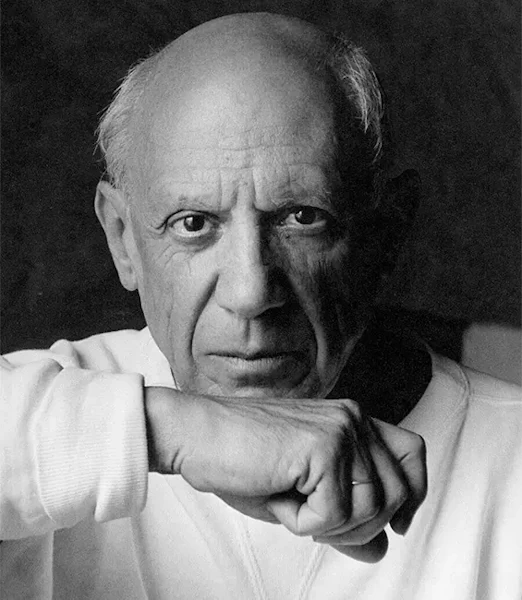
When the name Pablo Picasso is mentioned, Cubism and those familiar fragmented faces immediately come to mind; however, Picasso was not just a painter, but also an incredibly prolific and original sculptor. Born in 1881 in Málaga, Spain, and passing away in 1973 in Mougins, France, Picasso spent the vast majority of his 91-year life in a state of constant creation. As an extraordinary creative force who broke new ground or fundamentally questioned existing conventions as a painter, graphic artist, ceramicist, poet, and sculptor, he left a revolutionary impact on the field of sculpture that matches the stature of his paintings. Yet, this influence is far less discussed and recognized; it is precisely this overlooked dimension that forms one of the most exciting layers of discovering Picasso.
Who is Pablo Picasso? Famous Sculptures and Artworks
The period when Picasso truly began to draw attention in the realm of sculpture coincides with the maturation of Cubism in the mid-1910s. His "Absinthe Glass," produced in 1914, represents one of the first major steps in radically reckoning with traditional sculptural understanding. The inclusion of a real silver spoon into the bronze casting is considered a pioneering example of using "found objects" within sculpture. With this gesture, Picasso opened a door parallel to, yet independent of, Duchamp’s readymade concept. His broad range, stretching from his sculptures in Spain to the giant "The Chicago Picasso," best summarizes his freedom and diversity in this field. The monumental sculpture in Chicago was gifted to the city in 1967 and remains one of its most iconic symbols.
Picasso's collaboration with Julio González is also one of the most productive partnerships in the history of sculpture. When González’s expertise in metalwork met Picasso’s boundless formal imagination, a series of works produced via welding techniques emerged, completely upending traditional sculptural concepts. These works proved that metal did not have to be cast into a solid mass; instead, it could become a tool that draws lines in space, playing with movement and voids. This discovery deeply influenced the practice of metal sculpture for the following half-century.
Ceramics, Collage Sculpture, and Boundless Experimentation
Picasso’s approach to sculpture was never limited to a single material or method. Cardboard, wire, wood, plaster, and bronze are just a few of the materials he used together or separately. During his years in Vallauris, his deep relationship with ceramics introduced him to a completely different dimension of three-dimensional form; clay shaped on the potter’s wheel was transformed by Picasso’s hands into artistic objects that challenged traditional functionality. Carrying the collage technique into three dimensions effectively dissolved the boundary between sculpture and painting; these works exist in the very ambiguity of being neither fully sculpture nor fully painting.
The everyday objects Picasso collected in his Parisian studios and later transformed into sculptures best summarize the limitless scope of his creativity. "Bull’s Head," created in 1942 by combining a bicycle handlebar and a seat, remains one of the cleverest and most powerful objects in the history of sculpture. The transformation of meaning achieved by bringing these two ordinary objects together conveys the essence of Picasso’s sculptural philosophy in a single work: seeing the extraordinary potential within the ordinary and making it visible.
Contribution to the Art of Sculpture and Legacy
Picasso's contribution to the art of sculpture should be measured not by individual works, but by his attitudinal stance that fundamentally questioned the understanding of material and form. His relocation of the ready-made into an artistic context, the application of collage logic to three dimensions, and the discovery of welding techniques in metal sculpture opened entirely new vistas for subsequent generations of artists. The Musée Picasso in Paris offers the most comprehensive look at his work; here, it is possible to reach a full panorama of his sculptural output, which often stays in the shadow of his paintings but is just as rich. A Picasso sculpture is like an unexpected treasure found in an unexpected place; to discover it is to realize that a great artist was even greater than imagined.
Date Added: