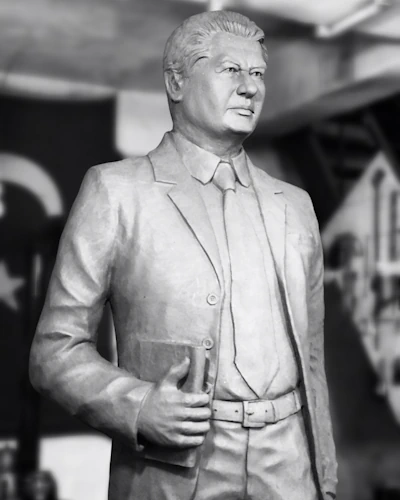
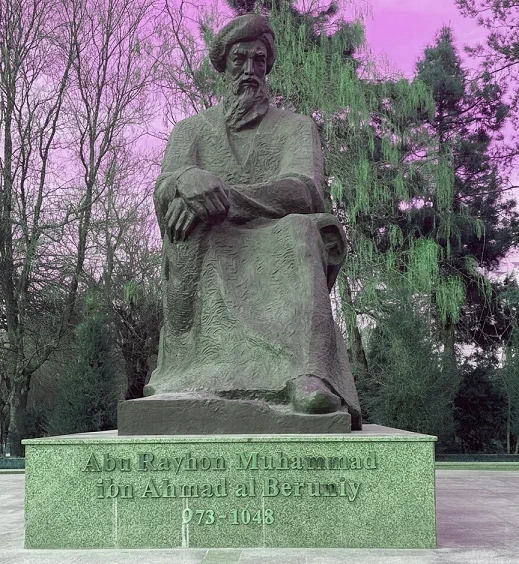
Biruni Statue - Uzbekistan - Tashkent
Throughout history, there are names that leave their mark not only on their own era but on the entire human heritage. Abu Rayhan Biruni is precisely such a name. Born in 973 in the Khwarezm region, within the borders of present-day Uzbekistan, Biruni grew up from childhood with an extraordinary curiosity and hunger for learning. Having absorbed the most deep-rooted scientific traditions of his time, he produced works in mathematics, astronomy, physics and geography, history and philosophy, pharmacy and mineralogy. It was impossible to confine him to one field; for he was one of those rare minds who aspired to the totality of knowledge.
The geography where Biruni was raised was, at that time, one of the brightest scientific centers of Islamic civilization. Having laid a solid foundation in mathematics and astronomy during his early years of education in Khwarezm, the young Biruni quickly attracted the attention of the leading scholars of his era. His correspondence with the great Islamic philosopher Ibn Sina has gone down in history; the scientific debates between these two geniuses have survived to our day as rare documents revealing the intellectual atmosphere of the period. Biruni respected Ibn Sina, yet did not hesitate to question his ideas. This independent mode of thinking was one of the most fundamental qualities that set him apart from an ordinary scholar.
A Mind That Pushed the Boundaries of Science
Biruni's scientific contributions span such a wide range that it remains a subject of debate in the modern academic world as to which discipline's pioneer he should be considered. In astronomy, he demonstrated through his calculations that the Earth might revolve around the Sun a thought expressed a full five hundred years before Copernicus's revolutionary theory. He addressed gravity at a conceptual level and calculated the shape and circumference of the Earth with remarkable precision given the conditions of his time. His astronomical work was not merely theoretical proposals, but genuine scientific findings based on meticulous observation and mathematical calculation.
His contributions to mathematics are equally striking. His work on trigonometry served as a critical bridge in the transmission of Islamic mathematics to the West. In mineralogy, he measured the specific gravities of various metals and precious stones; these measurements carry a surprising degree of accuracy when compared with the data of modern science. Biruni also put pen to paper in pharmacy and medicine, systematically examining the healing properties of plants. His ability to sustain productivity across all these fields shows that he possessed not only a brilliant intellect but also an iron discipline.
A Window Opening onto India
One of the most remarkable periods of Biruni's life coincides with the years he accompanied Mahmud of Ghazni on his campaigns to India. Although these campaigns were politically controversial, for Biruni, India was a tremendous treasury of knowledge upon which he needed to focus entirely. He learned Sanskrit an extraordinarily unusual undertaking for a Muslim scholar of that era to learn India's ancient language so deeply. The fruit of this effort, "Kitab-ul Hind" the "Book of India" is counted among the first works in history to examine a civilization so comprehensively and objectively.
In Kitab-ul Hind, Biruni conveyed Indian philosophy, astronomy, mathematical tradition, social structure, religion, geography and history through the pen of a meticulous observer. The most striking aspect of the work is the objectivity and respect with which the author approaches Indian culture. Biruni approached the different not with judgment, but with curiosity. This attitude proves that he was not only a great scholar but also a forward-thinking intellectual. Kitab-ul Hind is still considered one of the fundamental references in the field of Indology today.
Where Is the Biruni Statue, and Why Is It Important?
Tashkent, the capital of Uzbekistan, is one of Central Asia's most deep-rooted cities, and this depth is reflected in the city's public spaces. The statue dedicated to Biruni in Tashkent is a living part of the city's cultural memory. The statue carries Biruni into the future, depicted holding a book with a thoughtful expression; for all who look upon it, it serves as a silent yet powerful reminder of that vast accumulation of knowledge.
For the Uzbek state and people, Biruni is not merely a historical figure but a source of national pride. Since the Soviet era, Biruni's name has been given to many institutions, streets and buildings across the country. The Biruni Institute in Tashkent is one of the most deep-rooted academic establishments bearing his name. The location and design of the statue are a concrete expression of this respect; it not only offers visitors an aesthetic experience but also extends an invitation to forge a historical connection.
A visitor standing before Biruni's statue is not merely looking at a figure carved in stone. They are witnessing humanity's endless thirst for knowledge, the bridges built between different cultures, and the universal language of science that transcends national or religious boundaries. For every traveler heading to Tashkent, this statue is not part of the city's tourist routes it is part of its soul.
Date Added: