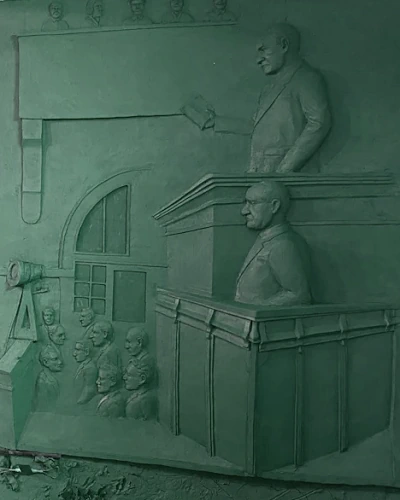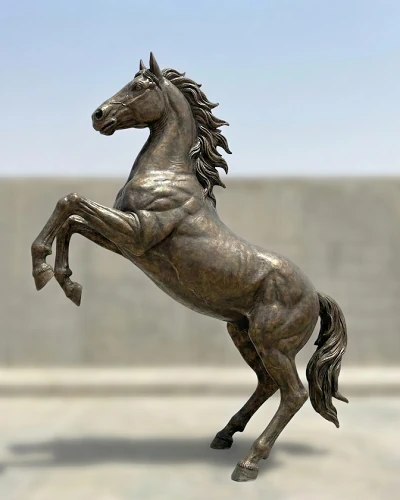
Relief Painting Price and Sales
A relief tableau is a plastic art work in which figures, scenes, or symbols are carved in relief technique on a flat surface (wall, floor, etc.). This art form, which stands between sculpture and painting, creates a three-dimensional depth and volume effect on a two-dimensional surface. The word relief comes from the French word "relief" and corresponds to "kabartma" (embossment) in Turkish. The most fundamental feature that distinguishes a relief tableau from an ordinary painting is the extent to which the figures protrude from the ground surface. This protrusion can sometimes mean a rise of just a few millimeters, while other times it can mean a dramatic three-dimensionality in which the figure is almost completely free.
Relief sculptures have appeared throughout history on temple walls, triumphal monuments, palace gates, and tombstones. Today, they can be found in public squares, schools, institutional buildings, and private collections. The material used can be stone, bronze, plaster, wood, or ceramic; however, the most durable and impressive results are generally achieved with the bronze casting technique. If you wish, you can read our article what is relief about the definition of relief.
A Brief History of Relief Art
The roots of relief art stretch back to the earliest periods of human history. About 25,000 years ago, Paleolithic people carved animal figures into cave walls. These primitive carvings carry the seeds of relief art. Horse and bison figures found in caves in the Dordogne region of France were crafted with a mastery that still astonishes us today. For the people of that era, these carvings were not merely decoration; they were the visual language of hunting magic, belief, and the struggle for survival.
The ancient Egyptian civilization elevated relief art to a systematic level. The reliefs covering the walls of Karnak Temple, Luxor, and Abu Simbel tell of the victories of the pharaohs, offerings made to the gods, and scenes from the afterlife. Egyptian artists masterfully employed both low relief and sunk relief techniques. The deep shadows created by sunk relief under the powerful desert sun added dramatic vitality to the figures.
Mesopotamian civilizations also left a great legacy in this field. The hunting and battle scenes adorning the walls of Assyrian palaces are the most advanced examples of their period, both narratively and technically. The lion hunt reliefs excavated from Nineveh and now displayed in the British Museum convey the expression of the animals and the dynamism of movement so realistically that they deeply move the viewer despite the distance of thousands of years.
Relief art reached its peak during the ancient Greek and Roman periods. The Parthenon frieze in Athens is a low relief band approximately 160 meters long depicting the Panathenaic procession. Greek artists brought their mastery of rendering the human figure with ideal proportion, movement, and elegance to its highest level in these works. In the Roman period, the Column of Trajan, narrating Emperor Trajan's Dacian campaigns with a spiral relief band approximately 200 meters long, still holds the distinction of being the longest continuous narrative relief of antiquity.
During the Middle Ages, relief art continued to live on in the door tympanums and altars of Christian churches. In the Renaissance period, the bronze door panels made by Lorenzo Ghiberti for the Florence Baptistery formed one of the turning points in art history with their revolutionary approach to the use of perspective and volume. Michelangelo named these doors the "Gates of Paradise"; this designation best summarizes the impact of the work on its era.
Bronze Relief Tableau
Bronze is a metal composed of an alloy of copper and tin, used for thousands of years in the fields of art and engineering. Extraordinarily resistant to weather conditions, moisture, and time, bronze is among the finest materials preferred for relief tableaux. The greenish or brownish patina layer that forms on its surface over time adds both historical depth and unique aesthetic value to bronze works.
The production of a bronze relief tableau is a multi-stage process requiring patience and expertise. In the first step, the artist prepares a detailed model of the work from clay or plaster. This model is the exact draft of the final piece. Then a mold is taken from this model, molten bronze is poured into the mold and left to cool. When the cooled bronze is removed from the mold, a rough piece emerges; in the next stage, the artist works the surface with chisels, files, and various hand tools, defines the details, and the work reaches its desired final form. This process can sometimes take weeks, and for large and complex works, months.
One of the most striking features of bronze relief tableaux is the way they use light. Depending on the angle of light falling on them, different sections come forward or recede; this causes the work to appear as if it is changing and transforming throughout the day. This feature makes bronze relief tableaux highly impressive even under artificial lighting in enclosed spaces.
Subject and Theme Selection in Relief Tableaux
Throughout history, the subjects depicted in relief tableaux have reflected the values, beliefs, and ideologies of the period in which they were made. In antiquity, victory scenes, depictions of gods, and hunting motifs came to the fore; in the Middle Ages, religious narratives and stories of saints took center stage. The Renaissance brought mythological subjects and historical events into relief art.
Today, the subjects of relief tableaux have spread across a much wider spectrum. Themes such as national independence struggles, social solidarity, the relationship between nature and humanity, industry and labor are frequently depicted in modern relief works. Reliefs placed in public squares and institutional buildings in particular take on the function of reinforcing collective memory and visually expressing collective identity.
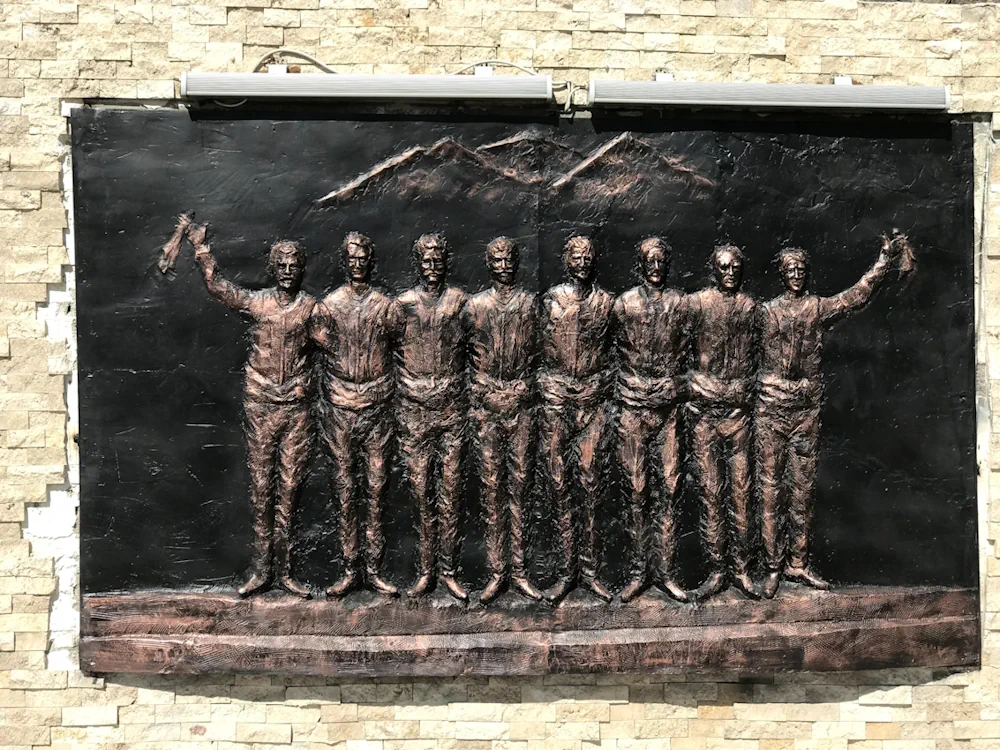
The relief tableau in the image presents a powerful example of this tradition. Seven male figures stand side by side in a shoulder-to-shoulder pose. The figures at the two ends raise their arms, holding torches or symbols of victory in their hands. The mountain silhouette rising in the background creates a geographical context, adding a strong local identity to the work. This composition brings to the fore the themes of unity, struggle, victory, and solidarity.
The Relief Tradition in Turkish Art
Anatolia is one of the most deep-rooted geographies in the world for relief art. The Hittite civilization laid the cornerstones of this tradition thousands of years ago with reliefs carved into stone in various regions of Anatolia. The depictions of gods and goddesses at the Yazilikaya Temple are among the most impressive examples of Hittite relief art. At the same period, the Late Hittite city-states also produced monumental reliefs adorned with gate lions, sphinxes, and hunting scenes.
Get Ideas for Your Order
Our company has been providing services in the field of sculpture art for over 20 years. If you are considering having an artistic work made, please be sure to get ideas from us. If you wish, you can complete your order in our art studio with our expert sculptors. All you need to do is use the order form below or try other means of communication.
Registration Date:
Rate:
5
5 Vote