Camel Statue Price and Sales
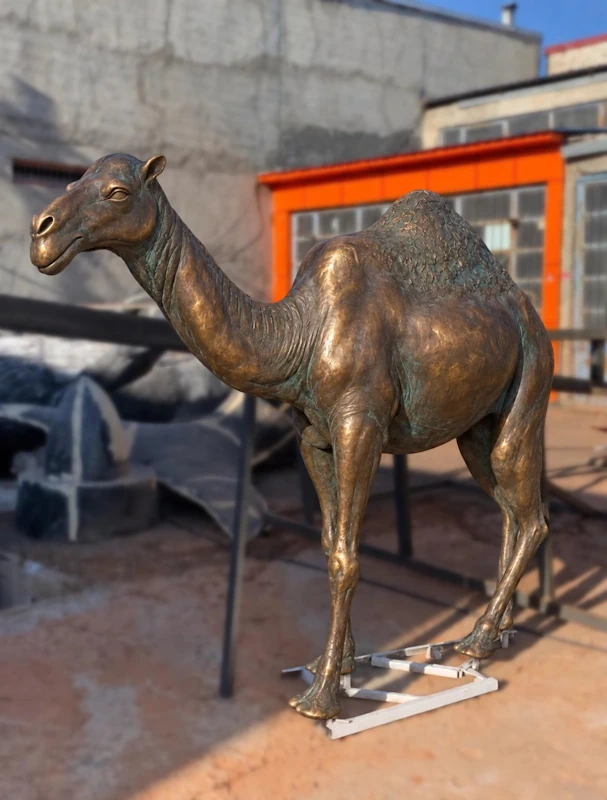
A new project just left our workshop, and this time it had a long way to travel. We built a camel statue that stands 2.4 meters tall and shipped it to the United Arab Emirates. The statue is made of fiberglass, and its surface was finished with an antique bronze paint technique. We took the photo in front of our workshop, right before it left. The copper tones and the greenish patina marks look great in daylight, and you can see them clearly in the picture. In this article we explain how the statue was made, why we chose fiberglass, how the customer reference image became a finished sculpture, and why the camel is so highly valued in that region.
Why Choose a Fiberglass Camel Statue?
The most common question about large animal sculptures is the material. Bronze is beautiful, but it is expensive and very heavy. If you cast a 2.4 meter camel in solid bronze, both the cost and the shipping bill grow seriously. This is where a fiberglass sculpture comes in. The material is light, it captures fine details very well, and it lasts for years outdoors without breaking down. It is not affected by sun, rain or humidity, and it does not rust. That is why fiberglass camel statues are often chosen for parks, hotel entrances, restaurant gardens, shopping malls and public square designs. A steel frame supports the inner structure, so the statue stands very firmly. Its low weight also makes installation easier and reduces the need for cranes and heavy equipment.
Antique Bronze Paint: A Finish Very Close to Real Bronze
The most striking part of this sculpture is its surface. Someone who does not know it is fiberglass will easily mistake it for bronze when looking at the photo. We achieved this with antique bronze paint. First, a metallic bronze base is applied to the surface. Then dark and light tones are worked in layer by layer. Greenish patina tones are added to the folds of the neck, the leg joints and the area around the hump. These are the colors we are used to seeing on aged bronze. Raised areas are left brighter and recessed areas darker. This way the skin folds, veins and muscle structure look more defined. This work cannot be rushed, because every pass of the brush changes the result. When it is done right, a person looking from far away and a person inspecting it up close get the same real bronze feeling.
Production Process of a 2.4 Meter Camel Sculpture
A statue of this size cannot be made easily in one go. First the dimensions are confirmed, and then the proportions of the figure are worked out. The camel is a difficult subject, because long thin legs, a flexible neck and a heavy body all come together. If one proportion is off, the statue immediately looks artificial. The parts taken from the mold are reinforced with fiberglass, and a load bearing steel frame is placed inside. The foot section is fixed to a base frame. That is why you can see the white steel frame under the statue in the photo. After the surface work is finished, we move on to the patina paint. Finally a protective coat is applied, the statue is checked one last time and then packed.
From the Customer Reference Image to a Custom Sculpture
This project did not come from a ready made model. The customer sent us a camel figure image and asked for the pose, the facial expression and the proportions to match that image. Making a custom sculpture from a reference is what we do most often. A customer brings a photo, a drawing or a small figure, and we scale it up to the size they want. The key point here is that the character of the original must be kept, while the statue still looks balanced at 2.4 meters. The slightly lowered head, the half closed eyes and the calm expression give this sculpture its character. To get them right, we compared the work against the image again and again as we went.
Why Is the Camel So Valuable in United Arab Emirates Culture?
To understand why this order matters, you need to look at the region. In desert life the camel is not just an animal, it has been part of daily life for centuries. It played the leading role in transport, trade and nomadic life. Providing milk, meat, wool and transportation, this animal has been seen as the key to surviving in the desert. For this reason, in the Gulf countries the camel is a symbol of cultural
Registration Date: Rate: 5