Yasser Arafat Statue - Palestine Ramallah
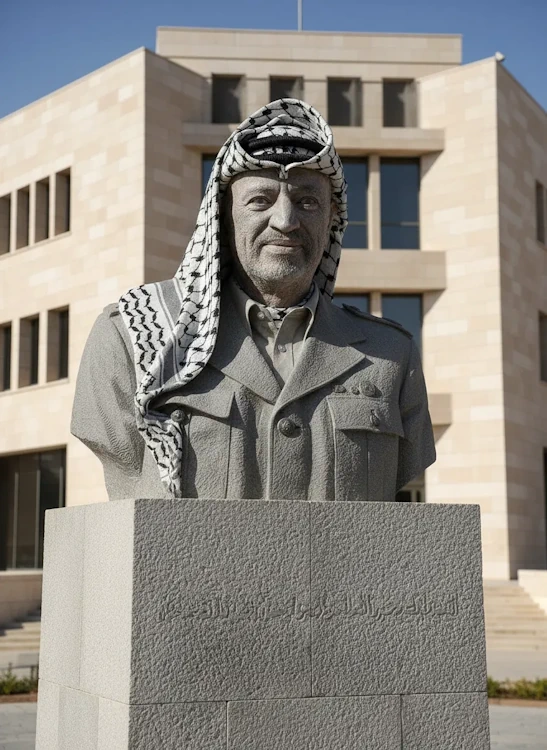
In Ramallah, the administrative capital of Palestine a land shaded by olive trees and bearing the marks of decades of resistance the statue of one of the Palestinian people's greatest symbols stands tall: Yasser Arafat. This statue is not merely a monument erected in memory of a political leader; it is also the most intense expression of a people's struggle for existence, their longing for their land, and their search for national identity. Yasser Arafat went down in history as a leader who carried the Palestinian cause to the world for decades, was deemed worthy of the Nobel Peace Prize, and transformed the Palestine Liberation Organization into a recognized force on the international stage. His statue in Ramallah, and the mausoleum right beside it, have become the most powerful symbolic site of national consciousness for the Palestinian people.
Yasser Arafat's Life and the Palestinian Cause
Yasser Arafat was born in Cairo in 1929. Having studied engineering in Egypt, Arafat deepened his commitment to the Palestinian cause during his student years and quickly became one of the prominent figures of Palestinian student movements. Founding the Fatah movement in 1959, he was subsequently elected chairman of the Palestine Liberation Organization (PLO) in 1969. These two critical steps permanently consolidated his centrality and leadership authority in Palestinian politics.
Arafat's political journey followed an extraordinarily turbulent course, filled with triumphs and setbacks. The Oslo Accords signed with Israel in 1993 were regarded as his greatest diplomatic achievement on the international stage, and within the framework of these accords he shared the Nobel Peace Prize with Israeli Prime Minister Yitzhak Rabin and Foreign Minister Shimon Peres. However, the Oslo process also sparked deep debate within Palestinian society; this period, in which hopes for peace and deep disappointment became intertwined, constitutes one of the most complex chapters in Palestinian politics. Arafat continued to be the indispensable voice of the Palestinian cause until his death in 2004.
Ramallah and the Location of the Statue
Ramallah, as the de facto capital of the Palestinian Authority, forms the political and cultural center of the West Bank. The area known as Arafat Square and the Mukataa Complex is the historic site where Arafat spent his final years and where his mausoleum stands today. The Yasser Arafat Statue rises in the square as the most visible element of this complex. The area where the statue is located is far more than an ordinary public space for Palestinians; it carries the character of a sacred site of commemoration and gathering.
Every year, thousands of Palestinians and foreign visitors come to this site, visit Arafat's mausoleum, pay their respects before the statue, and renew their commitment to the Palestinian cause. This powerful collective ritual transforms the statue into a national symbol carrying far deeper meaning than a purely aesthetic structure.
Artistic and Symbolic Features of the Statue
The Yasser Arafat Statue reflects his iconic appearance and personality with great fidelity. The keffiyeh on his head and his military appearance bring Arafat's most recognized image in the eyes of the world public to the statue. The posture of the figure simultaneously conveys determination, resilience, and his unwavering commitment to the Palestinian cause. The inscriptions on the base provide information about the turning points of his life and Palestine's struggle for independence. The overall design philosophy of the statue immortalizes Arafat as both a political leader and the voice of his people.
His Place in Palestine's National Memory
Yasser Arafat continues to be undisputedly the most central figure in the collective memory of Palestinian society. For the Palestinian people, standing before his statue means not merely commemorating a leader, but once again feeling the decades of struggle, exile, resistance, and hope for freedom. This emotional and symbolic weight makes the statue one of the most meaningful and most powerful monumental structures in the Middle East.
Date Added: