What Is Paper Relief
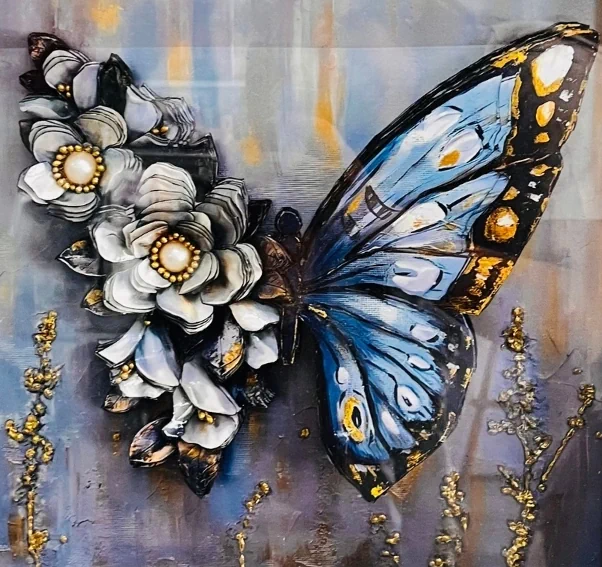
You are looking at a picture, but that picture is not flat. There are layers, there is depth, it evokes a feeling as if you could step right inside it. This is exactly the feeling that paper relief art gives you. This art form, which has captured the interest of many people today, is actually a modern reflection of a tradition rooted much further in the past. Appearing before us as both a hobby, a craft, and a serious art form, paper relief is a pursuit that demands patience and effort but rewards you far more than you put in.
What Is Relief, and What Does Paper Relief Mean?
The word "relief" has entered our language from French, and its basic meaning is "embossment." The operations of raising or recessing a surface are called relief. This art form, which sits somewhere between painting and sculpture, aims to create a three-dimensional effect on a flat surface. Relief can be applied to many materials such as stone, marble, metal, wood, and paper and its version made on paper stands out as both the most accessible and the most creative. Paper relief is the art of cutting multiple copies of the same image in layers and gluing them on top of one another, thus giving depth to the composition. The resulting work is not a flat picture; it presents an almost living image that changes according to light and viewing angle.
The Name of Paper Relief in Turkish Culture: The Art of Katı'
When we say paper relief, we should not think only of a modern hobby. The equivalent of this art in Turkish culture comes from a much deeper root: the Art of Katı'. This traditional Turkish decorative art, based on cutting paper and leather, has a history that stretches back to the pre-Islamic era. The Turks carried the cultural heritage they accumulated across the lands they inhabited blending it with the influences of different geographies after embracing Islam all the way to Europe. The Art of Katı' also secured a deep-rooted place among Turkish decorative arts throughout this process. Today, works bearing the traces of this art are exhibited in museums around the world, proving that the Art of Katı' is not merely a local but a universal art form. Masters who practice the art of Katı' are called kattaa.
How Is Paper Relief Made?
Making paper relief may seem complicated at first glance; however, once the basic logic is grasped, it turns into an extremely enjoyable process. First, the image to be worked on is chosen; landscapes, Ottoman motifs, architectural structures, or personal photographs are all very suitable for this purpose. At least 10 copies and usually more of the chosen image are prepared. Each copy is carefully cut with a craft knife to represent a different layer of the image. The cutting is done according to perspective; that is, elements in the background are cut less while figures in the foreground are brought out more distinctly. The edges of the cut papers are painted with a pencil or delicately curled inward with tweezers. Each layer is then lightly embossed by ironing. Finally, the layers are stacked and glued on top of one another with appropriately sized supports placed between them. The resulting work is an altogether different, deep, and striking version of that familiar image.
Types of Relief: Where Does Paper Relief Stand?
There are multiple forms of relief art, and paper relief is just one of them. According to technique, reliefs are divided into two: bas-relief and high relief. In bas-relief, the protrusion separating from the surface is not very prominent; figures are kept close to the base. In high relief, figures rise noticeably from the surface, creating an almost three-dimensional sculptural effect. By material, they can be classified as aluminum, copper, wood, and paper relief. While aluminum and copper are preferred for outdoor use, wood and paper are far more suitable for indoor works. Paper relief stands out in this classification as both the lightest and the most accessible form, which is why it attracts great interest from both professional artists and those interested in art as a hobby.
Uses of Paper Relief
When paper relief comes to mind, the first thing that springs to thought is a framed picture and wall decoration. Indeed, the most common use of this art is to be displayed as a decorative piece in home and office settings. However, paper relief goes far beyond this. Keychains, objects, gift boxes, album covers, and custom-designed cards also come to life through the paper relief technique. This art is also finding increasingly more space in the field of education in recent years; since it develops manual dexterity, patience, and spatial thinking ability all at once, it is frequently preferred in workshop activities and courses. Municipal cultural centers such as İSMEK have also incorporated paper relief training into their programs, demonstrating just how widespread the art has become throughout society.
Why Paper Relief? What Draws You to This Art
Paper relief is an art that takes a little time to learn at first, but once grasped, it is one you will not want to put down. The sense of satisfaction that comes from building an image layer by layer makes itself felt anew with each completed work. Moreover, the cost is low, the equipment is accessible, and it does not require a large space to work in. Beyond all of this, paper relief teaches you the habit of looking at an ordinary picture through different eyes. From now on, when you look at a landscape, you automatically see the background and foreground, the depth and the layers. This is one of the most natural ways to develop an artistic perspective. Whether you start as a hobby or take it seriously and advance further; paper relief art has the power to transform the paper at your fingertips into an entirely different world.
Date Added: