Vardan Mamikonian Statue - Armenia - Yerevan
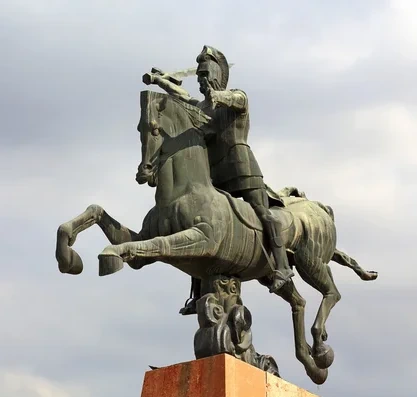
In Yerevan, the capital of Armenia, stands a statue dedicated to the hero of one of the deepest and most painful chapters in Armenian history: Vardan Mamikonian. The commander of the legendary battle known in Armenian history as the "Battle of Avarayr," fought against the Sasanian Empire in the 5th century, Vardan Mamikonian has been engraved into the deepest corners of the Armenian collective memory not merely as a warrior but as a martyr and hero who laid down his life for his faith, his homeland, and his people. His statue in Yerevan stands tall at the heart of the city as one of the most powerful means of passing this great sacrifice and indomitable spirit of resistance on to future generations. The name of Vardan Mamikonian is commemorated to this day as a saint by the Armenian Apostolic Church and kept alive through ceremonies held every year.
The Life of Vardan Mamikonian and the Battle of Avarayr
Vardan Mamikonian was born in the early 5th century into the Mamikonian dynasty, one of the most powerful military families in Armenia. The Sasanian Empire, one of the greatest powers of the era, was pursuing an intense policy of pressure aimed at consolidating its dominance over Armenia and forcing Armenians to renounce Christianity and adopt Zoroastrianism. In the face of this pressure, the vast majority of the Armenian population resolved to resist, and Vardan Mamikonian emerged as the military leader of that resistance. By choosing to fight against the vastly superior forces of the Sasanian Empire in order to protect his faith and his people, Vardan became one of the greatest heroes in Armenian history.
The Battle of Avarayr, fought in 451, is regarded as one of the most critical and most deeply impactful battles in Armenian history. The Armenian army under Vardan's command fought with extraordinary courage and determination against the numerically far superior Sasanian forces. The battle concluded with an outcome that could be considered a military defeat for the Armenians, and Vardan Mamikonian lost his life in this battle. Yet this "defeat" ultimately meant a great victory, for the Armenians never abandoned their faith and the Sasanians were eventually compelled to abandon their policy of converting Armenians away from Christianity. This spirit of resistance transformed Vardan Mamikonian far beyond a military commander into a symbol of a nation's conscience and faith.
The Location of the Statue and Its Symbolic Significance in Yerevan
The Vardan Mamikonian Statue rises in one of the most visible and most meaningful public spaces in Yerevan. In this area where the city's modern fabric and historic identity intertwine, the statue stands out both as a part of daily life and as a symbolic space carrying deep national meaning. Bearing profound ties to the spiritual world of the Armenian Apostolic Church, this statue represents not merely a historic figure but one of the cornerstones of Armenian identity.
Yerevan is a unique city that has carried the traces of countless civilizations throughout its millennia-long history and imprinted this rich past onto its urban fabric. Within this cosmopolitan identity, the Vardan Mamikonian Statue most powerfully symbolizes the struggle the Armenian people waged for their faith and the unwavering determination shown in that struggle. The area surrounding the statue transforms into a meaningful gathering space where Armenians come together especially on religious and national holidays.
Artistic and Symbolic Features of the Statue
The Vardan Mamikonian Statue stands out as one of the most impressive examples of Armenian sculptural art. Depicted in the battle equipment of the era and traditional Armenian attire, Vardan simultaneously conveys both military power and spiritual determination. The figure's stance carries a powerful expression that evokes faith, courage, and unwavering devotion to his people. The inscriptions on the base provide information about the turning points of his life and the place of the Battle of Avarayr in Armenian history. The overall design approach of the statue creates a monumental impact while also powerfully foregrounding Vardan's identity as both warrior and martyr.
The symbolic power of the statue derives not only from its physical characteristics but also from the unique place Vardan Mamikonian holds in the collective memory of Armenian society. The Armenian Apostolic Church's declaration of him as a saint elevates this symbolic weight to a religious dimension as well. To stand before this statue is to feel anew the spirit of the struggle for faith and identity that the Armenian people have sustained across the centuries.
Its Significance for Tourism and Cultural Heritage
Yerevan is rapidly advancing toward becoming one of the most important tourism destinations in the Caucasus in recent years. The ceremonies and religious events held on the anniversary of the Battle of Avarayr draw thousands of visitors to Yerevan each year. The Vardan Mamikonian Statue, one of the focal points of these events, stands out as one of the most powerful means of introducing Armenian cultural heritage and the spirit of resistance to the world. For visitors with a particular interest in Armenian history, the spread of Christianity, and ancient Middle Eastern civilizations, the statue offers a deeply meaningful and impressive experience. For visitors from the Armenian diaspora, this statue constitutes one of the most profound symbolic spaces for reconnecting with their roots and rediscovering their national identity.
Date Added: