Tigran the Great Statue - Armenia - Yerevan
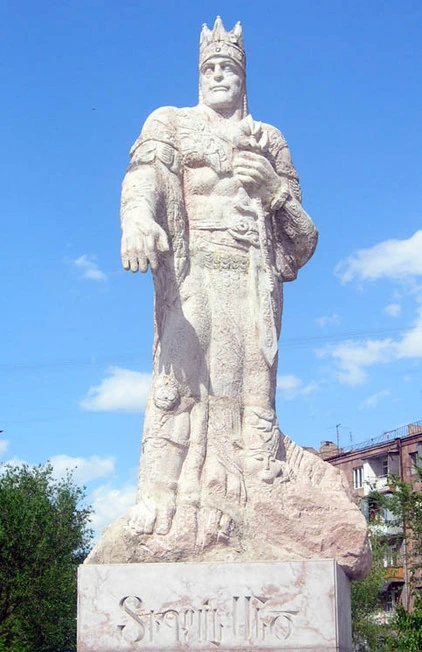
In Yerevan, the capital of Armenia, in this ancient city facing the magnificent silhouette of Mount Ararat, stands the statue of one of the greatest rulers in Armenian history: Tigranes the Great. The only Armenian ruler in history to bear the title "King of Kings," Tigranes transformed Armenia in the 1st century BC into one of the most powerful empires of the region and has gone down in history as a legendary leader. The Tigranes the Great Statue in Yerevan stands tall as one of the most powerful means of engraving this great legacy onto one of the city's most prestigious locations and passing on the Armenian people's sense of national pride and identity to future generations. The name of Tigranes continues to this day to live on in the streets of Yerevan, in school textbooks, and in the collective memory of the Armenian people.
The Life of Tigranes the Great and the Rise of the Armenian Empire
Tigranes II was born in 140 BC and ascended to the Armenian throne in 95 BC. When he came to power, the country was little more than a weakened kingdom under pressure from surrounding powers. However, Tigranes swiftly demonstrated extraordinary military and political abilities, transforming Armenia from a regional power into a global empire. Contending with the powerful states of his era such as the Parthians, Seleucids, and the Kingdom of Pontus, Tigranes extended his territories across a vast geography encompassing parts of present-day Iran, Iraq, Syria, Lebanon, and Turkey. With this territorial expansion came the title "King of Kings," and Tigranes built the most glorious era in Armenian history.
One of the most significant achievements of Tigranes the Great was the founding of the city of Tigranocerta. Established in what is today southeastern Turkey, this city rapidly became one of the largest and most magnificent urban centers of its time, transforming into the cultural and political heart of the empire. Tigranes positioned the city not merely as a capital but also as the most important center of art, culture, and commerce of the era. By inviting Greek philosophers, artists, and scholars to Tigranocerta, he turned his empire into an intellectual center alongside its military might. Although the empire lost territory following the peace agreement signed with Rome in 66 BC, the influence of Tigranes on Armenian history remained lasting and profound.
The Location of the Statue and the Urban Fabric of Yerevan
The Tigranes the Great Statue rises in one of the most central and bustling areas of Yerevan. In this area where the city's modern boulevards and historic structures intertwine, the statue stands among the most frequented spots for both locals and visitors to the city. Within the urban fabric shaped by Yerevan's buildings of pink tuff stone and wide boulevards, the Tigranes the Great Statue stands out as one of the symbolic spaces that most powerfully represents the city's historic identity and sense of national pride.
Yerevan is a capital that has been rapidly developing and transforming in recent years. In this city where modern cafes and restaurants coexist alongside historic buildings, the Tigranes the Great Statue symbolically reinforces the bridge between past and future. The area surrounding the statue transforms into a vibrant meeting point for families, young people, and tourists during the evening hours. With the snow-capped peak of Mount Ararat visible in the background, this view lends the statue a unique visual depth.
Artistic and Symbolic Features of the Statue
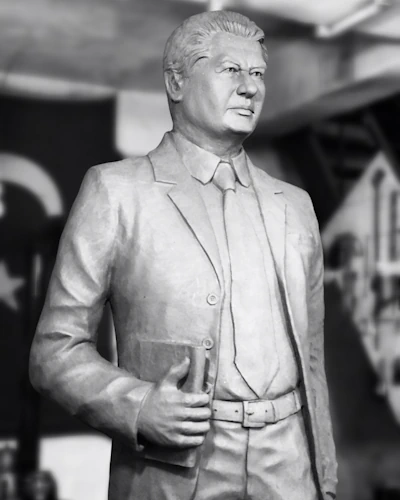
The Tigranes the Great Statue stands out as one of the most powerful examples of Armenian sculptural art. Depicted in royal attire and with the symbolic elements of his era, Tigranes simultaneously conveys both military power and political maturity. The figure's stance carries a powerful balance that evokes victory, honor, and deep devotion to his people. The inscriptions on the base provide information about the turning points of his life and the founding legend of the Armenian Empire. The overall design approach of the statue creates a monumental impact while also foregrounding the multi-dimensional personality of Tigranes in history.
The symbolic power of the statue derives not only from its physical characteristics but also from the deep historical resonance of Tigranes the Great within Armenian society. The title "King of Kings" conveys most concisely that he was not merely a ruler but also an empire builder and a visionary. To stand before this statue is to feel anew the spirit of the most glorious era in Armenian history.
Its Significance for Tourism and Cultural Heritage
Yerevan has in recent years become one of the most popular tourism destinations in the Middle East and the Caucasus. In Yerevan, which serves as the hub of world-renowned routes such as Geghard Monastery, Garni Temple, and the History Museum of Armenia, the Tigranes the Great Statue forms one of the most important stops on the city's historic tourism circuit. For visitors with a particular interest in Armenian history and ancient Middle Eastern civilizations, the statue offers a deeply meaningful and impressive experience. Combined with Armenia's rich cultural heritage and its warm-hearted people, this statue leaves a lasting impression on every tourist who visits the country.
Date Added: