Ulysses Grant Memorial - Washington, USA
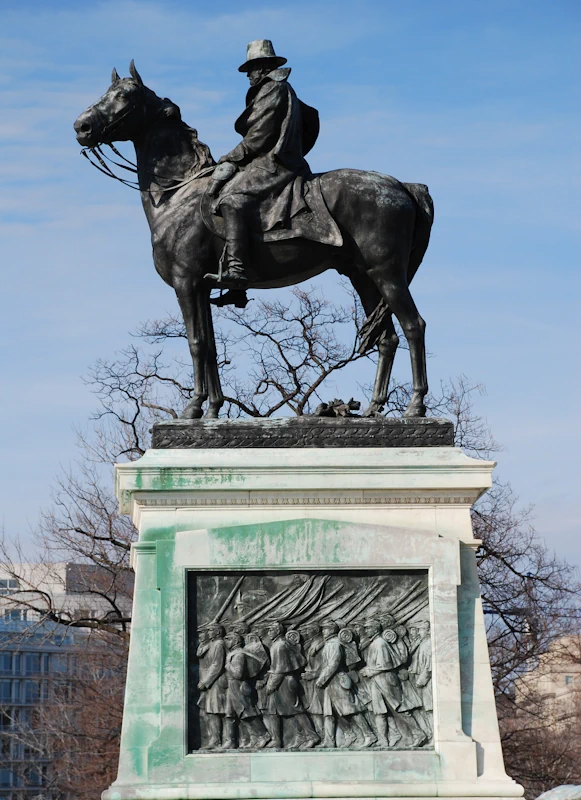
Washington D.C., the capital of the United States, is one of the cities hosting the world's most dense collection of monuments from a historical perspective. Rising in the wide area overlooking the National Mall reflecting pool, right in front of the Capitol building, the Ulysses Grant statue is one of the most magnificent and impressive pieces of this collection. Dedicated in 1922, this memorial is not a single statue; it is a comprehensive sculpture complex centering on Grant and surrounding two separate groups of soldiers. Grant sits on his horse at the center of the monument, scanning the horizon from a position dominating the panorama of Washington. On both sides of the complex, there are groups of cavalry and artillery depicting one of the most dramatic scenes of the American Civil War.
Who is Ulysses Grant?
Hiram Ulysses Grant was born on April 27, 1822, in the town of Point Pleasant, Ohio. A graduate of the West Point Military Academy, Grant served in the Mexican-American War; however, he had to leave the army during peacetime and experienced significant failures in civilian life. His farming, real estate, and trade ventures collapsed one after another; this period went down in history as the darkest years of his life. However, everything changed for Grant with the outbreak of the American Civil War in 1861. He returned to the army as a volunteer and soon proved his military genius.
Grant's rise in the Civil War was extremely rapid. The capture of Fort Donelson, the Battle of Shiloh, and especially the siege and surrender of Vicksburg moved him to the position of the North's most successful commander. In 1864, he was appointed commander-in-chief of all Union forces by President Abraham Lincoln. On April 9, 1865, he accepted the surrender of Southern Commander Robert E. Lee at Appomattox; this scene was the symbol of the official end of the four-year-long bloody war. Grant managed this surrender with extraordinary grace; he released Lee's officers by having them promise to keep their sidearms. This behavior is one of the most powerful examples in history of the respect shown to the honor of the defeated side.
Importance of the Washington Statue and Its Location
The Grant statue in Washington D.C. is one of the largest-scale works of American sculpture art. Designed by Henry Merwin Shrady, the complex is the product of a twenty-year working process; Shrady passed away only two weeks before the monument's dedication. The dimensions of the monument are extremely impressive; the central Grant statue maintains its distinction as being among the largest equestrian statues in the world. The soldier figures in the side groups of the complex are the embodiment of movement, tension, and the chaos of war cast in bronze. The dynamic stance of the horses and soldiers in the artillery group evokes the excitement and horror of a real battle scene in the viewer at the same time.
The monument's proximity to the Capitol building is highly significant. After the war, Grant served two terms as the eighteenth president of America between 1869-1877. His presidential term holds historical importance, particularly regarding Reconstruction policies in the South and the protection of the rights of Black Americans. However, this period was also shadowed by corruption scandals associated with his administration. Although Grant himself was not directly involved in these scandals, the corruption of names in his close circle damaged his presidential legacy. His statue in Washington primarily highlights his wartime leadership and his role in ending the Civil War.
Grant's Legacy Today
For many years, Ulysses Grant was evaluated by historians as an average president. However, this evaluation has changed fundamentally in recent decades. His policies during the Reconstruction era, his efforts to protect the voting rights of Black Americans, and the decisive measures he took against the Ku Klux Klan position him as a much more important and forward-thinking leader in the eyes of historians re-evaluating Grant. In surveys conducted in recent years, Grant's place in the ranking of presidents has risen significantly.
The Grant statue in Washington welcomes millions of visitors every year. Located right in the middle of the route extending from the Lincoln Memorial to the Capitol during walks along the National Mall, this complex has become a point that visitors cannot pass without stopping. Tourists taking photos in front of the statue, students on field trips, and veterans attending memorial ceremonies all touch the most transformative period of American history under the shadow of the same bronze figure. Grant's statue is the most powerful visual expression of how a nation emerged from its own civil war and how the leader who provided this emergence is remembered.
Date Added: