Tracey Emin - British Sculptor
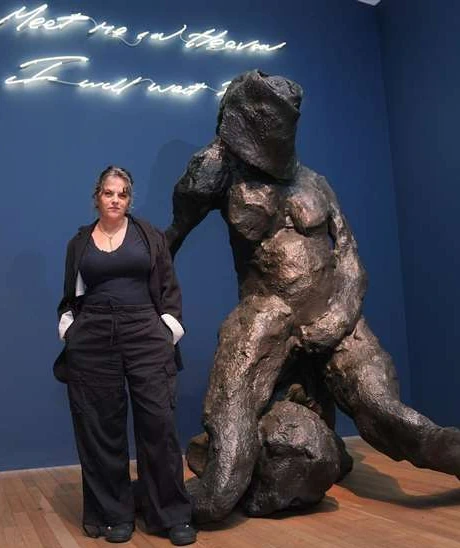
One of the most controversial, most personal and perhaps most daring voices of British contemporary art, Tracey Emin, was born on July 3 1963 in London. As the daughter of an English mother and a Turkish Cypriot father Emin grew up partly in Margate and partly in London. Her childhood and youth were extremely tough; economic fragility, family breakdown and traumatic experiences she had at a young age became the raw material of her art. Choosing to make this personal history completely visible instead of hiding it or putting it under an artistic veil Emin caused a deep rupture in the art world.
Having studied art at Maidstone College of Art and the Royal College of Art Emin was part of the most active period of British art in the early 1990s along with Damien Hirst and other Young British Artists. But Emin's position in this movement was special; because she developed an autobiographical and confessional language instead of leaning on the conceptual or shock tactics of the other members of the group. This language earned her both harsh criticism and a deep fan base. Being nominated for the Turner Prize, being elected to the Royal Academy of Arts and receiving one of Britain's highest civilian honors were signs that institutional art had finally fully embraced Emin.
My Bed: The Work Pushing the Limits of Art
The work that made Tracey Emin's name known to the international public is the piece titled "My Bed" produced in 1998. This installation consisting of Emin's real bed was exhibited with rumpled sheets, cigarette butts, vodka bottles, underwear and other personal objects. These objects around the bed were authentic remains of the days Emin spent on the verge of emotional collapse and suicidal thoughts. This work included in the Turner Prize exhibition started a big discussion in the British public.
While some of the critics said "this is not art" others praised the emotional honesty and courage of the work. Emin took a stance in this discussion that made it mandatory to face questions about what counts as art and what does not. "My Bed" was finally sold for about two and a half million pounds at auction in 2014 and is currently in the hands of a collector. The work maintains its place among the most controversial and most iconic studies of contemporary British art.
Everyone I Have Ever Slept With and Other Works
Another important work of Emin is the tent installation titled "Everyone I Have Ever Slept With 1963-1995" produced in 1995. The inner surface of this blue tent which can be entered was covered with appliqué where Emin embroidered the names of all the people she had slept with throughout her life. This list included not only sexual partners but also her mother, grandmother, her child sibling and even the baby she aborted. This inclusive approach turned the superficial interpretations based on the name of the work upside down. Unfortunately this work was destroyed in the fire at the Momart warehouse in 2004; this loss went down in history as one of the greatest destructions of the contemporary art world.
Emin's neon text works are also an inseparable part of her artistic identity. The neon texts that look like they were written by hand convey themes of love, loneliness, desire and destruction in a direct and raw language. Neon works like "I Promise to Love You" and "You Loved Me Like a Fly" are among the works that reveal Emin's artistic language in the purest and most accessible way. These neon texts are today in collections and museums all over the world; they have also become Emin's most recognized visual images.
Intersection of Personal Life and Art
For Tracey Emin the border between art and life is extremely thin and permeable compared to other artists. Every work of hers is a direct reflection of a specific moment, emotion or relationship in her life. While this confessional approach turns her into a figure criticized as narcissistic or exhibitionist in some circles for others exactly this originality is seen as the most valuable and rare feature of her art.
Emin who was diagnosed with cancer in 2016 also carried this experience into her art. The disease process is clearly felt in her recent works. This new layer about the transience of life, the fragility of the body and death anxiety has deepened Emin's artistic agenda while expanding it. Tracey Emin still continues to produce and both fascinate and disturb the art world today.
Tracey Emin's Contribution to Art
Tracey Emin made her most important contribution to contemporary art by both legitimizing the autobiographical and confessional understanding of art and carrying it to the international arena. There were artists who carried personal experiences into their art before her; but what Emin did is to present this personality directly and in a raw way without putting any aesthetic veil or conceptual distance. This honesty proves that art can be measured not only with formal perfection or conceptual intelligence but also with existential courage.
Tracey Emin's legacy finds its place in every serious discussion handling issues of art, identity and gender. The path she opened has offered a ground of deep courage and legitimacy to the next generation of artists regarding putting their own stories and vulnerabilities at the center of their art. It is not a sculpture; but every work she created is in a sense her most honest and most permanent sculpture.
Date Added: