Samuel de Champlain Statue - Ottawa Canada
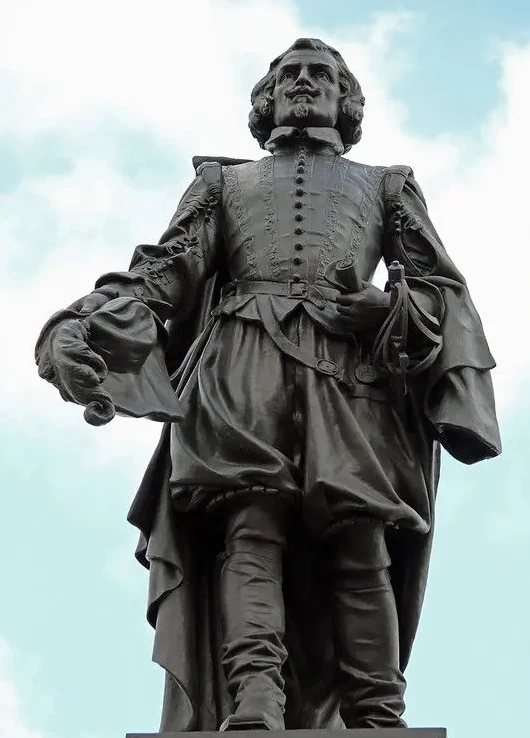
The capital of Canada, Ottawa, is an extremely rich city from a historical perspective, and this richness is clearly evident in the statues reflected in its public spaces. Among these statues, one of the most striking and controversial is undoubtedly the Samuel de Champlain statue. Rising on a hill overlooking the Ottawa River at Nepean Point, this statue depicts Champlain holding an astrolabe and looking toward the horizon. The location was chosen very deliberately; this spot overlooking the city panorama on the riverbank is in perfect harmony with Champlain’s identity as an explorer. The statue was erected in 1915 and has continued to be one of Ottawa’s most recognized symbols for over a century.
However, this statue stands out not only as an artistic monument but also as the focal point of a deep historical and political debate. The astrolabe Champlain holds in his hand is one of the most interesting and controversial elements of the statue. For many years, it was accepted that an astrolabe found near Ottawa in 1867 belonged to Champlain; however, later research revealed that this claim is highly doubtful. Despite this, the statue continues to portray Champlain with this instrument. This detail is an interesting example of how history is sometimes shaped in public memory by intertwining with myths.
Who is Samuel de Champlain
Samuel de Champlain was born in France in 1574 and went down in history as the founder of New France. His founding of Quebec City in 1608 formed the cornerstone of French colonization in North America. Champlain was not only an explorer; he was also a talented cartographer, an experienced diplomat, and a visionary colonizer. The relations he established with the Indigenous peoples were relatively peaceful by the standards of the time; however, it is a historical fact that these relations became a tool of colonialism in the long run. Today, Champlain is recognized as a symbol of Canada’s French-speaking identity, Quebec culture, and French-Canadian heritage.
The statue in Ottawa has moved back to the center of the agenda in recent years. At the base of the statue, directly below Champlain, is a figure of a crouching Indigenous guide. This design has been harshly criticized by Indigenous communities and historical researchers. Critics argue that this arrangement visually reinforces a colonial hierarchy and depicts Indigenous peoples in a secondary position. This debate directly overlaps with the movement to question the legacy of colonialism that has gained momentum in Canada in recent years. In this context, the Champlain statue has gone beyond being just a monument; it has become a symbol of a social debate on how Canada should confront its past.
Demands for the statue to be repositioned or completely removed occasionally come to the fore. Some groups suggest redesigning the pedestal, depicting the Indigenous guide figure in a more dignified way, or adding an additional information plaque to the statue. While the City of Ottawa is following these discussions carefully, no physical changes have been made to the statue so far. This process reveals how complex and sensitive the tension between public memory and historical justice is.
Despite all these controversies, Nepean Point remains one of the places that those visiting Ottawa must stop by. Its panoramic view overlooking the river and the city offers breathtaking beauty, especially at sunset. The Champlain statue is an integral part of this landscape; the natural beauty surrounding it makes the historical weight the monument carries both more visible and more thought-provoking. As visitors stand in front of the statue, they are looking not just at a figure carved in stone, but at the entire complexity, contradiction, and depth of Canada's founding story.
Date Added: