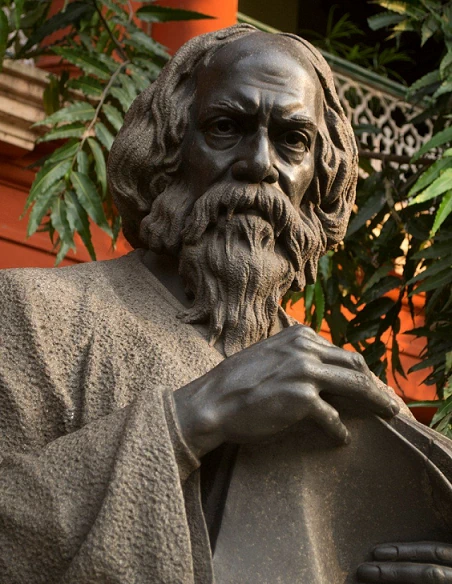
Rabindranath Tagore Statue - India - Kolkata
In the history of literature, there are names that define an era not only through what they wrote but through the very fact of their existence. Rabindranath Tagore is precisely such a name. Born on 7 May 1861 as a child of the deeply rooted and wealthy Tagore family of Kolkata, Rabindranath grew up in an environment where art and thought were almost breathed in the air. His father, Debendranath Tagore, was one of the leaders of Brahmo Samaj, the foremost religious reform movement of the era. His elder brothers were poets, musicians and novelists. The home was a space open to intellectual debate, musical performance and a passion for literary creation. In this environment, the young Rabindranath both nourished himself and matured, while instinctively striving to find his own voice.
Tagore never fully adapted to conventional school education. He possessed a mind that could not be contained within the four walls of a classroom; he regarded nature, music and poetry as his greatest teachers. For this reason, although his family tried to send him to various schools, he could not remain in any of them for long. The greater part of his education was completed through private tutoring at home and self-directed reading. This unconventional form of education is one of the most important factors explaining the boundless freedom of his thought. Tagore was a student not of institutional knowledge, but of experience, observation and imagination.
The Nobel Prize and Gitanjali
The name of Rabindranath Tagore is most widely known around the world for the Nobel Prize in Literature he won in 1913. This prize was the first Nobel Prize in Literature awarded to a writer from Asia, and it had the effect of an earthquake in the literary world. The work that earned him the prize was the poetry collection titled "Gitanjali" meaning "Song Offerings." Tagore had written these poems originally in Bengali, but later translated them into English himself. These translations allowed the Western world to look upon Indian poetry and its mystical tradition with fresh eyes.
Although the poems in Gitanjali may appear at first glance to contain religious themes, they in fact give voice to a far deeper human experience. Address to God, union with nature, peace in the face of death and the transience of life these themes acquire a universal dimension in Tagore's pen. The language of the poems is plain yet powerful; the images are concrete but the layers of meaning run deep. The Nobel Committee described Tagore as someone who, "by virtue of his profoundly sensitive, fresh and beautiful verse, has made his poetic thought, expressed in his own English words, a part of the literature of the West." This description remains one of the most powerful summations of his literary identity.
The Man Who Wrote the National Anthems of Two Countries
One of the most striking qualities that sets Rabindranath Tagore apart from all other writers is that he authored the national anthems of two different countries. India's national anthem "Jana Gana Mana" and Bangladesh's national anthem "Amar Shonar Bangla" both flowed from Tagore's pen. There is no known instance in history of another writer having composed the national anthems of two independent states. This unique circumstance clearly reveals how extraordinary a figure he was not only in literary terms but in cultural and political dimensions as well.
Jana Gana Mana was performed for the first time in 1911 at a session of the Indian National Congress. The poem's structure, which foregrounds a universal humanist emphasis and a theme of unity, laid the groundwork for its adoption as India's official national anthem after independence. Amar Shonar Bangla, meanwhile, became the national anthem of Bangladesh following that country's attainment of independence in 1971. This poem was a deep expression of love for the land and culture of Bengal; when Tagore wrote it, no state called Bangladesh yet existed, yet the poem settled into the exact spirit of that moment as though it had been waiting for it.
Where Is the Rabindranath Tagore Statue?
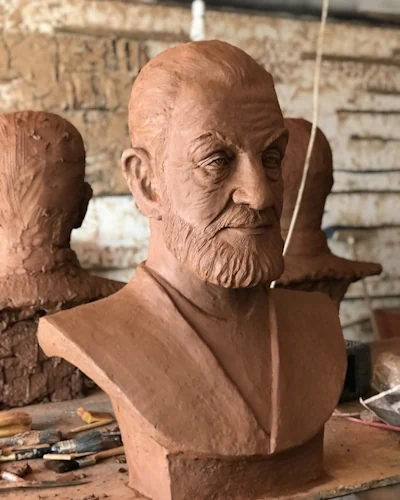
Kolkata is for Tagore not merely a city but the dwelling place of his soul. The family mansion in the Jorasanko neighbourhood has today been transformed into the Rabindra Bharati Museum, retaining its distinction as the most comprehensive space documenting Tagore's life, works and art. In the surroundings of this museum and at numerous points throughout Kolkata, statues dedicated to Tagore can be found. These statues typically depict him with his long hair and beard, his contemplative gaze and an elegant bearing an appearance that simultaneously reflects both his identity as a sage and as a poet.
Every year on the 25th of Baishakh Tagore's birthday according to the Bengali calendar grand celebrations are held in Kolkata. The ceremonies performed before the statue, Rabindra Sangeet concerts and poetry recitation events transform this day into something almost sacred for Kolkata. It is possible to encounter his traces in every corner of the city; street names, cultural centres and schools keep his name alive. In this sense, Tagore's statue is not merely a monument but a mirror in which Kolkata gazes upon its own identity.
What Does His Legacy Mean Today?
Rabindranath Tagore passed away in Kolkata on 7 August 1941. Yet the legacy he left behind carries a weight of the kind that renders him immortal. His poems are still fresh and vibrant today; his music is still sung; his philosophy of education is still debated. Every day in India and Bangladesh, millions of people recite the national anthems he wrote, forging through these songs an invisible yet powerful bond with Tagore.
On the international stage too, interest in Tagore has not diminished. His works have been translated into dozens of languages, hundreds of academic studies have been conducted about him, and he continues to serve as a point of reference in respected literary circles in many countries. Tagore's legacy is one of the most powerful proofs that art knows no borders that a person can both plunge into the depths of their own culture and speak to all of humanity. His statue in Kolkata is the most visible, most accessible and perhaps most moving expression of this universal legacy. That statue speaks quietly yet profoundly to every person who loves poetry, music and thought.
Date Added: