Niki de Saint Phalle - French Sculptor
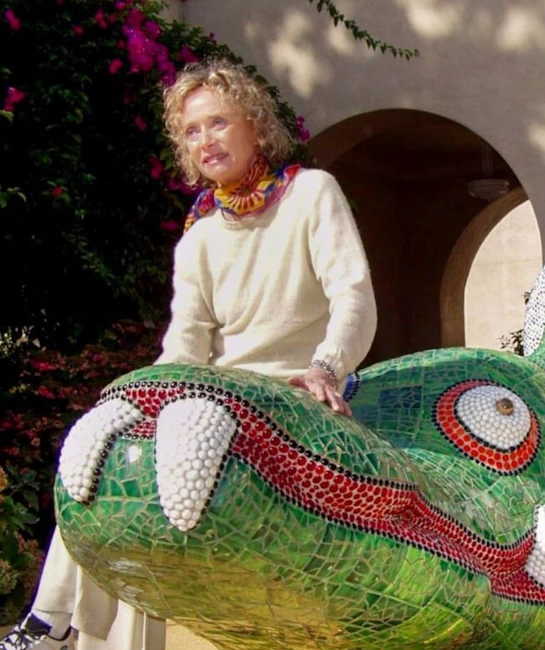
Niki de Saint Phalle is one of the most vibrant, liberated, and courageous voices of 20th-century sculpture. Born in 1930 in Neuilly-sur-Seine near Paris, Saint Phalle succeeded in shaking both the art world and social norms with works produced entirely from her internal drive, bypassing traditional art education and academic constraints. Her art is a fascinating blend of anger born of pain, the rediscovery of femininity, rebellion against gender roles, and an boundless joy for life. For her, color was not merely an aesthetic choice; it was a stance, a voice, and a declaration of freedom. Her giant, voluptuous "Nana" figures, eye-catching mosaic-covered sculptures, and the legendary Tarot Garden in Tuscany are among the most striking examples reflecting both the visual and conceptual richness of Saint Phalle’s art.
Who is Saint Phalle? Her Artistic Journey and Masterpieces
Following a career in modeling, Niki de Saint Phalle turned to spontaneous art production, gaining initial recognition for her performance pieces titled "Tir" (Shooting Paintings). These works, created by firing a rifle at plaster surfaces embedded with bags of paint, were expressions of a provocative artistic attitude that combined both violence and the act of creation. This move was also a manifestation of personal rebellion—an artistic release of the anger generated by childhood traumas, the roles society imposes on women, and the inability to express herself. In the period that followed, Saint Phalle turned toward large, colorful, and cheerful female figures she called "Nanas." These figures serve as a powerful response to social pressure regarding thin and idealized female bodies, representing the intersection of feminism and artistic language with their full-figured and confident stances. Her artistic and life partnership with Swiss painter and sculptor Jean Tinguely led to many collaborative projects, including the Stravinsky Fountain in front of the Centre Pompidou in Paris, which remains one of her most significant works.
Technical Mastery and Contribution to Sculptural Art
Saint Phalle's technical approach diverged radically from traditional sculpting methods. Utilizing polyester, glass mosaics, mirror fragments, painted metal, and various industrial materials, she pushed the boundaries of sculpture beyond conventional materials. The Tarot Garden, which she established with her own hands in the Capalbio region of Italy and transformed over the years into a park of 22 monumental sculptures, is considered her most comprehensive and personal masterpiece. Inspired by tarot cards, this park—with its organic forms reminiscent of Gaudí’s spirit, its vibrant colors, and its magical atmosphere—has become a major destination for international art tourism. Saint Phalle passed away in San Diego in 2002, leaving behind a unique legacy that proves art possesses an extraordinary power to transform anger into joy and pain into freedom.
Date Added: