Katsura Funakoshi - Japanese Sculptor
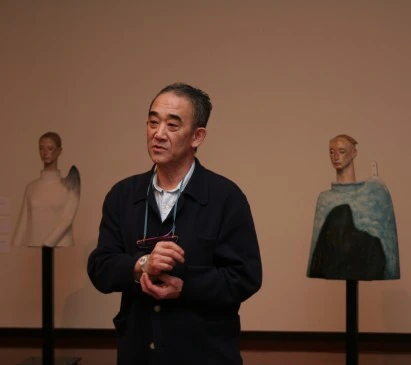
Katsura Funakoshi, one of the most original and compelling voices in contemporary sculpture, was born in 1951 in Morioka, Japan. The son of a sculptor, Funakoshi deepened his relationship with art both within his family environment and during his education at the Tokyo University of the Arts. However, what makes him unique in the world of contemporary sculpture is not just what he learned or where he came from, but the fact that he developed an entirely distinct visual language. His human figures, produced through a combination of wood and marble, blend Western sculptural traditions with Japanese aesthetics so profoundly and naturally that anyone standing before his works feels as if they have found themselves in a world that is simultaneously familiar and completely alien.
Artistic Identity and Style
What makes you pause when you first see Funakoshi's works is the facial expression of the figures. Neither fully sad nor happy, neither entirely in this world nor in another. This ambiguity is intentional; for years, the artist has sought to translate that thin, indefinable space between consciousness and existence into a visual language. Marble heads placed upon wooden torsos bring the natures of two different materials together in one body; the warmth and organic texture of the wood combined with the cold, enduring character of the marble gives the works a sense of being both fragile and immortal. Using this duality as a deliberate and conscious choice, Funakoshi establishes a balance that few artists in the history of sculpture have achieved.
The scale of his figures is also a noteworthy choice. Kept slightly smaller than life-size, these figures leave a gentle but distinct distance instead of establishing an equal dialogue with the viewer. This distance grants the works an emotional rather than a physical remoteness. Funakoshi’s figures do not look at you, they do not see you, yet somehow they make their presence felt. This paradoxical feeling is the most powerful and distinctive dimension of his art.
International Recognition and Exhibitions
Today, Funakoshi's works are held in leading art museums and private collections worldwide. The Venice Biennale, Art Basel, and numerous international galleries regularly feature his work. While the artist has a strong following in Japan, he also commands significant collector interest in Europe and America. The slow and meticulous production process of his work makes his pieces both rare and highly valuable. Funakoshi produces only a few works a year; this slowness is perfectly consistent with his philosophy. Choosing a deliberate slowness in an age of speed is a significant attitudinal decision that increases the thought-intensity of the works.
Contribution to Sculptural Art
Funakoshi's greatest contribution to the world of sculpture is the way he synthesizes the aesthetic traditions of the East and the West. The Western figurative sculpture tradition, the spiritual dimension of Japanese Buddhist sculpture, and the Shinto perspective on the relationship between nature and humanity form layers in his work that can be identified individually but remain inseparable. This synthesis is organic, not artificial; Funakoshi is an artist raised within these different traditions who has assimilated them into his own mental world. Consequently, the resulting works create a deep resonance in the viewer, regardless of their cultural background. This universality is perhaps the most precious quality of his art.
Date Added: