Kara Walker - American Sculptor
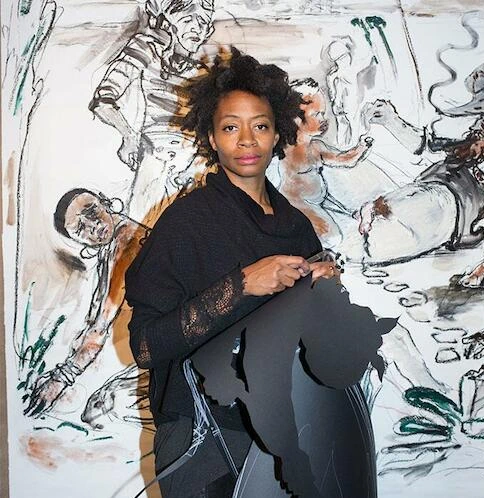
One of the most daring and disturbing voices of American contemporary art, Kara Walker, was born on November 26 1969 in Stockton California. As the daughter of Gwendolyn Walker and Larry Walker who was an artist and art professor, Kara grew up in an environment where art was an inseparable part of her family’s daily life. However the real transformation began when the family moved to Atlanta in 1983. Feeling the deep racial tensions, historical burden and social layering of the American South for the first time in this city Walker carried the traces of this experience into her art for decades. Life in Atlanta presented her with a portrait of America completely different from the relatively liberal atmosphere of Northern California.
After completing her undergraduate education at Atlanta College of Art Walker did her master's at Rhode Island School of Design. Immediately after her graduation in 1994 she began to attract the attention of the art world. When she was only twenty-six years old she won the MacArthur Foundation Genius Grant; this award is one of the most prestigious recognitions in the art world and clearly shows what a powerful impression Walker left in the international arena early in her career. Today serving as a faculty member at Columbia University Walker continues her presence as both a productive artist and an influential educator.
Artistic Language: Silhouette and Historical Memory
At the center of Kara Walker's artistic identity lies the cut paper silhouette technique. This technique creates a decorative and almost childish impression at first glance; but Walker uses this innocent-looking form as a conscious tool to handle the darkest and most painful dimensions of American history. These works produced as black silhouettes on white paper or white silhouettes on black paper process themes of slavery, race, gender, power and violence simultaneously. The duality of color is not just an aesthetic choice; it is a deliberate and powerful reference to racial binary.
In Walker's art the American South before the Civil War meaning the antebellum period holds a central place. She visualizes the slavery practice of this period, the master-slave relationships and the violence and sexuality these relationships contain in a direct and jarring language without covering anything up. The works sometimes use a language open and raw enough to disturb the viewer; but this discomfort is intentional. For Walker art means pulling away the civilized veil covering history and making it mandatory to look directly at the reality beneath. This attitude has gained her both a strong fan base and harsh critics.
A Subtlety: Sugar and Slavery
One of the most striking turning points in Kara Walker's career is her installation titled "A Subtlety" which she realized in 2014 at the Domino Sugar Factory in New York. In this historical factory space opened for use for the last time before being demolished Walker created a massive sphinx figure. Built entirely of white sugar this figure combined the Egyptian sphinx with the Mammy archetype and opened the historical bond between slave labor and the sugar industry to direct questioning. The small molasses figures placed around it were complementary elements reinforcing this narrative.
The exhibition remained open for six weeks and attracted over eighty thousand visitors. Images that went viral on social media brought along discussions about how visitors approached the work as much as its artistic dimension. The fact that some visitors took and shared funny photos with the parts of the figure carrying sexual connotations ignited a deep debate in the art world. This debate once again revealed how multi-layered and provocative Walker's work is. A Subtlety has gone down in records as one of the most important installation works in contemporary art history.
Other Important Works
Walker's giant-sized silhouette works have been exhibited in leading museums of the world and gallery spaces. Her works included in the collections of institutions like the Museum of Modern Art, Guggenheim and Tate Modern continue to attract intense interest from art critics and academics. However Walker has not remained limited to the silhouette technique; she has also produced powerful works in the fields of video installation, painting, sculpture and illustration.
The Turbine Hall installation she realized at London's Tate Modern in 2019 also created a great splash. This work called Fons Americanus was a massive fountain sculpture designed as a response to the Victoria Memorial in London, dealing with the history and consequences of the Atlantic slave trade. The work processed European imperialism, the slave trade and the traces of this history extending to the present with a bold and complex visual language. Rising in that giant space of Tate Modern this fountain both fascinated the viewer and invited them to a deep questioning.
Kara Walker's Contribution to Art
Kara Walker made her most important contribution to the American art world by developing an original language that handles issues of race, history and memory in a way that is both aesthetically strong and intellectually honest. There were artists who processed race and slavery themes before her; but Walker's approach maintains a unique balance that reduces these themes neither to a victim narrative nor to an angry slogan. In her works history is both cursed and analyzed; both pain is felt and the source of this pain is looked at honestly.
Kara Walker's art today does not remain limited to art galleries only; it continues to be a reference point in academic curricula, social justice discussions and every serious platform dealing with the issue of historical memory. Those works are rare examples that facilitate America's confrontation with itself, make this confrontation feel mandatory and make this process possible with the possibilities of art. Walker has never pushed the social responsibility of art to the background; she has placed this responsibility at the very center of her works.
Date Added: