John A. Macdonald Statue - Ottawa Canada
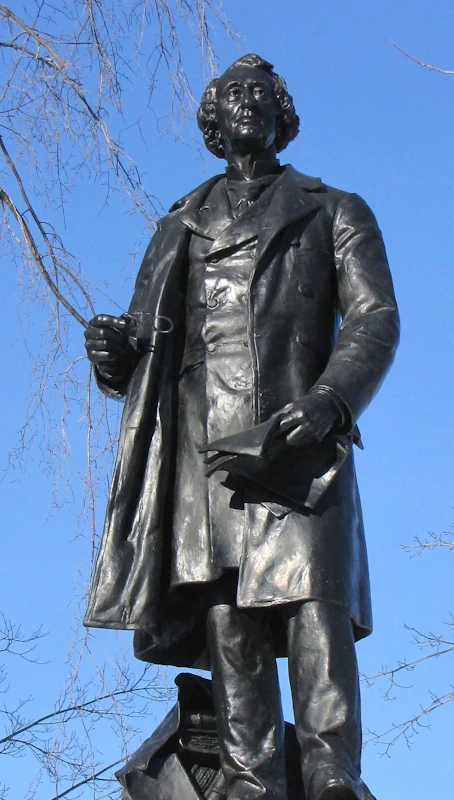
In Canada's capital, Ottawa, Parliament Hill is the place where the country's political and historical identity is most intensely felt. Among the statues rising on this hill, the most central and symbolic is undoubtedly the John A. Macdonald statue. Rising in the heart of the city, right in front of the parliament building, this statue depicts Macdonald in a formal stance, holding documents in his hand. The location is not coincidental; Macdonald's political genius and decisive role in the Canadian Confederation make him worthy of standing right in front of this building, on the threshold of the place where the country's founding documents were prepared. For decades, the statue has remained one of the most powerful images embodying Canadians' sense of national pride.
Who is John A. Macdonald
Sir John Alexander Macdonald was born in 1815 in Glasgow, Scotland, and immigrated to Canada with his family at a young age. After studying law in Kingston, Ontario, Macdonald soon stepped into the political arena and drew attention with his extraordinary negotiation skills. His decisive role in the establishment of the Canadian Confederation in 1867 marked him in history as the architect of modern Canada. He became Canada's first Prime Minister that same year and held this office for a total of nearly nineteen years across two separate terms. During his tenure, he completed the country's railway network stretching from east to west; this massive project was perhaps the most critical physical infrastructure investment in shaping Canada as a continental nation.
Macdonald's statue in Ottawa does not only keep the memory of a political leader alive; it is also a visual summary of Canada's nation-building process. When considered together with other statues and monuments on Parliament Hill, this area functions almost as an open-air history museum. When foreign heads of state and diplomats visit Canada, ceremonies are held on this hill; Macdonald's statue becomes an almost indispensable backdrop for these ceremonies. In this context, the Macdonald statue is not only a national symbol but also a part of international protocol and the identity Canada presents to the outside world.
However, like Champlain, Macdonald's legacy has become the focus of deep scrutiny in recent years. The Indigenous residential school system, implemented during his premiership, is today considered one of the darkest pages of Canadian history. Under this system, thousands of Indigenous children were torn from their families, forbidden from speaking their own languages, and distanced from their cultural identities. As cases of physical and psychological abuse in these schools came to light over the years, Macdonald's role in this policy began to be questioned more and more. The discovery of hundreds of unmarked children's graves at former residential school sites across Canada in 2021 brought this debate to a new dimension.
Following these developments, Macdonald statues became a subject of debate in many Canadian cities. In cities like Montreal and Victoria, some Macdonald statues were removed or temporarily put into storage. The Parliament Hill statue in Ottawa, however, has remained in place so far. The federal government maintains a stance toward adding informational materials that convey the historical context more comprehensively instead of removing the statue. This debate brings to the fore questions of how a nation should evaluate its founding fathers and how the achievements and crimes of historical figures can be handled simultaneously.
For every tourist and every Canadian citizen visiting Parliament Hill, the Macdonald statue is an inevitable stopping point. Throughout the year, there is no shortage of visitors taking photos around the statue, students coming on school trips, and officials participating in national ceremonies. Covered in snow during the winter months, the statue maintains its grandeur even in Canada's harsh climate; paradoxically, this image gives it an even stronger and more permanent character. The John A. Macdonald statue continues to be one of the most visible symbols of Canada's past—one that it both takes pride in and struggles to confront. That statue reminds us not only of how far a nation has progressed but also how much distance it still needs to cover.
Date Added: