Harriet Tubman Statue - USA New York
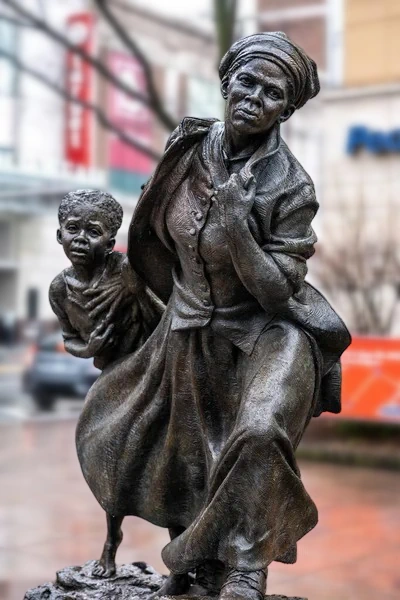
New York, as one of the world's largest and most visited cities, is home to many historical monuments and statues. Among these monuments, the Harriet Tubman statue, which has come to prominence remarkably in recent years, has been woven into the cultural fabric of New York as one of the most powerful symbols of not just a woman, but of courage, sacrifice, and human dignity. The statue of Tubman, who was born into slavery, managed to escape, and then repeatedly risked death to bring dozens more to freedom, is a silent but powerful cry raised against America's darkest historical period.
One of the most striking monuments dedicated to Harriet Tubman is located in the Harlem neighborhood of New York, at the intersection of 122nd Street and Frederick Douglass Boulevard. This statue, unveiled in 2008, was created by the artist Alison Saar. The statue depicts Tubman with her arms wide open, rising toward the sky and freedom. The pedestal beneath the figure consists of images of chains and burdens symbolizing slavery; this detail powerfully conveys how Tubman won both her own freedom and the freedom of others.
Design and Artistic Language of the Statue
The Harriet Tubman statue designed by Alison Saar has a unique and powerful artistic language that transcends the traditional understanding of monumental sculpture. The figure, produced from bronze, depicts Tubman with her feet planted firmly on the ground and her arms wide open; this stance simultaneously expresses both embrace and struggle. The images symbolizing slavery located in the lower section of the statue add a historical weight and depth to the work. In this piece, the artist Saar has positioned Tubman not just as a historical figure, but as a universal symbol of freedom. When considered in harmony with the cultural fabric of Harlem, the statue adds layers of both aesthetics and meaning to its location.
The Harlem neighborhood where the statue is located carries a special meaning as the historical center of the cultural and artistic life of African Americans. In this context, the placement of the Tubman statue in Harlem is not a coincidence, but a conscious and meaningful choice. This space, which forms an integrated public area with the surrounding trees, benches, and walking paths, is both a daily meeting point for New Yorkers and a deep point of contact established with history.
Harriet Tubman: Guide of the Path to Freedom
The figure depicted by the statue is Harriet Tubman, who was born into slavery in the state of Maryland around 1822. Born Araminta Ross, Tubman succeeded in escaping to the northern states in 1849. However, her story did not end there; after gaining her freedom, she returned to the south repeatedly, entering slave states using the secret escape network known as the Underground Railroad, and each time she carried dozens of people to freedom with her. It is estimated that Tubman conducted approximately 13 missions, bringing more than 70 slaves to freedom, and was never captured.
During the Civil War, Tubman served as a spy and rescue operative for the Union army and personally led the Combahee River Raid operation, ensuring the freedom of more than 700 slaves. After the war, Tubman also struggled for the women's suffrage movement and passed away in 1913 at approximately 90 years of age. Considered one of the bravest and most influential figures in American history, Tubman's portrait was planned to be moved to the 20-dollar bill in the 2020s; this decision confirmed once again her permanent place in national memory.
Cultural Heritage and Tourist Value
The Harriet Tubman statue has become one of New York's most important cultural and historical sites. Every year, thousands of visitors come to Harlem to see this statue and confront Tubman's extraordinary life. Within the scope of Black History Month activities, human rights festivals, and educational programs, the statue becomes a focus of intense interest. For history and culture enthusiasts visiting New York, the Tubman statue constitutes one of the most valuable stops on Harlem's tourist route. That statue is the permanent expression, transformed into stone and bronze, of one of the deepest marks a woman etched into human history with limitless courage and sacrifice.
Date Added: