Christ the Redeemer Statue - Brazil - Rio de Janeiro
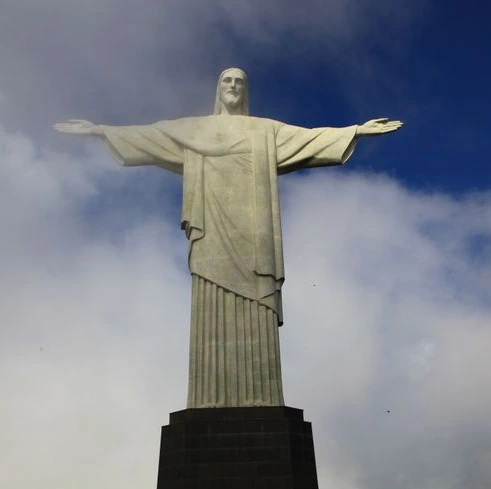
The Christ the Redeemer Statue represents Jesus Christ, a central figure in the Christian faith. According to Christian belief, Jesus was sent by God as the savior of humanity and was crucified to cleanse mankind of sin. The statue's outstretched arms symbolize Jesus embracing all of humanity with love and acceptance. This pose is widely interpreted as a symbol of forgiveness, love, and peace within Christianity.
In Christian theology, Jesus Christ is regarded as both human and divine. Believed to have lived in the lands of Palestine roughly two thousand years ago, his teachings form the foundation of Christianity, a faith followed by a large portion of the world's population today. The statue in Rio de Janeiro has become a visual and cultural symbol of this belief. Its calm and peaceful facial expression was specifically designed to reflect the compassion and mercy associated with Jesus.
For the predominantly Catholic population of Brazil, the statue is not only a religious symbol but also a part of national identity. Over the years, it has become a cultural heritage site visited by millions of people, extending its significance far beyond religious meaning.
Christ the Redeemer Statue: General Information
The Christ the Redeemer Statue is a world-famous landmark located atop Corcovado Mountain in Rio de Janeiro, Brazil. The statue stands at an elevation of approximately 710 meters above sea level and is visible from nearly every part of the city. Including its pedestal, the structure reaches a total height of 38 meters, with its outstretched arms spanning 28 meters.
Construction began in 1922 and was completed in 1931, when the statue was officially opened to the public. It was built using reinforced concrete and a special stone material known as soapstone. This material was chosen for its durability as well as its bright appearance under sunlight. Over the decades, the statue has undergone periodic repair and maintenance work to withstand natural wear from weather conditions.
In 2007, the Christ the Redeemer Statue was named one of the New Seven Wonders of the World, an achievement that further boosted its global recognition. Visitors can reach the statue via a dedicated train line, a roadway, or hiking trails starting from the base of the mountain. From the summit, visitors are rewarded with a panoramic view of Guanabara Bay, Copacabana, and Ipanema beaches.
This world-famous statue also features a nighttime lighting system that creates a striking visual display after dark. On special occasions, the statue is illuminated with colorful lighting themes, keeping it consistently in the spotlight across local and international media. Millions of tourists visit Rio de Janeiro each year specifically to see this landmark, making a significant contribution to the city's tourism economy.
Who Built the Statue? Design and Construction Process
The idea for the Christ the Redeemer Statue emerged in the 1920s within Catholic Church circles in Brazil as a response to growing secular trends in the country. While several design proposals were considered, the final concept was developed by Brazilian engineer Heitor da Silva Costa. Da Silva Costa laid the groundwork for the project by designing the statue with open, cross-shaped arms.
The facial features and overall body proportions of the statue were crafted by French sculptor Paul Landowski. Landowski meticulously designed the facial expression and bodily proportions of Jesus, elevating the artistic value of the work. Romanian engineer Gheorghe Leonida also contributed to the engineering aspects of the project. The combined efforts of these three individuals shaped the statue into the form we recognize today.
During construction, the individual parts of the statue were first designed and produced in France, then shipped to Brazil and assembled at the summit of Corcovado Mountain. Given the technological limitations of the era, this logistical process is considered a remarkable engineering achievement. Hundreds of workers were involved throughout the construction, which spanned nine years before the statue was finally completed.
Today, the Christ the Redeemer Statue stands as more than just a religious symbol; it is recognized as a shared heritage where engineering and art intersect. Listed as a UNESCO World Heritage Site, it remains one of the most visited tourist attractions in Brazil. Conservation and restoration efforts for the statue are regularly supported by the Brazilian government and local organizations.
Date Added: