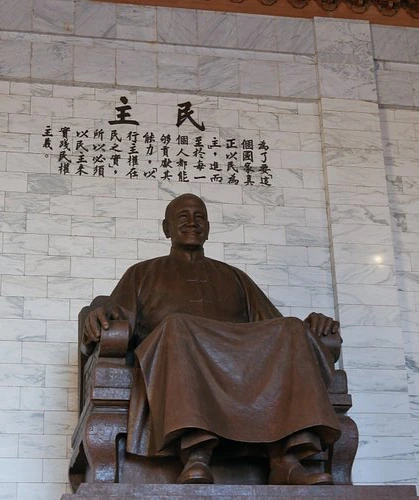
Chiang Kai-shek Statue – Taiwan Taipei
Rising at the eastern end of the vast open space known as Liberty Square, at the historic and political heart of Taipei, the capital of Taiwan, this white marble structure houses one of Taiwan's most controversial yet most magnificent and significant historic landmarks. Chiang Kai-shek, leader of the Kuomintang (KMT) Nationalist Party and founder of the Republic of China in Taiwan, was born in 1887 and ruled Taiwan until 1975. Taipei is today home to a grand memorial hall dedicated to him, widely regarded as one of the most striking monumental structures in the world. This landmark has become an unmissable stop for history enthusiasts and tourists visiting the city.
Construction and History of the Memorial
Following Chiang Kai-shek's death on April 5, 1975, the government established a funeral committee and resolved to construct a grand memorial in his honor. Architect Yang Cho-cheng's design was selected through an open competition. Inspired by the Sun Yat-sen Mausoleum in Nanjing, the design blends traditional Chinese architectural elements with a modern interpretation. Construction began and the memorial hall was officially inaugurated on April 4, 1980, the fifth anniversary of Chiang's death. The complex spans more than 240,000 square meters and is located in Taipei's Zhongzheng District.
Features and Artistic Details of the Sculpture
On the upper floor of the memorial hall sits a colossal seated bronze statue, reminiscent of the Lincoln Memorial. The monument itself reaches 70 meters in height from base to crown, distinguished by its four-sided white marble body and an octagonal blue-tiled roof. The octagonal form of the roof references the number 8, a symbol of abundance and good fortune in Chinese culture. Each staircase leading to the main entrance has 89 steps, representing the age at which Chiang died. The boulevard stretching before the memorial, together with the National Theater and National Concert Hall, forms the most magnificent urban axis in Taiwan.
Liberty Square and Surroundings
The memorial stands at the eastern end of Liberty Square, with the National Theater to the north and the National Concert Hall to the south. The gate at the western entrance to the square, once inscribed with "Great Centrality and Perfect Uprightness," has displayed the inscription "Liberty Square" since 2007. The square served as the epicenter of pro-democracy protests of historic significance during Taiwan's democratization process in the 1980s and 90s, becoming the gathering point of social movements that heralded the country's first democratic elections in 1996. The memorial is within walking distance of Chiang Kai-shek Memorial Hall Station on the Taipei Metro.
A Contested Legacy
After being defeated by Mao Zedong's communist forces in 1949, Chiang Kai-shek fled mainland China and took refuge in Taiwan, where he maintained authoritarian one-party rule. His government was marked by severe human rights abuses, most notably the February 28 Incident of 1947, in which hundreds of thousands of people lost their lives. At the same time, he is also remembered as the architect of reforms that set Taiwan on a path of economic development. Today the memorial is viewed differently across the political spectrum: the statue was doused in paint in 2018, and in 2024 the Ministry of Culture relocated the military changing of the guard ceremony from the memorial hall to the square outside, amid ongoing debates over a "cult of personality."
Visitor Information
Chiang Kai-shek Memorial Hall is located in Taipei's Zhongzheng District and is easily accessible from Chiang Kai-shek Memorial Hall Station on the Green and Red Lines of the Taipei Metro. The memorial hall and museum are open to visitors free of charge. The complex is open daily from 09:00 to 18:00.
Date Added: