Clay Relief Work Price and Sales
Clay relief is one of the most challenging and impressive branches of sculptural art. Creating depth from a flat surface, bringing figures to life in layers, and making the entire composition readable as a whole requires years of experience, a strong sense of observation, and a hand that truly commands clay. Every clay relief produced in our studio is an original work of art where these three elements come together.
From Scene to Clay Sculpture
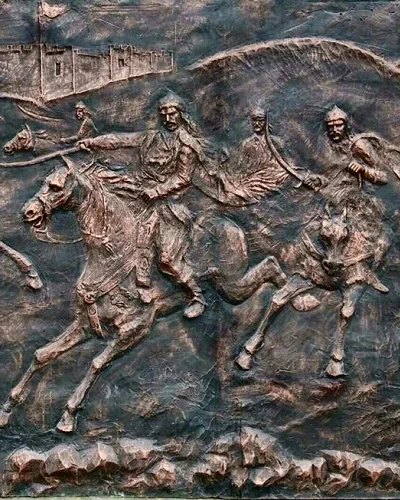
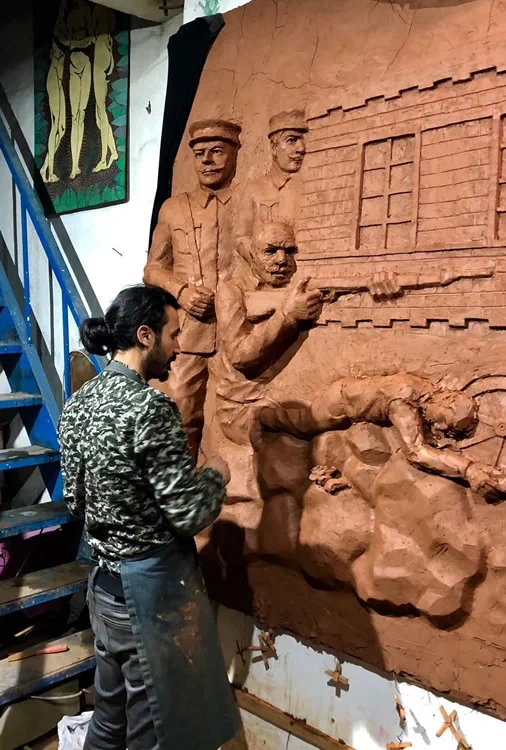
The relief work in the photograph shows the very heart of this demanding process. Our sculptor is bringing a historical scene to life on a large-scale clay surface. Figures in military uniforms have been positioned within a dramatic tension. A train carriage in the background, a fallen figure in the foreground, and the defining moment at the center; all these elements are masterfully combined on a single surface. The posture, facial expression, and costume detail of each figure have been modeled individually, and the dramatic impact of the scene has been carefully constructed.
The Challenges of Clay Relief
Producing a clay relief is a far more complex process than producing a standard sculpture. First, the entire composition is planned on paper. Where each figure will stand, the depth layers, light and shadow effects, and the balance between foreground and background; all of these are worked out before clay is ever touched. The surface is then prepared, base layers are established, and figures are modeled one by one.
The most critical point in this process is depth balance. While foreground figures project prominently from the surface, background elements are kept flatter. This difference gives the viewer a genuine sense of three-dimensionality. However, achieving this balance requires being able to see the whole at every stage. Losing sight of the rest of the composition while focusing on a single figure can disrupt the entire balance.
Large Scale, Great Responsibility
This relief work in our studio is a large-scale work that exceeds human height. Large-scale relief production requires far greater physical endurance, technical skill, and time compared to smaller works. Throughout the process, the sculptor must simultaneously manage the details at the lower sections and the figures at the upper sections by reaching up to them. Checking the composition as a whole from every angle requires the ability to constantly step back and look, and to intervene immediately when necessary.
The posture of the sculptor in the photograph illustrates this process clearly. While shaping the clay with one hand, his eyes are reading the scene as a whole. This is the most fundamental reflex of clay relief production: detail and whole must be seen simultaneously.
Historical Scenes and the Art of Relief
Clay relief is perfectly suited for conveying historical scenes. It offers a surface that is frozen yet alive, flat yet deep, silent yet narrative, much like a single photographic frame. Subjects such as military history, struggles for liberation, social events, and cultural turning points can be conveyed with extraordinary power through the art of relief. The presentation of figures together allows the context and emotional weight of the scene to be read at a single glance.
For this reason, clay reliefs are an exceptionally powerful and lasting choice for museums, memorial sites, public buildings, school and university campuses, and municipal cultural centers. These works, which give identity to the spaces where they are displayed and leave a deep impression on visitors, offer a genuine artistic experience that goes far beyond ordinary decoration.
Studio Environment and Production Process
The studio environment in the photograph clearly demonstrates just how comprehensive the clay relief production process is. A spacious and well-lit studio area is essential for large-scale works. The appropriate working environment, which allows the sculptor to move freely, assess the work from different angles, and reach elevated points when necessary, is a factor that directly affects production quality.
Our studio has the equipment and space to produce works of every scale, from small busts to large-scale reliefs. Every project is planned and managed in accordance with its own unique requirements. The clay material used is selected to ensure the longevity of the work, and the drying and firing processes are carefully monitored.
Custom Production and Orders
If you would like to have an original clay relief produced for your institution, municipality, or project, we would be delighted to design the most suitable composition together with you. All details such as subject, dimensions, number of figures, and suitability for the space are determined together at the order stage. To place a sculpture order or to obtain information, you can use the order form below, our WhatsApp line, telephone, or our contact page. We will get back to you as soon as possible.
Registration Date:
Rate:
4.3
4 Vote