Which is the Oldest Sculpture in the World?
"Which is the first sculpture?" The question sounds simple. But in the world of archaeology, the answer to this question is like a pit that deepens the more you dig. Every new find pushes history back a few thousand more years. Moreover, the examples we have are not truly the first ones made, but merely those that have managed to survive. Thousands of artworks made of wood, leather, or unfired clay have long since rotted away. Those that remain are a gift of a bit of luck and specific geological conditions.
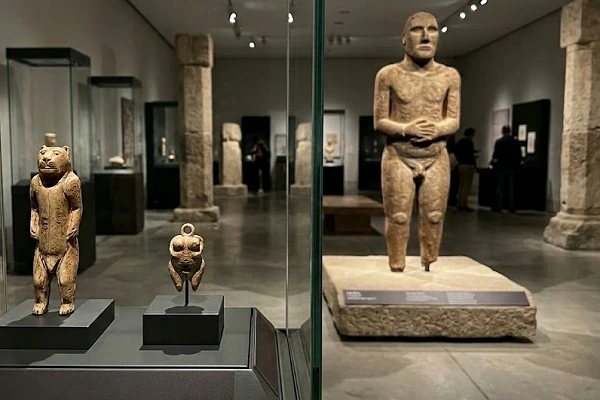
Despite this, today we possess three exceptional artworks. They are considered milestones in human history not just because they are "old," but due to the meanings they carry and the unanswerable questions they pose: the Lion-Man (Lowenmensch), the Venus of Hohle Fels, and the Urfa Man. Each comes from a different period, a different mindset. Yet behind them all is the same thing: a human who thinks, imagines, and seeks meaning.
The Lion-Man: Product of a 40,000-Year-Old Imagination
It is August 1939. Geologist Otto Volzing is excavating in Germany's Hohlenstein-Stadel Cave. On the very last day of the dig, a series of ivory fragments comes to light about 30 meters inside the cave entrance. The pieces are stuffed into a sack. But just then, history exhibits terrible timing: exactly one week after the excavation, World War II begins.
Those ivory fragments wait in a drawer at the Ulm Museum for nearly 30 years until archaeologist Joachim Hahn rediscovers them in 1969. When Hahn assembles the pieces, something striking emerges: a 30-centimeter-tall figure carved from mammoth ivory, possessing a human body but the head of a lion. The Lowenmensch. Translated: The Lion-Man.
The significance of this sculpture does not derive solely from its age. What is truly striking is this: a creature with a human body and a lion's head does not exist in nature. In other words, the person who made this piece imagined something that does not realistically exist and transformed it into a three-dimensional object. This is regarded as one of the oldest evidences of mythological thought—the human ability to bridge reality and imagination.
So, how long might it have taken to make this sculpture? Considering the primitive stone tools of that era, researchers estimate that completing the artwork took more than 350 hours. This was not merely a pleasure or leisure activity. An object upon which this much labor was expended must have held deep meaning for that community. Perhaps it was a totem, a spirit guide, or a piece of a belief system buried in history thousands of years ago, whose name we no longer even know.
Additional pieces of the sculpture were found in re-excavations in 2009, and restoration was completed. Today, in its almost complete form at 31 centimeters tall, it is exhibited at the Ulm Museum. Everyone who looks at it asks the same question: Who made this, and why?
The Venus of Hohle Fels: Headless But Full of Meaning
In 2008, an excavation team in the Hohle Fels Cave near Schelklingen, Germany, encounters an interesting object. A small, female figure, only 6 centimeters tall, made of mammoth ivory. And immediately, a detail catches the eye: it has no head.
At first glance, this might seem like a deficiency. But researchers think differently. Above the figure's shoulders, where the head should be, is a small ring. This indicates that the sculpture was designed to be hung around the neck as a necklace or amulet. Thus, the head was not forgotten, but intentionally omitted. The figure was conceived as a portable, personal, perhaps even sacred object.
The Venus of Hohle Fels is actually the oldest link in a tradition. Hundreds of similar female figurines from the Upper Paleolithic period have been found across Europe and Asia. All these figurines share common features: exaggerated breasts, wide hips, a prominent belly. Faces, on the other hand, are mostly either indistinct or absent entirely. Researchers believe these features symbolize fertility and abundance. Whether it points to the existence of a type of "mother goddess" cult is still debated.
Another interesting point regarding these Venus figurines is their distribution. Similar examples are found across a vast geography, from France to Siberia. This shows that in the period in question, communities very far apart shared similar forms of symbolic thought. How? Through migration, or did it develop independently? This question remains unanswered.
What makes the Venus of Hohle Fels particularly significant is that it is nearly simultaneous with the Lion-Man. Both artworks belong to the same culture, the Aurignacian culture. In other words, about 40,000 years ago, people living in the same era were both imagining and carving a mythological beast and making female figures as fertility symbols. This demonstrates that the thought world of that period was much richer and more complex than we might assume.
The Urfa Man: Another First in History
Our first two sculptures were made of ivory, small in scale, and portable objects. The Urfa Man stands in a completely different category. Found around Balikligol in the Sanliurfa province of our country, Turkey, this sculpture has been dated to approximately 11,000 years ago and holds the title of the oldest known life-sized human sculpture.
Carved from limestone, it is a male figure standing upright, about 1.80 meters tall, with hands clasped in front, and an expressionless face. Obsidian stone was used in the eyes; looking at this dark, deep gaze today, a slightly eerie feeling fills a person. The sculpture belongs to the beginning of the Neolithic period, that critical threshold when humans were just transitioning from hunter-gatherer to settled agricultural society.
The Urfa Man must also be evaluated in terms of the context in which it was found. Sanliurfa is the region where Gobeklitepe is located. And Gobeklitepe is accepted as the oldest known temple complex. So, these lands are the place where humanity's organized religious and symbolic thought first crystallized so tangibly. The Urfa Man does not look like a random find within this picture; he seems to be a part of that great mental transformation.
The sculpture's hands are prominently clasped over the genitals. This pose is a motif repeated in Near Eastern art in later periods as well. Some researchers interpret this as a gesture of obedience or respect, while others associate it with fertility. There is no clear answer. But this uncertainty makes the artwork even more fascinating.
Is there a "first sculpture, oldest sculpture in the world"?
When you line these three sculptures up consecutively, a timeline forms in your mind: 40,000 years ago the Lion-Man, 40,000 years ago Venus, 11,000 years ago the Urfa Man. But this timeline is deceptive. Because the gaps between these artworks are not empty; they just haven't been filled yet or are lost.
Archaeology is the science of things you can prove existed. Proving that something did not exist is nearly impossible. Perhaps there were much more impressive sculptures made 50,000 years ago. Perhaps they were of organic material and rotted. Perhaps they are waiting in a cave where no shovel has yet touched. Therefore, saying "this is the world's first sculpture" is not a scientifically accurate sentence.
What is accurate is this: they are the oldest known sculptures. And this distinction, though it may seem like a minor nuance, is actually a very important matter of intellectual honesty.
So, What Do These Sculptures Tell Us?
The Lion-Man shows that humans can imagine things that do not exist in reality and transform this imagination into a concrete object. This ability holds within it the seeds of religion, mythology, literature, philosophy, and science. That hand which carved mammoth ivory 40,000 years ago is the ancestor of the hands writing novels, designing machines, or reading this article today.
The Venus of Hohle Fels offers one of the oldest clues as to how humanity made sense of the body, fertility, and perhaps death. Furthermore, being portable indicates that the object points to a personal connection. Perhaps a mother carried it. Perhaps a shaman. Perhaps just a human holding onto it in loneliness.
The Urfa Man, conversely, represents a different stage. It is no longer a small, portable figure, but a large artwork erected, seen by the community, carrying a public meaning. This is art of the community, not the individual. Just before or at the beginning of the agricultural revolution, people were now believing together, building together, and producing meaning together.
Date Added: | Last Updated: