Thomas Sankara Statue - Burkina Faso Ouagadougou
Located in the heart of West Africa, Ouagadougou, the capital of Burkina Faso, is not only the administrative center of the country but also a symbol of a deep revolutionary spirit and unwavering hope. One of the strongest representatives of this spirit is the legendary leader Thomas Sankara, known as "Africa's Che Guevara," who dedicated himself to changing the fate of his country. In Ouagadougou, there is a magnificent monument and statue complex that keeps Sankara's legacy alive and passes his ideals to future generations: Mémorial Thomas Sankara.
Thomas Sankara served as the president of Burkina Faso between 1983 and 1987, leaving deep traces in his country and across the African continent during his short reign. His leadership brought not only a political transformation but also a social, economic, and cultural awakening. Sankara led the reconstruction of national identity and self-confidence by changing the name of his country from the French colonial-era "Upper Volta" to "Burkina Faso," which means "Land of Upright People" in local languages. The Statue of Thomas Sankara in Ouagadougou is a powerful symbol of this revolutionary transformation, the quest for independence, and the will of African peoples to determine their own destiny. The Statue stands in the center of the city as a touchstone, reminding us that Sankara's ideals are still alive and continue to inspire.
Thomas Sankara: The Birth of a Revolutionary and the Rebirth of Burkina Faso
Thomas Isidore Noël Sankara was born on December 21, 1949, in what was then French Upper Volta. After completing his military education in Madagascar and returning to his country, Sankara quickly drew attention with his charismatic personality and revolutionary ideas. Coming to power through a coup in 1983, Sankara vowed to erase all traces of colonialism by changing the name of his country to Burkina Faso. His leadership brought not only a political change but also a social awakening. Sankara initiated radical reforms for his country to escape poverty and stand on its own feet. These reforms covered a wide range from agriculture to education, health to women's rights.
One of Sankara's most important goals was to make his country self-sufficient in food. To this end, land was distributed to farmers, modern agricultural techniques were encouraged, and reforestation campaigns were launched. In the field of health, mass vaccination campaigns were organized against diseases such as polio, measles, and meningitis. In education, great efforts were made to increase the literacy rate. Taking groundbreaking steps regarding women's rights, Sankara passed various laws to ensure women played a more active role in social life and appointed them to important positions in government levels. These reforms quickly made Burkina Faso one of the most dynamic and promising countries in West Africa. The Statue of Thomas Sankara in Ouagadougou is a concrete expression of this revolutionary spirit and dedication to his people.
The Artistic and Symbolic Value of the Statue: Francis Kéré's Touch
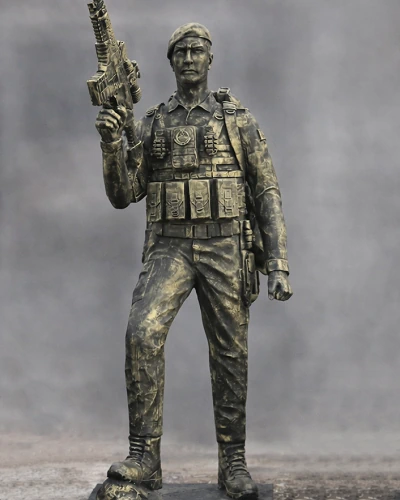
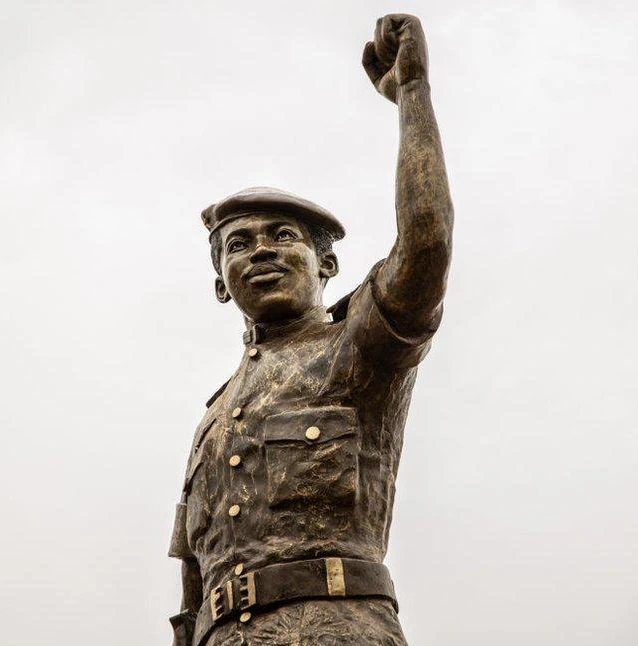
One of the most striking elements of the Mémorial Thomas Sankara complex is the Statue of Thomas Sankara. First erected in 2019, the statue was replaced in 2020 with a more realistic and impressive bronze statue following some criticism. The new statue depicts Thomas Sankara in his military uniform, with one hand raised (the revolutionary salute) and looking forward with a determined expression. This posture strongly reflects his leadership qualities, his commitment to his people, and his revolutionary spirit. Around the statue, there are also busts symbolizing his 12 comrades who lost their lives with Sankara in the assassination. This detail emphasizes that Sankara was not a lonely leader, but had a strong team and fellow travelers around him.
Architect Francis Kéré's design further enhanced the artistic and symbolic value of the monument. Kéré combined local materials and traditional African architecture with a modern approach, creating a structure that is both aesthetic and meaningful. The overall design of the monument reflects Sankara's ideals of equality, justice, and social solidarity. Beyond being just a work of art, the statue is a symbol of resistance, a source of inspiration, and a meeting point for the people of Burkina Faso. Visitors have the opportunity to stand before the statue, reflect on Sankara's legacy, and understand his ideals. This statue in Ouagadougou cries out that Thomas Sankara's name and struggle will never be forgotten.
Date Added: