Terry Fox Statue - Ottawa Canada
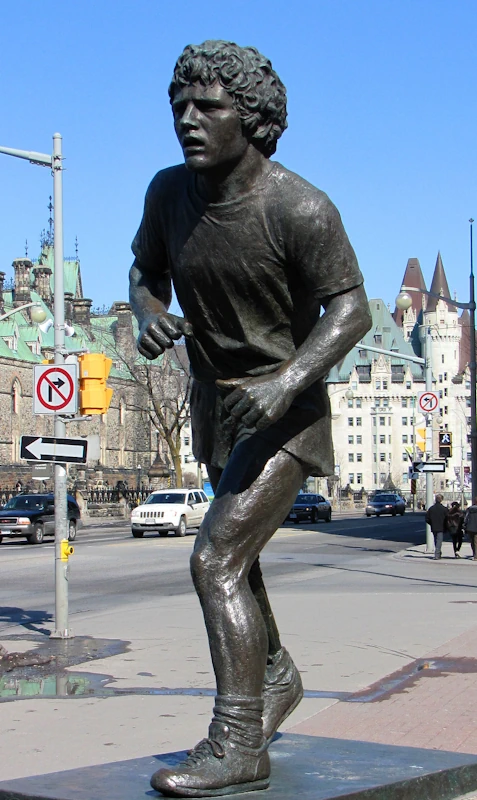
In Ottawa, the capital of Canada, very close to Parliament Hill and at one of the city's busiest and most symbolic points, the Terry Fox statue rises. The statue depicts Fox running, with a determined expression on his face and his prosthetic leg. This image is one of the most powerful visual expressions of moving forward despite pain, running without ever giving up hope, and how a human can surpass their own limits. This statue in Ottawa is the most central and prestigious among the many monuments dedicated to Terry Fox across Canada. During the annual Terry Fox Run events, the area in front of this statue overflows with flowers and commemorative messages; this scene reveals how deep a place Fox's legacy holds in the hearts of Canadians.
Who is Terry Fox?
Terrance Stanley Fox was born on July 28, 1958, in Winnipeg, Manitoba, Canada. The life of Fox, an energetic and competitive young man who loved sports and basketball, changed radically with a diagnosis he received in 1977. Due to osteosarcoma—bone cancer diagnosed in his right knee—the part of his leg above the knee had to be amputated. He was only eighteen years old. This traumatic experience could have devastated many people; however, for Fox, it ignited the fuse of a new and much larger goal. Witnessing the suffering of other patients receiving cancer treatment in the hospital awakened a deep sense of responsibility in him. He decided he had to do something to raise funds for cancer research, and this decision gave birth to one of the most unforgettable stories in Canadian history.
Marathon of Hope
Terry Fox planned to cross Canada from the Atlantic coast to the Pacific coast by running with his prosthetic leg. He named this initiative the Marathon of Hope. Starting from St. John's, Newfoundland, on April 12, 1980, Fox ran an average of forty-two kilometers—the distance of a full marathon—every single day. He accomplished this with a prosthetic leg, often in harsh weather conditions, and at a heavy physical cost that his body paid anew each day. In the first weeks of the run, public interest was quite limited; but as Fox progressed and moved from city to city, his story began to spread across Canada. People would wait for him along the roadsides, cheering through tears and reaching out with their donations.
Fox ran for 143 days, covering approximately five thousand six hundred kilometers during that time. However, in September 1980, he stopped at a point in Ontario. It was determined that the cancer had spread to his lungs. He was forced to give up the run; this news was met with deep sadness throughout Canada. Fox passed away on June 28, 1981, at the age of twenty-two. However, he had reached his goal before his death; the Marathon of Hope provided the largest amount of funding ever raised by a single Canadian for cancer research up to that day. Today, the Terry Fox Runs held annually around the world have raised a total of over eight hundred million dollars in donations; this figure continues to grow every year.
The Ottawa Statue and Its National Significance
The Terry Fox statue in Ottawa was erected in 1982; that is, immediately following Fox's death. This speed shows the depth of the loss and the respect the Canadian people felt for him. The location of the statue is extremely meaningful; its proximity to Parliament Hill is an official expression of Fox being recognized not just as a sports hero, but as a national treasure. In every season, visitors take photos, leave flowers, and hold silent commemorations in front of the statue. For children visiting as part of school trips, this statue is the concrete form of one of Canada's most powerful moral lessons: a lesson in perseverance, sacrifice, and living for others.
The Canadian government honored Fox with the Order of Canada, the country's highest civilian honor, shortly before his death. In addition, many schools, streets, parks, and sports facilities bear his name. Canada Post issued a stamp in his name; his portrait was featured on Canadian currency. All of these are ways for a nation to express gratitude for the courage of a young man. However, the statue in Ottawa is the most direct and emotional among all these honors. Because that statue is not a plaque; it has carved into stone the very moment of Fox caught in full stride, that determination, and that stubbornness.
Every visitor standing in front of the statue in Ottawa is not just looking at a bronze figure. That person is looking at a young man's effort to make the impossible possible, his will to turn pain into meaning, and his courage to put everything on the line for others. The Terry Fox statue represents Canada's purest and most universal values. Patriotism, compassion, perseverance, and hope; these values are etched into every inch of that statue. Fox could not finish his run, but the legacy he left behind continues to keep millions of people running on the path he started.
Date Added: