Sukarno Statue – Indonesia – Jakarta
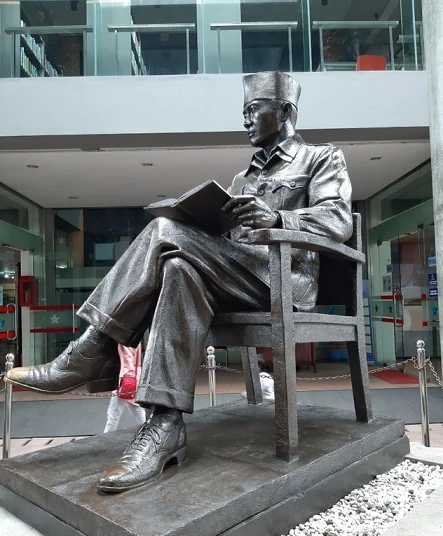
In Jakarta, the capital of Indonesia, at the heart of a population exceeding 270 million, there is a name: Sukarno. This name is not merely the name of a statesman; it is also the symbol of a nation's will for independence, its shared identity, and its national pride. The Sukarno Statue inscribes this great legacy into Jakarta's political and cultural landscape by casting it in stone and bronze. Sukarno, who played a decisive role in Indonesia's winning of independence from Dutch colonial rule, who was the country's first president, and who formulated the Pancasila principles, continues to this day to live in the daily lives, on the lips, and in the hearts of millions of Indonesians.
Sukarno's Life and Indonesia's Independence Struggle
Sukarno was born in 1901 in the city of Surabaya in East Java. Studying engineering at the Bandung Institute of Technology, Sukarno's political consciousness developed rapidly during his student years and he quickly became one of the most brilliant figures of the Indonesian nationalist movement. The Indonesian Nationalist Party (PNI), which he founded in 1927, formed the organizational backbone of the independence struggle. Repeatedly imprisoned and sent into exile by the Dutch, Sukarno continued his struggle each time with greater strength and greater determination.
During the years of the Second World War, with Japan's occupation of Indonesia, Sukarno followed a pragmatic strategy and cooperated with the Japanese. Viewing this cooperation as an opportunity for independence, Sukarno, following Japan's defeat, proclaimed Indonesia's independence together with Muhammad Hatta on August 17, 1945. This declaration, read in the early hours of the morning before a small crowd, was the moment the world's fourth most populous country wrote its name onto the pages of history. Sukarno went down in history as both the architect and the voice of that moment.
Following the declaration of independence, the Netherlands launched military operations to reestablish its sovereignty over Indonesia. The four-year war of independence concluded in 1949 with the Netherlands recognizing Indonesia's independence, as a result of international pressure and UN resolutions. At every stage of this difficult process, Sukarno played a decisive role on both the military and diplomatic fronts. Taking on the first presidency of the new republic established after independence was won, Sukarno came face to face with the heavy responsibility of governing the country.
The Sukarno-Hatta Monument and Features of the Statue
The Sukarno Statue in Jakarta stands out as part of a monument that depicts him together with the co-founder of the republic, Muhammad Hatta. This monumental structure, showing the Sukarno-Hatta duo side by side, symbolizes the historic moment when the declaration of independence was read. The depiction of the two leaders standing shoulder to shoulder in a determined and dignified posture reflects the collective spirit and sense of solidarity of the Indonesian independence movement. The figures cast in bronze are portrayed in the formal attire of the period, and the pedestal of the monument is adorned with references to the declaration of independence.
The area where the monument is situated is located near Jakarta's Bung Karno Sports Complex; this complex also forms an important part of his legacy as one of Sukarno's greatest infrastructure projects. Built for the 1962 Asian Games, this complex is one of the largest projects that gave concrete form to the understanding of modernization and national honor characteristic of the Sukarno era.
Traces of Sukarno in Every Corner of Indonesia
Sukarno's legacy is not limited to Jakarta alone. From Jakarta to Bali, from Sumatra to Sulawesi, streets, squares, bridges, and buildings bearing Sukarno's name can be found in every corner of Indonesia. The memorial sites in Surabaya where he was born, the house in Bengkulu where he spent his years of exile, and the mansion in Jakarta where he lived out his final days have all been transformed into important historical points carrying his traces. This widespread tradition of commemoration clearly reveals that Sukarno is not merely a political figure, but a national legend.
Date Added: