Ron Mueck - Australian Sculptor
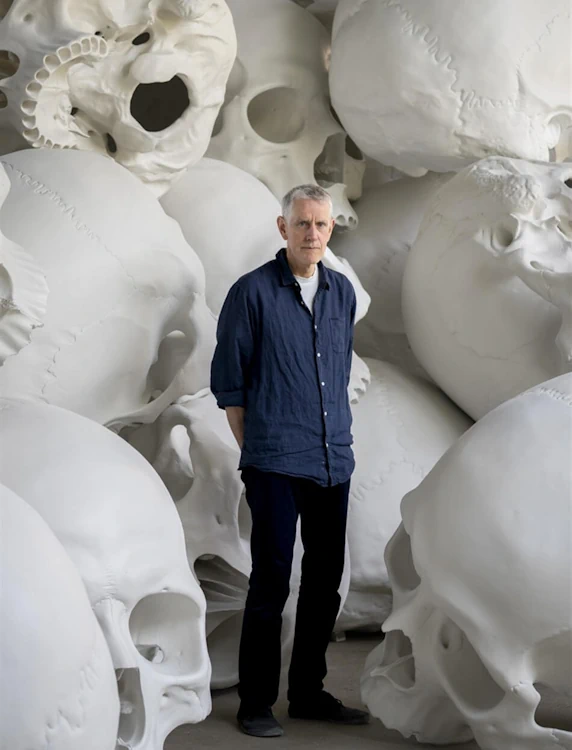
Ron Mueck, who pushes the limits of realism in the contemporary sculpture world and produces works that almost shock the viewer at first glance, was born in 1958 in Melbourne, Australia. The profession of his parents, who were toy manufacturers, made an unexpected contribution to Mueck's early training in materials and form; he absorbed the importance of manual work, detail and realism from a young age. However, his actual career started in a quite different field. Making puppets and animatronic figures for children's television programs in Australia, Mueck moved to London at the age of twenty-five and turned towards the technical challenges of the advertising world. For years he produced realistic models and effects for commercials and film sets.
Mueck's transition to the art world happened thanks to his mother-in-law the British artist Paula Rego. Rego introduced Mueck to art circles in the late 1990s and helped him carry his talents to an artistic platform. The most important result of this introduction was Mueck's meeting with Charles Saatchi. His work in the Sensation exhibition held in London in 1997, which turned the British art world upside down, threw him to the center of the international art scene all of a sudden. This exhibition was like a manifesto of the period where the Young British Artists movement left its mark and names like Damien Hirst and Tracey Emin stood out. Mueck existed in this environment with his own original voice.
Master of Hyper-Realistic Sculpture
For someone seeing Ron Mueck's works for the first time the experience is a shock that is hard to express fully with words. The sculptures are so realistic that the viewer isn't sure at first if they are seeing a human or a sculpture. Every hair, every vein, every skin fold and every expression is processed with meticulous observation and unique mastery. But the most basic feature that separates Mueck's work from ordinary hyper-realism is the play with scale. His works are produced either in massive sizes or in extremely miniature scales; there is not a single work made in real human size.
This scale choice is not accidental. A giant baby figure or an old man fitting into a palm; these scale deviations mess with the viewer both physically and psychologically. Something normally familiar suddenly becomes alienated. While the big makes you feel small the small becomes fragile and unprotected. Mueck doesn't just create a visual surprise with this scale play; he invites people to ask deep questions about their own bodies, birth and death and the transience of existence.
Important Works
One of Mueck's most recognized works is the piece titled "Dead Dad" which took place in the Sensation exhibition in 1997. Recreating his own father at a scale of one-third of his actual size immediately after his death this work handles universal themes like death, loss and the son-father relationship from an extremely personal and fragile perspective. Every viewer standing in front of the work experiences not an ordinary sculpture experience but almost a feeling of witnessing a funeral. This feeling is one of the experiences that reveals the emotional power of Mueck's art in its most naked form.
His work titled "Boy", exhibited at the Venice Biennale in 2001, is also among the artist's most recognized works. This giant figure, depicting a child crouching and looking like he is afraid of or observing his surroundings with a size exceeding four and a half meters, expresses the contradictory nature of childhood containing both innocence and vulnerability through the power of scale. Besides these, works like "In Bed", "Wild Man" and "A Girl" are in the permanent collections of the world's leading museums. Mueck's works can be found in many prestigious institutions, especially the National Gallery of Australia, Hirshhorn Museum and Fondation Cartier.
Production Process and Materials Used
Ron Mueck's production process has an extremely slow and meticulous nature. Each work is the product of a study lasting months or even years. Using silicone, fiberglass, acrylic and human hair together Mueck spends hundreds of hours of manual labor for each of his works. That's why the number of works he has produced throughout his career is relatively small; but each one is an independent masterpiece with its technical perfection, emotional intensity and conceptual depth. Ron Mueck stands as a defender of the slow, deep and permanent against the culture of fast production and consumption.
Ron Mueck's Contribution to Art
Ron Mueck made his most important contribution to the contemporary sculpture world by taking hyper-realism beyond being a mere technical show and bringing it together with deep existential questions. His sculptures both fascinate and disturb the viewer; they pull them into a world both familiar and foreign. Birth, death, old age, childhood and loneliness exist in Mueck's works in raw and un-makeup forms. This honesty overlaps with the state of art at its most powerful moment. Ron Mueck's sculptures are in the most important art institutions of the world today and attract large crowds every time they are exhibited. Those works stand on that threshold where man confronts his own reflection, feeling both familiar and strangely foreign.
Date Added: