Norodom Sihanouk Statue – Cambodia – Phnom Penh
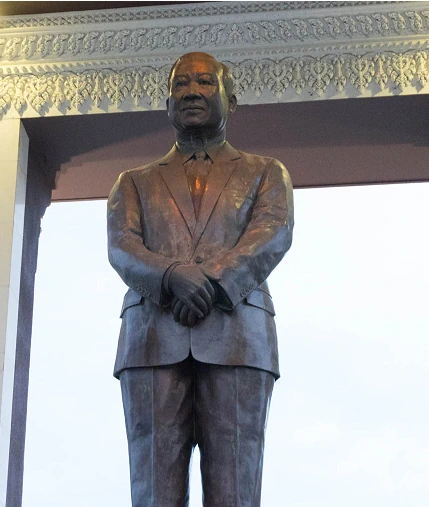
In the wide boulevards of Phnom Penh, under the shade of tropical trees and accompanied by the magnificent silhouette of the Royal Palace, a statue rises: the Norodom Sihanouk Statue. Norodom Sihanouk, referred to as the "Father King" of Cambodia, was a leader who stood at the very center of the country's most turbulent and most defining periods of the 20th century. Throughout this long and painful historical journey stretching from independence to civil war, from the Khmer Rouge genocide to reconstruction, Sihanouk's name appears at every turning point. His statue in Phnom Penh stands tall in the heart of the city as one of the most visible symbols of this long and contradictory journey.
Norodom Sihanouk's Life and Political Career
Norodom Sihanouk was born in Phnom Penh in 1922. Growing up as a member of the royal family in Cambodia under French colonial rule, Sihanouk was proclaimed king in 1941 at the age of just 18, chosen by the French. The French believed it would be easier to keep a young and inexperienced figure under control; however, they were mistaken. Shortly after ascending to the throne, Sihanouk began working for his country's independence and in 1953 liberated Cambodia from French colonial rule. This achievement elevated him to the level of a national hero in the eyes of the people.
Abdicating the throne in 1955, Sihanouk founded his political party, assumed an active role in the democratic process, and took on the position of prime minister on multiple occasions. The neutrality policy he pursued during the Cold War era made Cambodia one of the rare countries able to maintain relations with both the Eastern and Western blocs. However, the effects of the Vietnam War spreading across the region made this balance increasingly difficult to sustain. American bombardments and the spillover of the Vietnam War onto Cambodian soil deeply shook the country's stability.
The military coup carried out in 1970 removed Sihanouk from power. Taking refuge in China, Sihanouk attempted to return to his country from exile by forming an alliance with the Khmer Rouge; however, this alliance produced tragic consequences. During the genocide period that began with the Khmer Rouge's rise to power in 1975, Sihanouk effectively became a prisoner. This dark period, in which between 1.7 and 2 million people lost their lives, remains to this day the deepest wound in Cambodian history. Sihanouk's role and responsibility during this process continues to be debated among historians.
The Location and Design Features of the Statue
The Norodom Sihanouk Statue is located at one of Phnom Penh's most prestigious intersections, at the crossing of Sihanouk Boulevard and Norodom Boulevard. This location, within walking distance of the Royal Palace, gives the statue an exceptionally powerful position both symbolically and geographically. Depicted with a gold colored coating and traditional Khmer royal attire, Sihanouk greets visitors in the traditional greeting posture with both hands clasped together before him.
The Khmer artistic tradition played a defining role in the design of the statue. The traditional royal ornamentation, clothing details, and the overall posture of the figure are a clear reference to Cambodia's rich cultural heritage. The inscriptions on the pedestal summarize Sihanouk's contributions to the country and his role in Cambodian independence. The wide open area surrounding it transforms in the evening hours into a gathering and resting place heavily used by the people of Phnom Penh.
Its Place on Phnom Penh's Tourism Route
Phnom Penh is one of Southeast Asia's capitals with the richest historical fabric. Together with the Royal Palace, the National Museum, the Tuol Sleng Genocide Museum, and the Choeung Ek Memorial Site, the Sihanouk Statue forms an important stop on the city's main tourism route. Particularly for visitors wishing to gain a deep understanding of Cambodian history, the statue serves as an important window into the country's 20th century political history. At sunset, the gold-coated surface of the statue and the surrounding tropical trees combine to offer an unforgettable visual experience.
Date Added: