Naum Gabo - Russian Sculptor
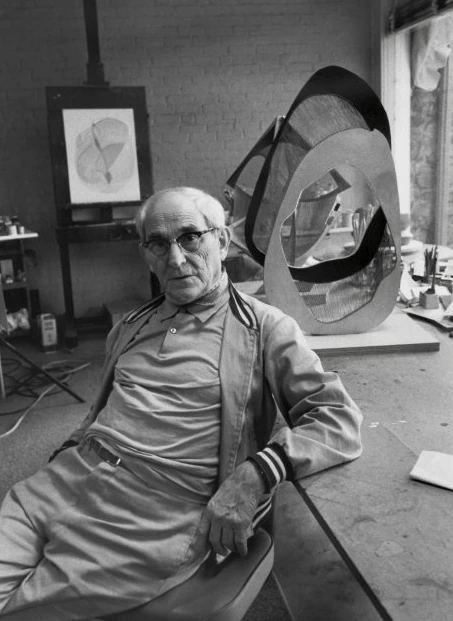
Naum Gabo is one of the artists who radically transformed the 20th-century understanding of sculpture and played the most decisive role in this transformation from both a theoretical and practical perspective. Born in 1890 in the city of Bryansk, Russia, the artist, whose real name was Naum Neemia Pevsner, adopted his brother Antoine Pevsner's surname as his own in later years. As someone educated in medicine and natural sciences, Gabo approached art from an unusual perspective; he investigated the concepts of space, time, and movement with both scientific and artistic curiosity. This multidisciplinary point of view left its mark on the Realistic Manifesto, which he co-authored with his brother in 1920, and on all of his subsequent production.
Where is Naum Gabo, Information About Him: A Traveling Genius from Russia to England
Gabo's life was spent in constant motion between multiple continents and cultures. Having lived in Moscow, Berlin, Paris, London, and ultimately Connecticut, Gabo carried this story of migration into the universality of his works. Tate Modern in London is one of the richest institutions in terms of its Gabo collection; here, it is possible to see works produced from different periods of the artist's life and with different materials together. MoMA in New York and the Museum of Fine Arts in Boston also host significant Gabo works. Gabo's traces in London, where he spent many years, can also be followed through his connection with the St. Ives art community; Tate St. Ives in Cornwall is a valuable location documenting this connection.
Gabo's largest public work is the giant steel sculpture rising in front of the De Bijenkorf store in Rotterdam. Completed in 1957, this work is the most striking example of the unique interpretation Gabo brought to large-scale public sculpture. In the same years, Zadkine's sculpture describing the pain of war was also located in Rotterdam; the presence of these two works in the same city brings together two different but equally powerful voices of 20th-century sculpture side by side.
Realistic Manifesto and His Role in Constructivism
The Realistic Manifesto, published in Moscow in 1920, bears the signature of Gabo and his brother Antoine Pevsner and is considered one of the most important theoretical documents in modern sculpture history. Among the most fundamental arguments of the manifesto, the rejection of static rhythm and the adoption of kinetic rhythm stand out; that is, it is argued that art should cover not only visual but also temporal and kinetic dimensions. This principle became the guide for Gabo's production throughout his entire career. His work titled "Kinetic Sculpture" is among the first art works that truly move in 1920 and is considered a pioneer of kinetic art due to this feature.
Gabo's material choices are also extremely revolutionary when compared to the art understanding of his period. Being one of the first names to bring industrial materials such as transparent plastic, nylon wire, and steel into the art of sculpture, Gabo made the relationship these materials established with light and space his most fundamental area of artistic research. Light passing through transparent plastic gives the work both physical and metaphorical depth; the permeability between solid and transparent, visible and invisible, constitutes the most original dimension of Gabo's art.
Contribution to Sculpture Art and His Legacy
Naum Gabo passed away in 1977 in Connecticut. The legacy he left behind is extremely rich and comprehensive in terms of both Constructivism theory and kinetic art history. Adopting space and time as sculptural materials, making transparency and movement fundamental concepts of art, and doing so by using scientific meticulousness and artistic intuition together, makes Gabo one of the most visionary and enduring voices of 20th-century sculpture. Today, there is a legacy that every artist working on kinetic art, light, and transparency owes to Gabo, whether knowingly or unknowingly.
Date Added: