Marc Quinn - British Sculptor
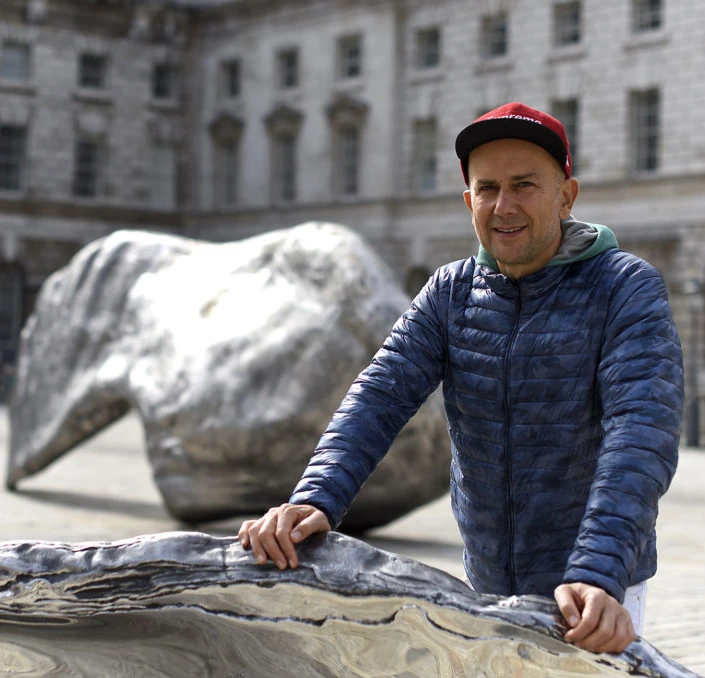
One of the boldest and most provocative names in British contemporary art, Marc Quinn, was born in London on January 8 1964. His education on art history at Cambridge University became one of the most important intellectual sources feeding his artistic vision. Coming from an academic background Quinn positions his art not just as a form of expression but as the output of a comprehensive research on biology, philosophy, politics and social identity. In the late 1980s and early 1990s he was part of the most active and controversial period of British art along with Damien Hirst, Tracey Emin and other Young British Artists. This movement redefined British contemporary art in the international arena and Quinn became one of the strongest voices of this redefinition.
Quinn's artistic production spreads across an extremely wide range. Giving works in the fields of sculpture, painting, photography and installation the artist sees these different disciplines not as disconnected areas but as an integrated practice where he researches common themes through different materials and forms. Body, identity, beauty standards, disability, media and the changing definition of nature constitute the basic headings of Quinn's artistic agenda. The way he handles each of these themes attracts attention with both its conceptual depth and visual courage.
Self: Blood and Identity
Marc Quinn's most recognized and discussed work in the art world is undoubtedly the sculpture series titled "Self". This series, which started in 1991, consists of skulls made from Quinn's own frozen blood. This work which is reproduced every five years represents a real self-portrait made with the artist's own blood. This process using five liters of blood starts with Quinn giving blood at a level that he personally needs a blood transfusion. The work must be kept at minus fifteen degrees with a special cooling system; otherwise it melts and disappears.
This choice is extremely conscious. The "Self" series expresses the transience of identity, the fragility of the body and on what a fine balance existence stands in the most radical way. The work, renewed every five years, also records the physical change of the artist; the traces time leaves on the body become visible in this blood head too. The work is in the Charles Saatchi collection today and maintains its feature of being Quinn's most important and controversial study.
Alison Lapper Statue and Public Space
Marc Quinn's work that reached the widest masses was the "Alison Lapper Pregnant" sculpture placed on the fourth plinth of London's Trafalgar Square in 2005. This sculpture carved from marble depicts the artist Alison Lapper, who was born without most of her arms and legs and was pregnant. Placing a sculpture of a disabled pregnant woman in Trafalgar Square, which hosted statues of male military heroes for decades, led to deep discussions both in the art world and in the public opinion.
With this work Quinn opened beauty standards, the concept of heroism, who is represented in public space and the social perception of disability to questioning at the same time. The sculpture was seen by millions of London visitors within all these discussions and went down in history as one of the most effective public interventions of contemporary British art. Alison Lapper later took part in the opening ceremony of the 2012 London Paralympic Games with a performance referring to this work; this moment proved once again how lasting the cultural impact of Quinn's sculpture is.
Nature, Body and Other Important Works
The changing definition of nature also holds an important place in Quinn's artistic agenda. The frozen flower sculptures he produced within the scope of the "Garden" series handle the illusion of perfection, the transience of beauty and the effort to take nature under control. These studies are dependent on the cooling system just like "Self"; this dependence functions as an element reinforcing the conceptual meaning of the work. The flowers look perfect; but this perfection depends on completely artificial and fragile conditions.
The sculpture of Kate Moss made of pure gold is also among Quinn's most striking works. Depicting Moss doing a yoga pose this work is loaded with a sharp irony criticizing the beauty industry, body representation in the media and celebrity culture. Marc Quinn's works are in the collections of Tate, MoMA and many important museums of the world. The artist continues to be one of the most defining voices of contemporary British art with his conceptual depth and visual courage.
Marc Quinn's Contribution to Art
Marc Quinn made his most important contribution to contemporary art by including biological materials and his own body in art and using them to radically question issues of identity, body and existence. His art disturbs; but this disturbance is a conscious aesthetic strategy inviting to face the realities that society ignores. Quinn's legacy carries the lasting traces of a bold practice that uses the body, blood, time and social norms as the material of art.
Date Added: