Mahatma Gandhi Statue - India - New Delhi
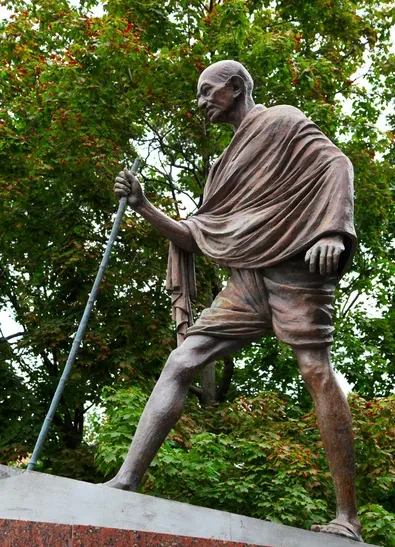
The Mahatma Gandhi statue seated in the courtyard of the Parliament of India in New Delhi is the most powerful public representation of this legendary leader, symbolizing love against violence, resistance against colonialism, and an eternal will born out of perceived weakness. Designed by Ram V. Sutar and inaugurated in 1993 by then-President Shankar Dayal Sharma, this bronze statue depicts Gandhi in a cross-legged meditation position with a height of 4.9 meters, greeting every parliamentarian with a silent yet powerful reminder. Today, the statue is not only a work of art but has also gone down in history as the most preferred symbolic protest and press conference site for opposition parties in India.
Who is Mahatma Gandhi? Information About the Statue
Mohandas Karamchand Gandhi was born in 1869 in Porbandar, Gujarat; he is a revolutionary figure who liberated India from British colonial rule in 1947 through a struggle based on the principles of peaceful resistance, civil disobedience, and non-violence, becoming one of the most influential political leaders of the modern world. The title "Mahatma," meaning "Great Soul," was bestowed upon him by Rabindranath Tagore. His philosophy of resistance based on the power of truth, which he called Satyagraha, inspired Martin Luther King, Nelson Mandela, and civil rights movements in many corners of the world. Assassinated in 1948, Gandhi is today referred to as India's national symbol and the Father of the Nation. Rajghat remains one of the most sacred visitation points in New Delhi as the site where Gandhi was cremated.
Artistic Features and Sculptor of the Statue
One of India's most prominent sculptors, Ram Vanji Sutar, was born on February 19, 1925, in the village of Gondur, Maharashtra; he graduated with a gold medal from the Sir J.J. School of Art and, in a career spanning over seven decades, created works that shaped India's public art identity. The Gandhi statue in the Parliament is considered one of his most valuable works. Sutar's most famous work is the 182-meter-tall Statue of Unity, which holds the title of the world's tallest statue. The cross-legged meditation pose in the Gandhi statue departs radically from the leader's usual representations, while the tranquility on the figure's face and the simplicity of the posture add deep philosophical meaning to the work. Honored with the Padma Shri and Padma Bhushan awards, Sutar has gone down in history as India's greatest living sculptor.
Date Added: