Louis Riel Statue - Winnipeg Canada
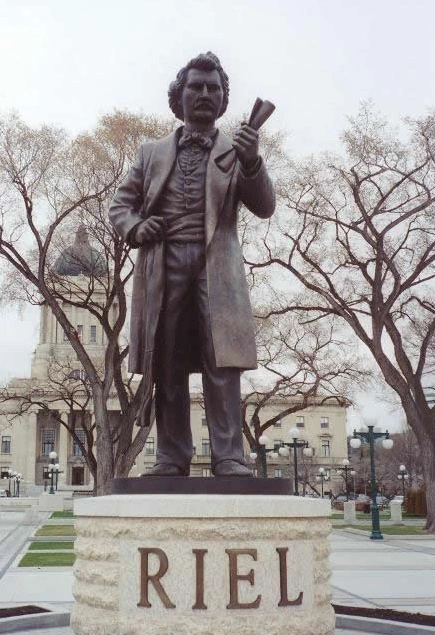
In the heart of Winnipeg, right alongside the Manitoba Legislative Building, stands a figure. Its posture is unusual, its form is controversial, and its expression is distressingly human. The Louis Riel Statue is a work that deliberately breaks away from the tradition of Canada's official monumental sculpture. This rupture is no coincidence; because Louis Riel himself is a figure in constant tension with the official narrative of Canadian history. The leader of the Métis people, the organizer of two rebellions, and the man executed in 1885; a patriotic hero to some, a dangerous rebel to others. His statue is designed to reflect this deep duality: neither a triumphal arch nor a pillar of shame.
Louis Riel: Voice of the Métis People
Louis Riel was born in 1844 in the very heart of North America, in the region where present-day Winnipeg is located. Growing up as a child of the Métis people—a mix of French-Canadian and Indigenous heritage—Riel became one of the best-educated Métis intellectuals of his time through his studies in Montreal. But his true identity was defined by the struggle he waged for the rights of his people.
In 1869-1870, during the process of the Hudson's Bay Company lands joining the Canadian Confederation, the land rights and cultural existence of the Métis people came under threat. In this process, Riel emerged as the spokesperson and organizer of the Métis community in the North-West Territory. The Provisional Government he established negotiated Métis rights and the recognition of the French language with the Canadian government. These negotiations resulted in Manitoba joining the Confederation as a province; Riel saw this as a victory.
Rebellions, Exile, and Execution
However, Riel's political career did not end in victory. Making a controversial execution decision during the events of 1870 turned him into a hated figure in the English-speaking part of Canada. Forced into exile, Riel spent years in the United States. It was recorded that during this period, he experienced serious mental crises and acted with a sense of messianic mission.
In 1885, Métis and Indigenous peoples in the Saskatchewan River region rose up again against increasing pressures on their land rights. Riel was summoned from Montana to lead the movement. This process, which went down in history as the North-West Resistance, was suppressed by the military intervention of the Canadian government. Riel was captured, tried, and executed on November 16, 1885. This decision shook French-Canadian communities to their core and passed into history as a political breaking point that is still debated today.
The Striking Design and Artistic Features of the Statue
The Louis Riel Statue in Winnipeg was designed by Canadian architect and sculptor Etienne Gaboury and placed in the area in front of the Manitoba Legislative Building in 1971. The statue stands out with a design concept that completely upends the expectations of traditional monumental sculpture.
The figure is depicted not standing tall, but in a slightly bent, inward-looking posture. The torso is tense and almost distorted, as if under the weight of the history and pain it carries. The facial expression is anxious, even anguished. This composition, which is the exact opposite of the traditional pose of victory, reflects both Riel's personal tragedy and the collective suffering of the people he represented. The surface of the statue bears a rough and unrefined texture; this raw surface expresses a conscious break from the cold perfection of polished victory monuments.
The size of the statue is on a human scale; neither overwhelmingly large nor negligibly small. This choice of scale is also significant: Riel is presented not as a state symbol or an abstract ideal, but as a real human being. Standing right beside the Neo-Renaissance architecture of the Manitoba Legislative Building, this modern, expressionist figure creates a powerful aesthetic dialogue through the tension between architecture and sculpture.
Date Added: