Lenin Statue - Kazakhstan Almaty
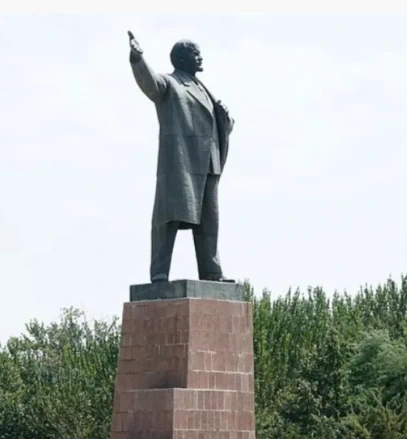
Walking through the streets of Almaty, you feel history overlapping. The heavy architectural legacy of the Soviet era, the modern glass structures of the post-independence period, and the old-era monuments encountered every now and then; all are parts of this city's complex identity. The Lenin Statue in Almaty is perhaps the point where this complexity is most intensely embodied. Since the dissolution of the Soviet Union, Lenin statues have been toppled, dismantled, or moved to museums in dozens of countries. But a portion of them continues to stand. This statue in Almaty has reached the present day as an entity that both resists and is questioned within more than half a century of history.
Vladimir Lenin: Ideology and Power
Vladimir Ilyich Lenin was born in Russia in 1870. Entering the revolutionary movement by adopting Marxist thought, Lenin fundamentally changed Russian history as the leader of the 1917 October Revolution. Overthrowing the Romanov dynasty and establishing Soviet power, Lenin was not just a Russian politician; he became one of the most influential figures defining the political geography of the 20th century.
Lenin's legacy in Central Asia is particularly complex. The transition from the colonial rule of Tsarist Russia to Soviet rule did not mean liberation for the peoples of the region; it meant a domination that continued in a different form. The fact that Kazakh, Kyrgyz, Uzbek, and other Central Asian peoples were subjected to land arrangements, forced collectivization policies, and pressures of cultural assimilation positions the Soviet era as a process that left deep wounds in the regional memory.
Post-Independence: Should the Statue Stay?
When Kazakhstan declared its independence in 1991, the question of how to confront the Soviet legacy inevitably came to the agenda. In many former Soviet republics, Lenin statues were toppled or removed; these actions were often celebrated as an emotional expression of independence. This process, known as "Leninfall" in Ukraine, gained a dramatic momentum particularly with the 2013-2014 Euromaidan events.
Kazakhstan's stance has been more cautious and pragmatic. The new administration led by President Nursultan Nazarbayev preferred to preserve some Soviet symbols while removing others. This selective approach can be partially explained by practical reasons: removing dozens of statues and monuments is a process that is both costly and carries the potential to create social tension. But at the same time, it reflects a preference to postpone an ideological reckoning.
The Current Meaning of the Statue in Almaty
Today, the perspective of people passing by the Lenin Statue in Almaty has become highly differentiated. For the older generation that grew up in the Soviet era, the statue can carry a nostalgic meaning; the social security of that period, the collective way of life, and a sense of a certain order come to mind. For the younger generation, the statue is mostly a historical object; a concrete remnant of a past that does not have a place in their own memory but must be learned.
From the perspective of academics and urban planners, the existence of the statue raises other questions: Should such monuments be removed, or should they be transformed into a tool of critical memory by being supported with contextual information? Take it and put it in a museum? Leave it in place but interpret it? This debate mirrors a negotiation ongoing throughout Eastern Europe and all former Soviet republics.
A Historical Tour to Understand Almaty
Almaty continues to be one of the most cosmopolitan and vibrant cities in Central Asia. In Almaty, which maintains its importance as the economic and cultural capital of Kazakhstan, the Lenin Statue—along with Panfilov Park, Zenkov Cathedral, the Uyghur Bazaar, and contemporary art galleries—forms a whole of spaces that help analyze the city's layered history. Discovering these layers in person by walking around Theatre Square is the most natural way to grasp Almaty's Soviet and post-independence periods all at once.
Date Added: