King Sejong Statue - Seoul, South Korea
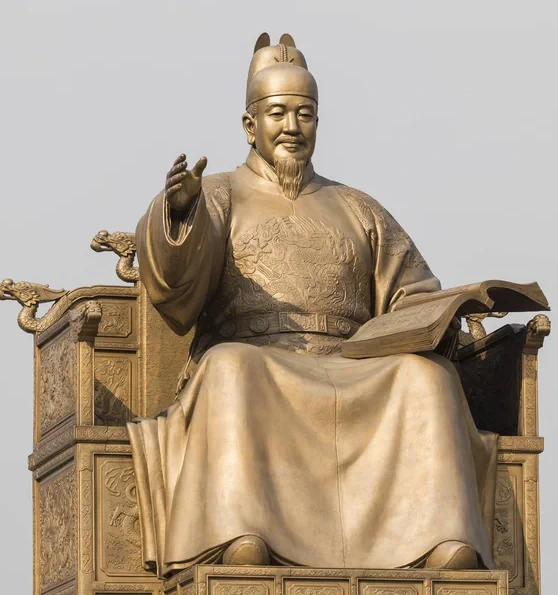
In the very heart of Seoul, South Korea’s capital, a commanding figure overlooks the city’s busiest boulevard from Gwanghwamun Square: King Sejong the Great. This statue is far more than a bronze silhouette of a monarch; it is the immortalized symbol of one of the greatest leaps in Korean civilization—the creator of the Hangul alphabet and the visionary who brought literacy to the masses. When King Sejong ascended the throne in the 15th century, the vast majority of Koreans were illiterate, as the complexity of Chinese characters kept education the exclusive privilege of a select elite. Determined to rectify this injustice, Sejong developed Hangul, now celebrated as one of the most scientific and functional writing systems in the world. Standing tall in a square crossed by millions daily, his statue remains a powerful testament to a legacy that continues to define Korea's identity on the global stage.
Who is King Sejong and What is His Place in Korean History?
Born in Seoul in 1397, King Sejong was the son of King Taejong, the third monarch of the Joseon Dynasty. Raised within the palace walls, he stood out from a young age for his extraordinary intellect and passion for learning. Taking the throne in 1418, Sejong quickly distinguished himself not just as a ruler, but as a scientist, philosopher, and cultural architect. His thirty-two-year reign is widely regarded as one of the most brilliant eras in Korean history.
Sejong’s most enduring achievement is undoubtedly the Hangul alphabet, completed in 1443. This original script, which perfectly captures the sounds of the Korean language, was introduced to the public through the document Hunminjeongeum. Designed to be learned in a matter of hours, Hangul became the ultimate tool for democratizing literacy and fueling the growth of Korean culture. Beyond linguistics, the Sejong era saw revolutionary advances in agricultural techniques, medicine, and music theory. From sundials and rain gauges to printing presses and astronomical instruments, his wide-ranging inventions are tangible proof of his multifaceted vision.
Gwanghwamun Square and the Statue’s Location
The Statue of King Sejong is located at Gwanghwamun Square, Seoul’s most symbolic public space. Positioned on Sejong-daero Boulevard directly in front of Gyeongbokgung Palace, the square is the point where Korea’s historical and modern identities most powerfully intersect. The palace behind the statue creates a visual bridge to the very complex where Sejong once ruled, immersing visitors in the flow of history. This placement is no accident; it is a consciously designed symbol of historical continuity.
Gwanghwamun Square is more than a tourist landmark; it is the heartbeat of Korean civic life. Major national celebrations, commemorations, and public demonstrations take place here. By sitting at the center of this vibrant public sphere, King Sejong remains not just a figure of the past, but an active witness to the present day.
Construction, Sculptor, and Technical Features
The Statue of King Sejong was erected in 2009 as part of the Gwanghwamun Square renovation project. Cast in bronze and standing approximately 9.5 meters tall, the figure exerts a monumental presence. The pedestal beneath the statue further elevates it, ensuring the figure stands out even amidst the surrounding modern skyscrapers. The design was meticulously based on Joseon-era royal iconography, depicting King Sejong in traditional robes, seated on his throne with a book in his hand. This pose emphasizes his identity as a wise scholar-king rather than a military conqueror.
Beneath the statue lies the "The Story of King Sejong" museum, offering visitors an immersive look at his inventions and the history of the Hangul alphabet. This underground facility transforms the monument from a mere visual landmark into an educational and cultural hub. The surrounding fountains and lighting systems further enhance the square’s atmosphere, particularly after sunset.
Symbolic Weight in Korean Culture and Impact on Tourism
King Sejong is arguably the most respected historical figure in the collective memory of the Korean people. His portrait on the 10,000 Korean Won banknote ensures his presence remains a part of daily life. The statue is the most visible expression of this widespread reverence. Every year, millions of local and international tourists place Gwanghwamun Square and the King Sejong Statue at the top of their itineraries. Combined with the nearby Gyeongbokgung Palace and National Museum, the statue serves as the anchor of Seoul’s most comprehensive cultural tourism route.
Date Added: