King Chulalongkorn Statue - Bangkok, Thailand
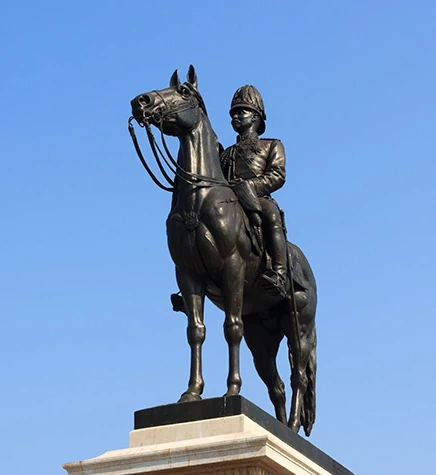
In Bangkok, the capital of Thailand, an equestrian figure rises in one of the city's most prestigious squares, amidst tropical rains and the golden glow of nearby pagodas: King Chulalongkorn. This statue is far more than a monument dedicated to a monarch; it is a symbol of Thailand’s independence, its will to modernize, and the abolition of slavery. King Chulalongkorn is remembered as one of the rare leaders who successfully kept Siam (Thailand) independent while most of Southeast Asia was being colonized by European powers in the late 19th century. In doing so, he protected his country from Western encroachment while simultaneously transforming it into a modern state through deep-rooted internal reforms. Standing in the heart of Bangkok, his statue remains the most powerful symbolic structure anchoring this dual legacy in the soul of Thailand.
The Life of King Chulalongkorn and His Contributions to Thailand
King Chulalongkorn, also known as Rama V, was born in Bangkok in 1853. The son of the renowned monarch King Mongkut (Rama IV), Chulalongkorn ascended the throne in 1868 at the age of 15 following his father’s death. After the regency ended in 1873, the young king took full command and immediately began implementing his vision for reform. One of his most significant achievements was the gradual abolition of slavery; a process completed in 1905, making Thailand one of the first countries in the region to end the practice.
Chulalongkorn’s greatest success was safeguarding the nation’s sovereignty. Caught between the colonial ambitions of Britain and France, Siam maintained its independence through clever diplomatic maneuvering and strategic territorial concessions. During this period, Chulalongkorn personally visited European capitals to strengthen diplomatic ties and study Western administrative models. The judicial reform, the modern education system, the construction of railways, and the centralization of government are among the most lasting gains of his reign. By the time he passed away in 1910, Thailand had been fundamentally transformed.
Royal Plaza and the Statue’s Location
The Statue of King Chulalongkorn stands in Royal Plaza, one of Bangkok’s most central and symbolic landmarks, directly in front of the Ananda Samakhom Throne Hall. The juxtaposition of this magnificent hall—inspired by European Renaissance architecture—with the Western-style equestrian statue physically embodies Chulalongkorn’s vision of modernization. Royal Plaza serves as the primary venue for Thailand’s most important national ceremonies, military parades, and celebrations.
Every year on October 23rd, known as Chulalongkorn Day, thousands of Thais gather at the statue to offer flowers and tributes. The reverence for King Chulalongkorn is so profound that these commemorations have evolved beyond official state events into spontaneous, large-scale public rituals of devotion.
Construction, Features, and the Sculptor
The Equestrian Statue of King Chulalongkorn was designed by French sculptor Georges Saulo and unveiled in 1908. Cast in bronze, the figure depicts Chulalongkorn in military uniform, exuding royal authority. Inspired by the grand equestrian monuments of Europe, the design reflects the stylistic dialogue Chulalongkorn established with Western modernism. The inscriptions on the pedestal are written in both Thai and French; this choice of languages alone summarizes the delicate diplomatic balance of the era.
Place in Thai Culture and Impact on Tourism
King Chulalongkorn remains one of the most beloved and respected monarchs in Thai history. Often referred to by the epithet Phra Piya Maharaj, meaning "The Great Beloved King," he holds a special place in the hearts of the people. For the millions of tourists who visit Bangkok annually, Royal Plaza and the Chulalongkorn Statue are essential landmarks. Combined with the nearby Grand Palace, Wat Phra Kaew, and national museums, this area forms the epicenter of Bangkok’s most comprehensive cultural tourism route.
Date Added: