Kim Il-sung Statue – North Korea Pyongyang
Pyongyang, the capital of North Korea, founded on the banks of the Taedong River in the northern part of the Korean Peninsula, is home to one of the most extraordinary and largest monumental complexes in the world. Kim Il-sung, the founder of North Korea and revered as the "Great Leader," was born in 1912, led the armed resistance against Japan, and ruled the country from 1948 until his death in 1994. Pyongyang is today home to a colossal monumental complex that keeps his name and legacy alive, unlike anything found anywhere else in the world. This complex is regarded as the most sacred site that foreign tourists visiting the country are required to stop at on all tours.
Construction and History of the Monument
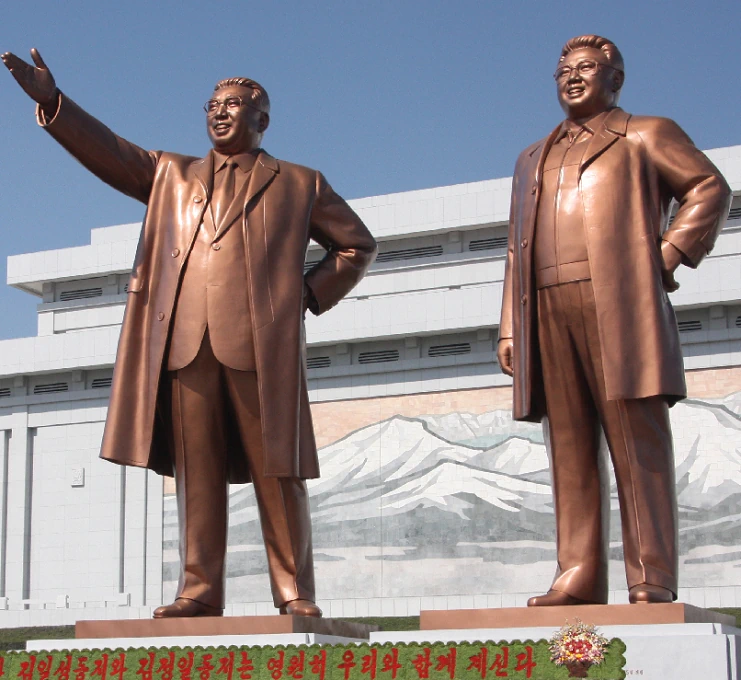
The Mansudae Grand Monument was unveiled in April 1972 on the occasion of Kim Il-sung's 60th birthday. Originally it consisted of a single statue depicting Kim Il-sung in his youth. The first version was coated in gold leaf, but this was later converted to bronze after Deng Xiaoping expressed his discomfort upon seeing how Chinese aid was being spent. Following Kim Jong-il's death in December 2011, his statue was added in 2012, expanding the complex to feature two leader figures. As part of this process, the statue of Kim Il-sung was also remade with an older likeness and a smiling expression, and his attire was changed from a Mao jacket to a Western-style suit.
Features and Artistic Details of the Statues
Both bronze statues stand 22 meters tall. The statue of Kim Il-sung faces Pyongyang with one arm extended forward, while the figure of Kim Jong-il stands beside him. Behind the statues, incorporated into the facade of the Korean Revolution Museum, is a vast mosaic depicting Mount Paektu, considered the sacred mountain of North Korea. Flanking both statue figures are two monumental groups consisting of 229 bronze figures averaging approximately 5 meters in height each, representing the anti-Japanese revolutionary struggle and the process of socialist construction. The entire figure grouping extends approximately 200 meters.
Mansudae Hill and Surroundings
The monument complex is situated atop Mansudae Hill in the center of Pyongyang. In its immediate vicinity are Kim Il-sung Square, the Grand People's Study House, and Moran Park. The urban planning of Pyongyang has been arranged to make the Mansudae Monument the visual and symbolic focal point of the city. The monument grounds serve as the central gathering point where thousands of North Koreans come to lay flowers and pay their respects on all national holidays and significant occasions, and it is also a popular location for wedding photographs.
The Legacy of Kim Il-sung
Kim Il-sung led a guerrilla movement against Japanese colonial rule, founded the Democratic People's Republic of Korea in 1948, and launched the Korean War on June 25, 1950. Following the signing of the armistice in 1953, Kim continued his rule, establishing the "Juche" ideology of self-reliance as the country's official philosophy and constructing an absolute cult of personality. Kim Il-sung died on July 8, 1994 and was immortalized in North Korea with the title "Eternal President"; his remains are displayed at the Kumsusan Palace of the Sun. Visits to the monument are subject to extremely strict protocol rules: both statues must appear in full frame in all photographs, visitors must pay their respects with a bow, and flowers must be laid.
Visitor Information
The Mansudae Grand Monument is located atop Mansudae Hill in the center of Pyongyang. Tourist visits to North Korea are only possible through approved tour operators, and a visit to the monument is a mandatory stop on virtually all Pyongyang tours. Note: North Korea may be closed to foreign tourists due to current travel restrictions; it is strongly recommended to confirm the latest restrictions before planning a visit.
Date Added: