George Washington Statue - Washington, USA
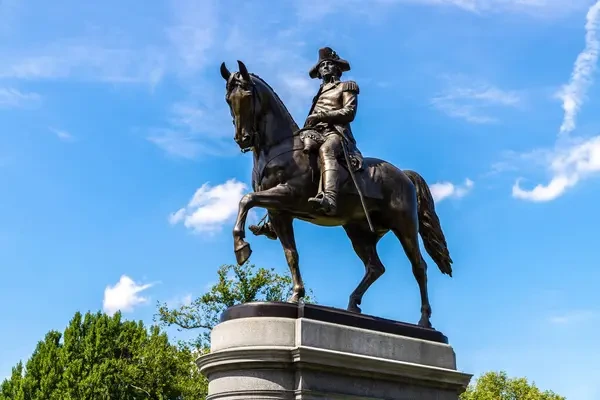
One of the most significant George Washington statues in Washington, D.C., stands at Washington Circle, located in the Foggy Bottom neighborhood at the edge of George Washington University's campus. The circle sits at the intersection of 23rd Street, New Hampshire Avenue, and Pennsylvania Avenue, and was part of the original urban plan drawn up by Pierre Charles L'Enfant. Another notable Washington statue is the seated marble statue on display at the Smithsonian American Art Museum. In addition, five bronze busts of George Washington created by Avard Fairbanks are located across the George Washington University campus.
Who Created the Washington Circle Statue?
The equestrian statue of George Washington at Washington Circle was made by sculptor Clark Mills. Mills is also well known for creating the equestrian statue of Andrew Jackson in front of the White House. Completed in 1860, the statue has since become one of the defining landmarks of the city. Another important work in the museum collection is the marble statue completed by Horatio Greenough in 1841, commissioned by the U.S. Congress in 1832 to mark the centennial of the first president's birth.
What Kind of Work Is Horatio Greenough's George Washington Statue?
Greenough's George Washington statue is considered one of the most debated and largest-scale public artworks of its era. The 12-ton marble statue was designed drawing on ancient Greek sculpture, depicting Washington draped in a toga with his chest partially bare — a stylistic choice that drew sharp criticism from some quarters at the time. The work is rich in symbolism; while it references the ideals of Greek democracy, the sword in Washington's outstretched hand celebrates his decision to relinquish power to the people following the American Revolution. The statue was displayed in the Capitol Rotunda before being moved through several locations and is now presented to visitors as part of the National Museum of American History.
Who Was George Washington and Why Was a Statue Made of Him?
George Washington (1732–1799) was the first president of the United States and one of the most pivotal commanders of the American Revolution. His successful leadership of the Union forces against the British placed him at the forefront of the nation's founding fathers and gave him a defining role in shaping the country. What has been remembered throughout history as his greatest political virtue is not his refusal to leave office, but rather his choice to peacefully transfer power once his term was complete — stepping down voluntarily rather than clinging to authority as a ruler might. This act of selflessness is considered a rare example in the history of democracy and is placed at the very heart of the symbolic content expressed in his statues.
Features of the Washington Circle Statue
The equestrian statue placed at Washington Circle by Clark Mills depicts George Washington astride a horse. The statue rises at the center of a traffic circle, surrounded by trees and parkland, making it one of the most visible public artworks in the city and a historic landmark in its own right. This circle, part of L'Enfant's original plan, has been a designated space since the earliest days of the city's founding, and stands as one of the rare spots where Washington's legacy and the fabric of urban life are seamlessly intertwined. Located in the Foggy Bottom neighborhood, the circle merges with the George Washington University campus to create a distinctive setting where academic life and historical heritage stand side by side.
The Symbolic Meaning of George Washington Statues
Statues dedicated to George Washington represent not only an individual, but the core values of American democracy itself. The ancient Greek references found in Greenough's statue emphasize that American democracy draws from the democratic traditions of antiquity. The hand extending the sword, in turn, symbolizes submission to civilian will over martial leadership. This figure — one who acknowledged the sovereignty of the people and transferred power peacefully — has come to embody both American and universal democratic values. For this reason, Washington statues are regarded not merely as monuments, but as visual expressions of American identity.
Visiting the George Washington Statues
The equestrian statue at Washington Circle is located in a publicly accessible area of the Foggy Bottom neighborhood and can be visited free of charge all 365 days of the year. The nearest metro station is Foggy Bottom-GWU. The Greenough statue on display at the Smithsonian American Art Museum can be seen during the museum's visiting hours. Both works are essential stops on Washington D.C.'s historical heritage tours. Guided walking tours are also available for those wishing to see multiple George Washington memorials across the city in a single visit. These works stand among the most important pieces that any visitor with an interest in American history should not miss.
Date Added: